7 Things to Know About the iX4
BMW has just unveiled the iX4, and it’s not just another electric SUV. It’s a statement. With up to 514 miles of range on a single charge, a sleek coupe-like silhouette, and the kind of charging speed that makes road trips genuinely practical, the iX4 is BMW’s answer to the question every EV buyer asks: can I actually live with this thing?
The answer, based on the specs, appears to be a resounding yes. The iX4 is the third model built on BMW’s next-generation Neue Klasse platform, following the iX3 and the i3 sedan. It’s a sportier, more emotional take on the electric SUV formula—and it’s arriving at a moment when range and charging speed are the two metrics that matter most to buyers.
Here are seven things you need to know about BMW’s new electric flagship.
1. The Range Is Genuinely Class-Leading
Let’s start with the headline. The iX4 50 xDrive delivers up to 514 miles of WLTP range from a 108.7kWh battery. In EPA terms—the standard used in the United States—that translates to an estimated 428 miles.
To put that in perspective: that’s more range than the Tesla Model Y, the best-selling electric vehicle in the world. It also beats the iX3’s headline range by 14 miles, thanks to the iX4’s sloped rear roofline, which gives it a lower drag coefficient of 0.23 compared to the iX3’s 0.24.
The entry-level iX4 40 xDrive offers up to 396 miles of WLTP range from an 82.6kWh battery—still more than enough for most drivers.
2. Charging Is Blisteringly Fast
Range is only half the equation. The other half is how quickly you can add it back.
The iX4 50 xDrive supports DC fast charging at up to 400kW. Under ideal conditions, BMW says you can add up to 240 miles of range in just 10 minutes. A 10-80% charge takes around 21 minutes.
The iX4 40 xDrive isn’t far behind, with 300kW max DC charging that adds up to 187 miles in 10 minutes.
Both variants support 22kW AC charging as an option, and the iX4 also supports bidirectional charging (V2L, V2H, V2G), meaning it can power your home or appliances in a pinch.
3. Three Versions, One for Every Buyer
BMW will offer the iX4 in three distinct flavors.
The iX4 40 xDrive is the entry point. It produces 374hp and 520Nm of torque, accelerates from 0-62mph in 5.6 seconds, and offers up to 396 miles of range from its 82.6kWh battery.
The iX4 50 xDrive is the range champion. It delivers 469hp and 645Nm, hits 0-62mph in 4.9 seconds, and offers that headline 514-mile range from its larger 108.7kWh battery.
The iX4 M60 xDrive is the performance flagship. It packs 612hp and 875Nm, launches from 0-62mph in 3.9 seconds, and still offers up to 483 miles of range. It arrives in spring 2027.
4. The Design Is Bold—and Divisive
Coupe-styled SUVs are always a gamble. The iX4 leans into that gamble.
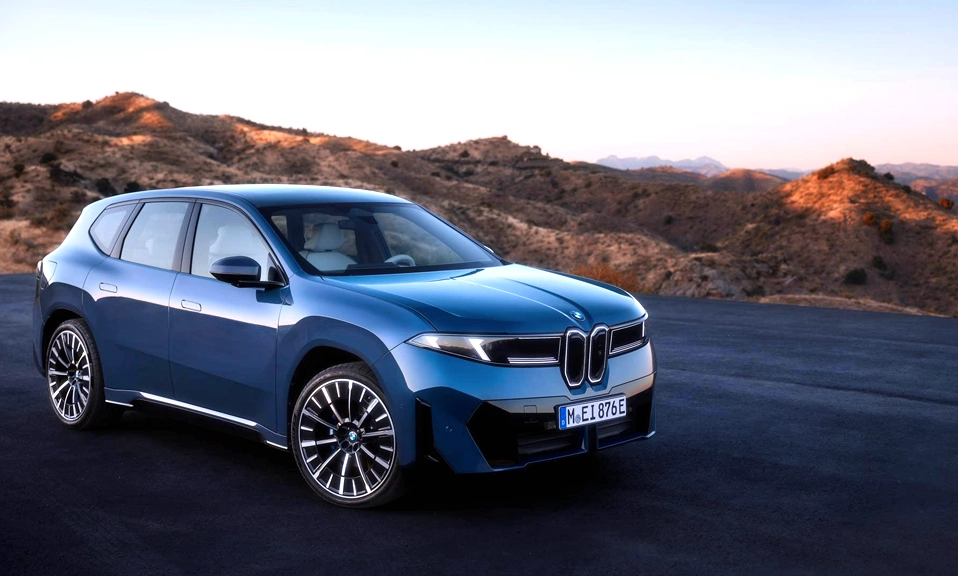
BMW describes it as “extroverted” and “unmistakable”. The front end mirrors the iX3, with narrow, upright kidney grilles and twin headlights integrated into a slim, illuminable panel. The roofline is dramatically sloped, merging into a pronounced spoiler with an integrated brake light.
It’s a design that will polarize. But that’s the point. The iX4 isn’t trying to blend in. It’s trying to stand out in a crowded market.
5. The Interior Is a Tech Showcase
Inside, the iX4 introduces BMW’s new Panoramic iDrive system. The centerpiece is a 17.9-inch central touchscreen, paired with BMW’s Panoramic Vision head-up display that spans the full width of the windscreen.
The iX4 comes with M Sport trim as standard, which includes 20-inch alloy wheels, a panoramic glass roof, ambient cabin lighting, heated electric front seats, and wireless Apple CarPlay and Android Auto.
The M Sport Pro trim adds massaging front seats, adaptive LED headlights, and additional M styling tweaks.
6. Practicality Takes a Small Hit
The coupe roofline costs you a little space. The iX4’s boot holds 490 litres, expanding to 1,600 litres with the rear seats folded—30 litres less than the iX3 in the boot and 150 litres less when the seats are down.
There’s also a 58-litre frunk under the bonnet for storing charging cables. BMW claims the cell-to-pack battery design “preserves rear headroom beneath the sloping roofline,” though the proof will be in the pudding.
7. Pricing and Availability
The iX4 is available to order now, with first deliveries beginning 6 March 2027.
UK pricing:
iX4 40 xDrive M Sport: £60,170
iX4 50 xDrive M Sport: £66,075
iX4 M60 xDrive: Pricing to be announced closer to launch
US pricing:
iX4 50 xDrive: $66,200 (excluding destination and handling)
European pricing:
Starting from €70,900
The iX4 will be built alongside the iX3 at BMW Group Plant Debrecen in Hungary, using renewable electricity and no fossil fuels during normal operation.
The BMW iX4 is not a
compromise. It’s a genuine alternative to petrol and hybrid SUVs, with range that eliminates anxiety, charging that makes long trips practical, and performance that reminds you why you bought a BMW in the first place.
It’s also a statement of intent. As Chinese EV makers flood the European market with affordable, tech-heavy alternatives, BMW is betting that range, quality, and driving dynamics still matter. The iX4 is its answer—and on paper, it’s a compelling one.
The first deliveries arrive in March 2027. If you’re in the market for an electric SUV that can genuinely replace your petrol car, the iX4 deserves a spot on your shortlist.