Meta had the smart glasses market to itself for years. Google and Samsung just crashed the party with a cheaper product, a more open philosophy, and a warning shot: Meta’s 64% market share is not as safe as it looks.
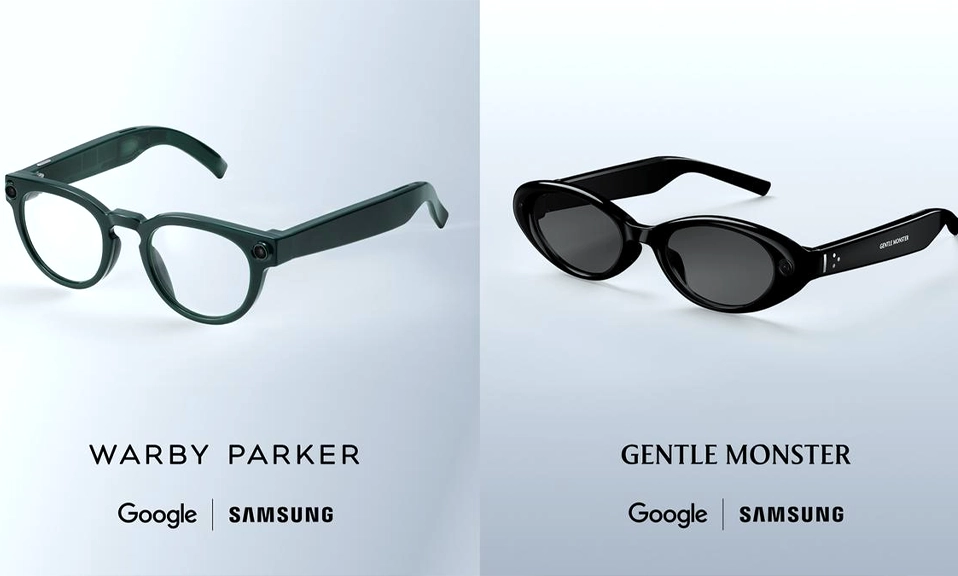
The first Android XR “Intelligent Eyewear” collection—built with Warby Parker and Gentle Monster—opens pre-orders today and ships on December 10, 2026. The Ray-Ban Meta Gen 3 has been on sale since September. This is the first genuine head-to-head in AI eyewear. Here is how they stack up.
The Price: Google Undercuts Meta
| Google/Samsung Intelligent Eyewear | Meta Ray-Ban Gen 3 | |
|---|---|---|
| Entry price | $395 (Warby Parker) | $449 |
| Premium frames | $449–$489 (Gentle Monster) | Up to $579 (limited Aviator) |
| Camera-free option | No | $349 (Ray-Ban Meta Audio) |
Google’s starting price is $54 cheaper than Meta’s flagship, and its premium frames still undercut Meta’s top-end. For prescription wearers, the final cost will rise, but the base comparison favors Google.
The Hardware: Lighter, More Storage, Bigger Case
Both glasses are display-free audio-and-camera frames. The differences are in the details.
Weight: Samsung’s frames weigh 40–44 grams, with the standard-lens version at 41 grams. Meta’s Gen 3 is not far off, but early hands-on impressions describe the Android XR frames as feeling lighter and less chunky than Meta’s display-equipped models.
Processor and memory: Both run on Qualcomm’s Snapdragon AR1 Gen 1. Samsung pairs it with 2GB of RAM and 64GB of storage—double the storage of the Ray-Ban Meta Gen 3.
Battery: Both claim up to 9 hours of continuous use. Samsung’s included charging case provides up to 7 additional charges (72 hours total), compared to Meta’s case, which adds roughly 50 hours.
Camera: Both use a 12MP sensor. Meta’s Gen 3 shoots 3K video and adds Dolby Atmos audio and 360° spatial sound recording in a later update. Samsung’s camera records 3K at 30fps.
Microphones: Meta has six mics with noise cancellation that blocks over 90% of background noise on calls. Samsung has four mics—a meaningful difference for call quality in loud environments.
Durability: Samsung rates its glasses IPX4 for water resistance. The charging case has no IP rating.
The AI: Gemini vs. Meta AI
This is the real battleground, and the two companies are taking different approaches.
Google’s advantage is Gemini’s depth. The glasses run on Gemini, with Google’s Project Astra vision system enabling real-time object recognition and contextual memory. In practice, this means the glasses can translate menus, identify landmarks, give walking directions, summarize a whiteboard to Samsung Notes, and answer follow-up questions about what you are looking at. Google’s integration with Maps, Search, and Samsung’s productivity suite gives it a functional ecosystem that Meta cannot match.
Meta’s advantage is maturity and speed. Meta AI has been on the market for years. The Gen 3 adds an action button that opens the assistant instantly, removing the need to say “Hey Meta” in public. Meta’s ecosystem—WhatsApp, Messenger, Instagram—is deeply embedded in billions of lives, and the glasses integrate with those services natively. The Meta Neural Band, available with the Ray-Ban Display, adds gesture control that Google’s audio-only frames do not currently offer.
The verdict on AI: Google has the more capable AI platform on paper. Meta has the more proven, more widely used implementation today.
The Privacy Question: Google Went Further
Camera glasses are a privacy minefield. Both companies have responded, but Google’s approach is more aggressive.
Google’s safeguards: A physical on/off switch for the camera. A blinking white LED that lights up whenever the camera is recording. Automated hardware checks that disable recording if the LED is covered. And Gemini Live automatically redacts faces and filters out surrounding voices before returning answers. Google has confirmed it does not use visual query data for ad targeting or AI model training.
Meta’s safeguards: An external LED indicates recording, and the Gen 3 includes an action button for quick AI access. But Meta’s glasses lack the physical camera switch and the automatic face-redaction layer that Google has built into Gemini Live. Meta’s camera-free Ray-Ban Meta Audio ($349) is the company’s answer to privacy-conscious buyers, but it cannot take photos or video.
The verdict: Google has built a more defensible privacy architecture. Meta’s camera-free option is a smart product strategy, but for the camera-equipped models, Google’s safeguards are more comprehensive.
The Ecosystem: Android XR vs. the Meta Universe
Google’s frames are built for Android XR, the platform developed with Samsung and Qualcomm. They work with Samsung Galaxy phones running One UI 9 (Android 17), Google Pixel 7 and later, and iPhone 13 Pro or later via a Made for iPhone companion app. Some features—particularly deeper Samsung Notes integration—require a recent Galaxy S or Z series device. The glasses are not locked to Samsung hardware, but the best experience is on Samsung’s ecosystem.
Meta’s frames are ecosystem-agnostic in the sense that they work with iOS and Android, but they are optimised for Meta’s services. The Ray-Ban brand carries enormous fashion credibility, and the Gen 3 comes in 27 frame-and-lens combinations, including Aviator and cat-eye styles. Samsung’s collection offers 30 variations across Gentle Monster (6 styles) and Warby Parker (3 styles), with prescription and tinted lens options.
The verdict: Meta has the stronger brand recognition and the wider fashion appeal. Google has the more open platform and the deeper productivity integration.
The Market Reality: Meta Is Still Winning—For Now
Meta dominates AI glasses. Counterpoint Research estimates its market share at 80%, while IDC puts it at 69.2%. The company sold 7 million AI glasses in 2025 alone—more than triple its sales in 2023 and 2024 combined. Analysts expect Meta to hold roughly 64% of the market in 2026.
But Google and Samsung are forecast to sell 2 million units in 2026, which would give them 18% market share and the No. 2 position. The significance is in the speed: Meta took 18 months to reach 2 million sales for its first Ray-Ban glasses. Google and Samsung may reach that number in a few months.
The caveats are real. The forecast assumes no major supply constraints, no launch delays, and a “reasonable price tag”—which Google has now delivered. But the launch is limited to the US and South Korea. Europe, the UK, and the rest of the world have no confirmed timeline. Meta’s global footprint is a major advantage.
Who Is Winning the AI Eyewear Battle?
Meta is still winning. Google is closing the gap faster than anyone expected.
If you want the most polished, most widely available, most fashion-forward smart glasses with the largest app ecosystem, the Ray-Ban Meta Gen 3 remains the safest choice. It is a mature product from a company that has been iterating on this category for years.
If you want the most capable AI, the most comprehensive privacy safeguards, a lighter frame, more storage, and a lower starting price, the Google/Samsung Intelligent Eyewear is the more compelling device on paper. The Gemini integration is genuinely deeper than Meta AI, and Google’s face-redaction and physical camera switch are meaningful advantages.
The battle is not over. It has barely begun. But for the first time, Meta has a rival that is not just cheaper—it is credible.
The smart glasses war is here. And Google just fired the first real shot.