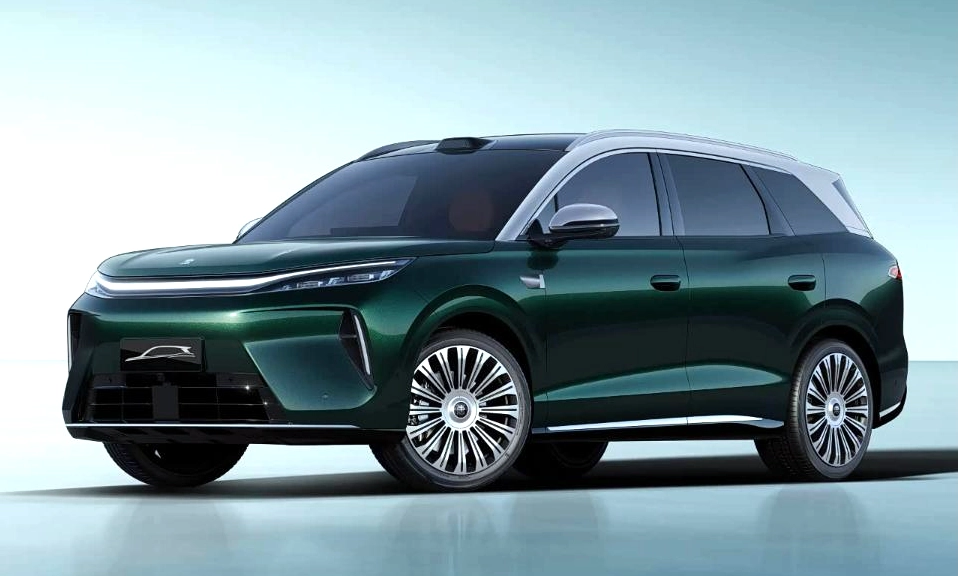
The range anxiety conversation just got a lot shorter. On November 24, 2026, BYD launched the third-generation Tang, a five-seat electric SUV that delivers up to 850 kilometers of CLTC range on the rear-wheel-drive variants—and it does so at a starting price of 187,900 yuan (about $28,000) . That combination of range and price is not just competitive. It is a direct challenge to the assumption that long-range electric family cars must cost a premium.
The question is whether the 850 km figure is a genuine breakthrough for family motoring, or a headline number that fades under real-world conditions. The answer, as with most things in the EV transition, is both.
The Numbers That Matter
The third-generation Tang arrives in three rear-wheel-drive trims: the 730 km entry model at 187,900 yuan, the 850 km Laser Honor at 207,900 yuan, and the 850 km Laser Flagship at 219,900 yuan . All three use a 300 kW (402 hp) rear motor and BYD’s second-generation Blade Battery . An optional 20,000 yuan all-wheel-drive package adds a second motor for a combined 515 kW, a 0–100 km/h time of 4.3 seconds, and a reduced but still substantial 770 km of range .
The 850 km figure is measured on the CLTC cycle, China’s standardized test procedure. CLTC figures tend to be more optimistic than WLTP or EPA estimates, and real-world highway range will be lower—particularly in cold weather or at sustained high speeds. One owner review noted that while the official range is 850 km, “real-world range will drop somewhat, as with all EVs” . That caveat matters. But even with a 15–20% real-world haircut, the Tang is delivering a genuine 650–700 km of usable range in most conditions. For a family car, that is the difference between charging once on a long trip and charging three times.
Flash Charging Changes the Equation
Range is only half of the family-EV equation. The other half is charging speed, and here the Tang makes an equally aggressive play. BYD’s flash charging technology can take the battery from 10% to 70% in about five minutes, and from 10% to 97% in roughly nine minutes at normal temperatures . Even in -30°C conditions, the charge time only increases by about three minutes .
The infrastructure is catching up, too. BYD has already deployed more than 10,000 flash-charging stations, a number that matters enormously for families without home charging . A nine-minute stop is roughly the time it takes to wrangle everyone out of the car, use the restroom, and grab a coffee. It is not quite as convenient as a gasoline fill-up, but it is close enough that the charging stop stops being the defining feature of a family road trip.
A Five-Seat Bet on Comfort Over Headcount
The most consequential decision BYD made with the third-generation Tang is to drop the third row entirely. This is a five-seat SUV, full stop. The seven-seat market is served by the larger Da Tang, which launched earlier in 2026 . By committing to five seats, BYD freed up space for the second row, and the result is genuinely impressive: 1,003 mm of second-row legroom, a seatback that reclines to 130 degrees, and a 910-liter rear cargo area that expands to 2,098 liters with the second row folded . There is also a 205-liter power frunk with drain holes, useful for wet gear or messy cargo .
For families with one or two children, this is the right trade-off. Most three-row SUVs in this price range have a third row that is barely usable for adults and compromises cargo space when in use. The Tang’s approach is to be exceptionally good at carrying five people and their luggage, rather than mediocre at carrying seven. It is a bet that the average family does not need a third row every day, and that comfort for the people who are actually in the car matters more than theoretical seating capacity.
The cabin equipment reinforces that philosophy. All four outer seats get heating, ventilation, and 10-point massage . There is a 6.8-liter heating and cooling fridge . The dashboard is dominated by a 35.4-inch “Star Ring” display and a 30-inch panoramic entertainment screen . A 22-speaker Devialet audio system is available, and the car supports more than 12 seating and cargo configurations . This is not a stripped-down range champion. It is a fully equipped family vehicle that happens to have extraordinary range.
The Chassis and the Tech
Underneath, the Tang uses a double-wishbone front and five-link rear suspension, with DiSus-A dual-chamber air suspension available on higher trims . The air suspension and rear-wheel steering give the car a minimum turning radius of 5.6 meters, which is remarkably tight for a vehicle that is 5,045 mm long and 1,980 mm wide . That maneuverability matters in school drop-off lines and narrow parking garages.
The Tang is also the first BYD model to feature the company’s new-generation drive-by-wire digital chassis, with steer-by-wire and brake-by-wire technology that eliminates the mechanical linkage between the steering wheel and the wheels. BYD claims this improves response speed by more than 25% .
On the safety and assistance front, the Tang comes with BYD’s God’s Eye B system, which includes LiDAR, urban navigation assistance, and smart parking . Standard safety equipment includes 11 airbags and a TBC high-speed tire blowout stability control system . The presence of LiDAR even on the mid-tier 850 km trim is notable; in the 20–30万元 segment, laser radar and urban navigation are becoming more common, but BYD is putting them on a vehicle that undercuts many rivals on price .
The Competitive Reality: Model Y and Beyond
The most obvious benchmark is the Tesla Model Y. The rear-wheel-drive Model Y offers 593 km of CLTC range at a starting price of 263,500 yuan; the long-range all-wheel-drive version offers 750 km at 313,500 yuan . The Tang’s 850 km rear-wheel-drive model at 207,900 yuan undercuts the base Model Y by more than 55,000 yuan while offering significantly more range.
That comparison is not entirely apples-to-apples. Tesla’s advantage lies in software polish, charging network maturity, and driving dynamics. One review noted that the Model Y’s “electronic control efficiency and handling feel are indeed better,” while the Tang’s advantage is in “rear-seat space and interior luxury” . The Tang is not trying to be a driver’s car. It is trying to be a family car, and on that metric—space, comfort, range, and price—it is a formidable package.
Against domestic rivals like the Xpeng G9, which offers up to 725 km at 248,800–278,800 yuan, the Tang’s range advantage is clear, and its starting price is lower . The Chinese electric SUV market is brutally competitive, and the Tang’s combination of 850 km range, five-seat comfort, and sub-220,000 yuan pricing for the long-range trims positions it as a value leader in its segment.
The Caveats: What the 850 km Figure Doesn’t Tell You
The Tang is not a universal solution, and BYD’s own product strategy acknowledges that. The five-seat-only layout means families with three children, or those who regularly carry grandparents, will need to look elsewhere—to the seven-seat Da Tang, or to a competitor . The CLTC range figure will not translate directly to highway range, and buyers should expect real-world numbers in the 650–700 km range under mixed conditions. The flash charging is impressive, but its real-world benefit depends on access to BYD’s charging network, which is extensive in China but not yet global. And the car is China-only for now, with European availability expected in the second half of 2027 and no confirmed US launch .
There is also the question of weight and efficiency. A 105.79 kWh battery pack (as reported for the rear-wheel-drive model) adds mass, and while the Tang’s range is impressive, its efficiency in terms of kilometers per kWh will not match lighter, smaller EVs . For families who mostly drive short distances and charge at home, a smaller battery would be lighter and cheaper. The 850 km Tang is for the family that regularly drives long distances, or that wants the freedom to do so without planning.
A Genuine Step Forward for Family EVs
The third-generation BYD Tang is not the first electric SUV to promise long range. It is one of the first to deliver that range at a price that makes sense for ordinary families, without stripping out comfort, safety, or technology. The 850 km CLTC figure is a headline, but the real story is the package around it: a spacious five-seat cabin, genuinely fast charging, air suspension and rear-wheel steering, and a starting price under 220,000 yuan for the long-range trims.
Is this the future of family cars? In China, it is already part of the present. The Tang series sold 16,664 units in October 2026, up 15.24% year-on-year, and the third-generation model is positioned to accelerate that momentum . For families who prioritize range, comfort, and value over brand prestige or driving thrills, the Tang makes a compelling case that the electric family car no longer requires compromise. The 850 km figure will get the headlines. The five-seat, fast-charging, fully equipped reality behind it is what will get families into the driver’s seat.