There is a very specific kind of misery that hits on a 35°C afternoon in stop-and-go traffic. You crank the AC dial to max, and your car responds by wheezing out a stream of lukewarm, faintly musty air that smells like a wet dog in a gym bag.
So you do what millions of drivers do: you buy a can of refrigerant from the auto parts shop, “top it off,” and hope for the best.
Sometimes that works. Often, it makes things worse — and occasionally it destroys the compressor, turning a £100 fix into a £1,200 one.
Here’s the thing most drivers get wrong about car air conditioning: it isn’t like fuel or oil. Refrigerant doesn’t get “used up.” Your AC is a sealed, closed-loop system. If it’s low, there’s a leak, and pouring more in without finding it is treating a symptom while ignoring the disease.
Whether you’re dealing with weak cooling, weird smells, or you just want to avoid a summer breakdown, here are 10 practical ways to keep your car’s AC efficient, cold, and healthy.
❄️ 1. Stop “Topping Off” Refrigerant Without Fixing the Leak
The Problem: This is the single most expensive mistake in DIY car maintenance. Refrigerant isn’t a consumable. If your system is low, it escaped somewhere — a worn O-ring, a corroded condenser, a leaking compressor seal.
The Cost: Ignoring the leak means you’ll keep buying cans every few months. Worse, low refrigerant also means low oil circulation (the oil travels with the refrigerant), which starves the compressor of lubrication. Compressors are the heart of the system and the most expensive part to replace.
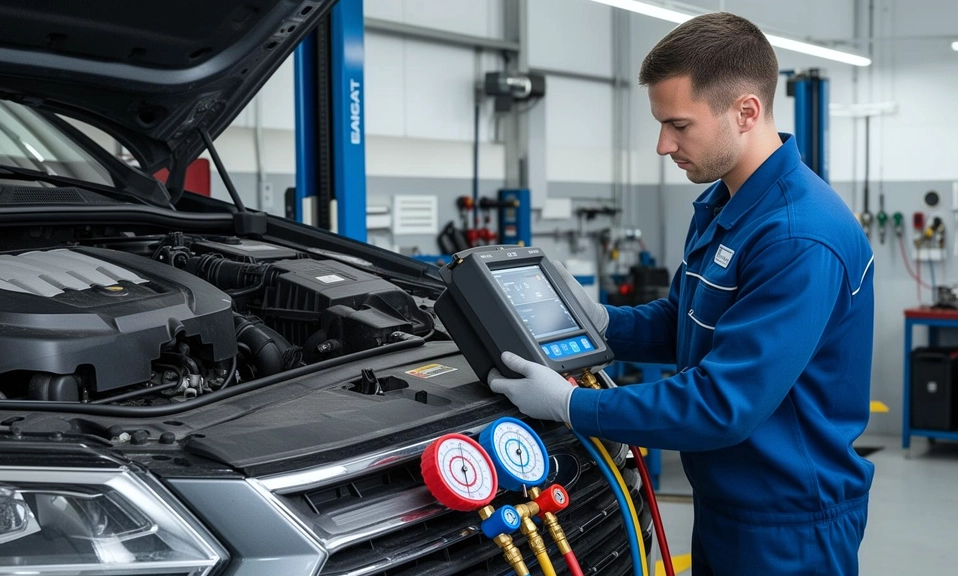
The Fix: If your AC has gone weak, get a proper diagnosis. A technician will use UV dye or an electronic sniffer to locate the leak, repair it, then evacuate and recharge the system to the exact specification. It costs more upfront and dramatically less over three years.
🌬️ 2. Replace Your Cabin Air Filter (The Cheapest Fix Nobody Does)
The Problem: Weak airflow from your vents, foggy windows that won’t clear, and a persistent musty smell.
The Cost: A clogged cabin filter chokes airflow, forcing your blower motor to work harder (they do burn out) and making the system feel like it’s failing when the AC itself is perfectly fine.
The Fix: Check your cabin air filter every 12 months or 12,000 miles — more often if you drive on dusty roads or in heavy pollen. It usually lives behind the glovebox or under the bonnet near the windscreen. In most cars it’s a 10-minute, no-tools job and costs £10–£25.
This is the first thing to check if airflow is weak but the air is still cold. Nine times out of ten, it’s the filter.
🧽 3. Keep the Condenser Clean
The Problem: The condenser is the radiator-looking grille at the very front of your car. Its job is to dump heat from the refrigerant into the outside air. If it’s clogged with dead bugs, leaves, road grime, or plastic bags, it can’t shed heat.
The Symptom: AC that works fine while you’re moving but goes warm at idle or in traffic. That’s a classic airflow/heat-exchange problem, not a refrigerant problem.
The Fix: Once or twice a year, gently rinse the condenser from the engine side outward using a low-pressure hose. Never use a pressure washer — the fins are thin aluminium and bend easily, which permanently reduces efficiency. Straighten minor bends with a fin comb.
🔄 4. Run Your AC Regularly — Even in Winter
The Problem: People switch the AC off entirely from October to May. Then in June it doesn’t work, and they can’t understand why.
The Science: The compressor shaft seal and the system’s rubber O-rings are lubricated by the oil circulating with the refrigerant. If the system sits idle for months, those seals dry out, shrink, and crack — creating the very leaks that kill your AC.
The Fix: Run your AC for 10 minutes at least once a week, year-round. Easiest method: use the demist/defrost setting, which runs the compressor automatically in most cars to dry the air. You get clearer windows and a healthier AC system. Two jobs, one button.
🚫 5. Be Very Careful With DIY Recharge Cans
The Problem: Those £30 cans from the parts shop are seductive. But they come with real risks:
- Overcharging. AC systems need a precise refrigerant weight — often to the gram. Too much refrigerant raises pressures and can damage the compressor or trigger a shutdown.
- Wrong refrigerant. Older cars use R-134a. Most cars built from around 2014 onward use R-1234yf, which is chemically different, more expensive, and mildly flammable. Mixing them is a serious problem.
- Sealant additives. Many cans contain “stop-leak” compounds that gum up the system and can contaminate the recovery equipment at professional shops. Some garages will refuse to service a system that’s been dosed with them.
The Fix: Check the sticker under your bonnet for the refrigerant type and exact charge weight. If you’re not confident, a professional recharge with proper recovery and vacuum testing is genuinely worth the extra money. A vacuum test also removes moisture, which forms corrosive acid inside the system.
🌡️ 6. Vent the Oven Before You Blast the AC
The Problem: After sitting in the sun, your cabin can hit 60°C+. Cranking the AC to max immediately means the system is trying to cool an oven while you sit in it.
The Fix: For the first 30–60 seconds, open the windows (or fan the door a few times) and drive with the fan on high, AC off, drawing in outside air. Push the superheated air out first. Then close the windows and switch on the AC with recirculation.
You’ll cool down faster and put far less strain on the compressor.
🔁 7. Use Recirculation Strategically (But Not Forever)
The Problem: Many drivers either never use recirculation, or leave it on permanently. Both are wrong.
The Science: Fresh-air mode has to cool hot outside air continuously. Recirculation re-cools already-chilled cabin air, which is dramatically more efficient — it reduces compressor load and improves fuel economy or EV range.
The Fix:
- Recirculation ON: Hot days, traffic jams, tunnels, or when you’re behind a smoky diesel.
- Recirculation OFF: Cool/damp weather, long motorway drives, or whenever windows start fogging. Recirculated air traps moisture from your breath and fogging gets worse.
Most modern cars with climate control handle this automatically. If yours is manual, cycle it deliberately rather than setting and forgetting.
👃 8. Deal With Musty Smells Properly (Don’t Just Mask Them)
The Problem: That vinegary, damp-gym smell when you first switch on the fan.
The Cause: Your evaporator core sits in a dark, enclosed box and gets cold and wet during operation. Condensation collects, and mould and bacteria grow on the fins. You’re then blowing that air directly into your face.
The Fix — three steps:
- Dry it out. For the last 2–3 minutes of your drive, switch the AC compressor off but leave the fan running on high with fresh air. This dries the evaporator before you park, starving mould of moisture.
- Clear the drain tube. There’s a small rubber drain hose under the car that lets condensation drip out. If it clogs, water pools inside the HVAC box. Look for a puddle under the passenger footwell or a sloshing sound. A gentle clear with a length of soft wire usually fixes it.
- Clean it. Use a dedicated evaporator cleaner sprayed into the intake vents, or replace the cabin filter with an activated-charcoal version. Air fresheners just perfume the mould.
🅿️ 9. Park Smart and Reduce the Heat Load
The Problem: Every degree of cabin heat your AC has to remove is work the compressor has to do — which costs fuel, range, and component life.
The Fix:
- Park in shade or a garage whenever practical.
- Use a reflective windscreen sunshade. It genuinely drops dashboard and cabin temperatures significantly.
- Crack windows slightly if it’s safe and dry to do so.
- Light-coloured seat covers or a towel over dark leather/vinyl stops the seats becoming heat batteries that radiate at you for ten minutes.
EV owners: Precondition the cabin while still plugged in. You cool the car using grid power instead of battery power, and you leave with a full charge and a cold cabin.
🔧 10. Get a Professional AC Service Every 2–3 Years
The Problem: AC systems lose a small amount of refrigerant naturally over time through permeation and micro-seepage — roughly 5–10% per year is normal in older systems. Combined with oil degradation and moisture ingress, performance slowly slides.
The Fix: A proper AC service isn’t just “a regas.” It should include:
- Recovering and weighing the old refrigerant (this tells you if there’s a leak)
- Replacing the receiver/drier or accumulator if specified
- Vacuum testing the system for leaks and boiling off moisture
- Recharging to the exact factory weight
- Adding the correct type and amount of compressor oil
- Checking vent output temperature and pressures
The benchmark: On a 25°C day, a healthy system should deliver air at the centre vent somewhere around 4–10°C once the engine is at speed and the system has run for a few minutes. Stick a cheap thermometer in the vent and check. It’s a genuinely useful five-minute test.
⚡ A Note for EV and Hybrid Owners
Your AC matters more than you think.
Cooling: Most EVs use an electric compressor driven by the high-voltage battery, so it works even with the “engine” off. Heavy AC use can trim a few percent off your range — noticeable on a long trip, but not dramatic. Preconditioning while plugged in is your best tool.
Heating (the important bit): Many modern EVs use a heat pump, which is essentially a reversible AC system. It also heats your cabin and conditions your battery. That means the refrigerant circuit in an EV isn’t a comfort feature — it’s part of the thermal management system that protects your battery.
If your EV’s heat pump develops a leak or a fault, you may see reduced heating efficiency, slower fast-charging (because the battery can’t be preconditioned properly), and worse winter range. Get EV AC faults diagnosed promptly, and use a shop familiar with high-voltage systems.
🚩 5 Signs You Need Professional Help, Not a Can
- AC blows warm at idle but cold when moving → condenser airflow or fan issue
- Compressor clutch never engages → electrical fault, pressure switch, or low refrigerant
- Loud grinding or squealing when AC is on → failing compressor or bearing (stop using it immediately)
- Water sloshing inside the dash or wet passenger carpet → blocked evaporator drain
- Sweet, chemical smell or oily film on windows → possible refrigerant/oil leak or heater core issue
It’s a Sealed System, Not a Fuel Tank
The single most important mindset shift is this: your AC doesn’t consume refrigerant. It circulates it. If it’s low, something is wrong, and adding more without diagnosing is expensive procrastination.
Do the cheap things consistently — change the cabin filter, rinse the condenser, run it weekly year-round, dry out the evaporator, and use recirculation intelligently. Those five habits alone will prevent the majority of AC problems.
And when it does go wrong, spend the money on a proper diagnosis once rather than a can of refrigerant four times.
Your future self, sitting in traffic in August with genuinely cold air on your face, will be extremely grateful.