For 99 years, Chile was the almost team.
Almost beat Brazil. Almost made the final. Almost had a golden generation. Almost mattered.
Then, for two perfect years, they didn’t almost anything. They beat everyone — including Lionel Messi‘s Argentina. Twice.
This is how a country that never won anything became the team that won everything that mattered.
The Long Dark Before The Red
Chile participated in the first South American Championship (now known as the Copa América) in 1916, finishing as runners-up. For the next 90 years, that was basically the story.
They had moments:
1962 — The Home World Cup. Chile hosted the World Cup and achieved an impressive third-place finish under Fernando Riera. The team with Eladio Rojas and Leonel Sánchez beat Yugoslavia for third. The country went crazy. Then went quiet for 30 years.
1998 — Zamorano and Salas. Iván “Bam Bam” Zamorano and Marcelo Salas — La Roja’s twin strikers — took Chile to the Round of 16 in France. They scored 4 goals together and made Chile cool again.
But mostly, Chile was known for being tough, dirty, and heartbroken. They were banned from the 1990 World Cup because their goalkeeper Roberto Rojas faked an injury by cutting his own forehead with a razor blade hidden in his glove — the most Chilean cheating story ever.
By 2006, Chile hadn’t qualified for a World Cup in 8 years. The youth teams were good, but the senior team was a mess. Players drinking, fighting, missing training. La Roja meant red, but it also meant embarrassment.
Then a crazy Argentine arrived.
2007: Marcelo Bielsa Changes Everything
In 2007, Chile hired Marcelo Bielsa — El Loco, the obsessive Argentine who makes his players watch 100 hours of video and runs 3-hour training sessions.
Bielsa didn’t care about Chile’s past. He looked at the U20 team that had finished 3rd in the world and said: You are my team now.
He picked:
- Alexis Sánchez】 — 18-year-old winger from Tocopilla, fastest thing in Chile
- Arturo Vidal — mullet, tattoos, midfielder who tackled like a linebacker
- Gary Medel — 5’7″ defender they called Pitbull because he would die on the pitch
- Mauricio Isla — fullback who never stopped running
- Claudio Bravo — calm goalkeeper from the south
He made them press like animals. 3-3-1-3 formation, man-marking everywhere, attack, attack, attack. Chilean media said he was insane. Players puked in training.
But in 2010, Chile qualified for the World Cup in South Africa playing the most exciting football in South America. They beat Spain in the group? No, they lost 2-1 but outplayed them. They lost to Brazil in Round of 16, but the world noticed: Chile was back, and they were fun.
Bielsa left in 2011 after a fight with the federation. Chile collapsed again. They needed someone who understood Bielsa’s crazy — but could win.
2012-2017: The Golden Generation Explodes
A new manager, Jorge Sampaoli, was appointed in December 2012. A disciple of Marcelo Bielsa, Jorge Sampaoli broke new records for La Roja by winning 10, drawing 3, and losing only 3 of 15 games as the head coach of the Chile national team.
Sampaoli was Bielsa’s student, but smarter about winning. He kept the press, but made it more flexible. And he had the players at their peak:
Alexis Sánchez — Arsenal’s star, the kid from the mining town who could dribble through 3 people
Arturo Vidal — Juventus’ warrior, the best box-to-box midfielder in the world in 2015
Claudio Bravo — Barcelona’s goalkeeper, best in the world with his feet
Gary Medel, Mauricio Isla, Charles Aránguiz, Eduardo Vargas — all playing Champions League
His coaching era witnessed a rise of the golden generation of Chilean football, with numerous talents such as Alexis Sanchez, Arturo Vidal, Eduardo Vargas, Gary Medel, Mauricio Isla and Claudio Bravo.
In the 2014 World Cup in Brazil, Chile beat Spain — the defending champions — 2-0 and knocked them out. Vargas and Aránguiz scored. Spain, the team that had won everything, was dead, killed by La Roja. Chile then almost beat Brazil in the Round of 16 — they lost on penalties after Bravo nearly saved everything. The world said: If Chile had a little luck, they’d be champions.
They would get luck. At home.
2015 and 2016: Back-to-Back Copa América — Beating Messi Twice
Chile’s rise to the top was nothing short of spectacular. In 2015 and 2016, they won back-to-back Copa América titles, beating none other than Lionel Messi’s Argentina in both finals.
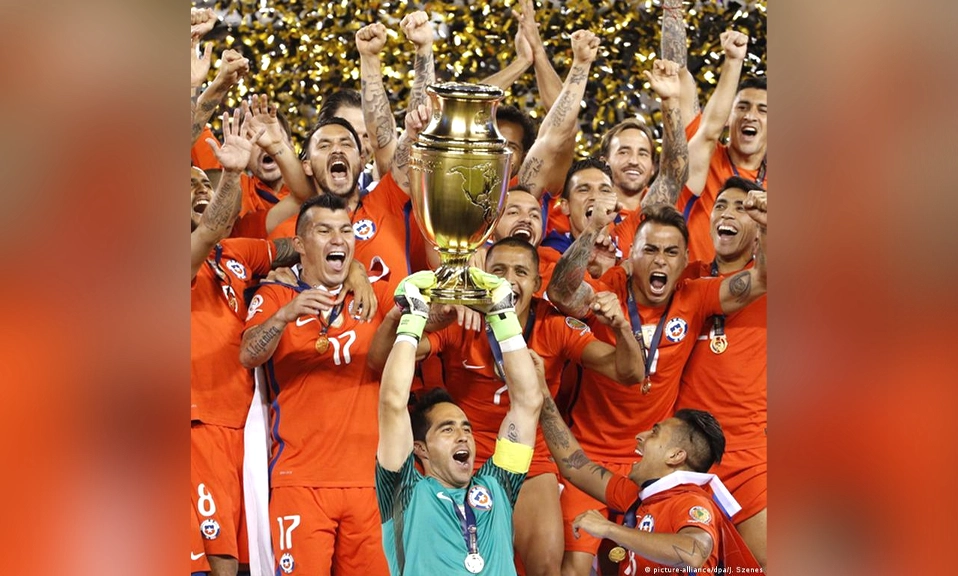
2015 — In Chile. First Copa América ever hosted in Chile. Final vs Argentina in Santiago. 0-0 after 120 minutes. Penalties. Messi scores. Then Higuaín misses. Banega misses. Alexis Sánchez does a Panenka — a cheeky chip — to win it. Chile had waited 99 years for a trophy. The country shut down. Alexis cried. Vidal screamed. Bravo lifted the cup.
2016 — Copa América Centenario, USA. 100-year anniversary tournament. Same final: Chile vs Argentina. Again 0-0. Again penalties. Again Messi misses his penalty — his first miss for Argentina. Again Chile wins 4-2. Again Alexis and Vidal dance.
Chile became the first team since 1940s Argentina to win back-to-back Copas. They did it by beating the best player in history twice in 12 months. In those days, they played with a style — high press, quick passing, no fear — that Brazil and Argentina had forgotten.
With Brazil and Argentina struggling to maintain their once-dominant styles, Chile stepped up, led by a golden generation.
They went to the 2017 Confederations Cup final, beating Portugal (with Ronaldo) on penalties, losing to Germany 1-0. For a moment, Chile was ranked 3rd in the world. 3rd. For a country of 19 million.
Chile experienced a golden era in the 2010s, winning two consecutive Copa América titles. This success was largely due to a generation of exceptionally talented players. La Roja, as the national team is known, showcased a blend of skill, determination, and tactical nous.
The Fall
What happened to La Roja, a team that was once the embodiment of Latin American football beauty?
They partied too much. They didn’t qualify for 2018 — losing 3-0 to Brazil on the last day while Peru overtook them. They didn’t qualify for 2022. They are struggling for 2026.
Chile’s challenge is to rebuild and find the next generation of stars to replace their aging legends.
The golden generation is 35 now. Vidal in Colo-Colo, Alexis in Udinese, Bravo retired. The kids aren’t the same.
Why The Rise Still Matters
La Roja’s golden generation didn’t just win two cups. They proved something Chile never believed about itself:
That a small, long, skinny country at the end of the world — that had always been told it was too far, too poor, too disorderly — could play football that the whole world wanted to watch, and could beat giants not by copying them, but by pressing them until they choked.
As Bielsa said in his first press conference in Santiago: “A man with new ideas is a madman, until his ideas triumph.”
For two years, they triumphed.
La Roja was never about red shirts. It was about red faces, from running so hard you couldn’t breathe — and still running.
Watch the 2015 final penalty shootout. Watch Alexis’ Panenka. That’s Chile’s history in one chip: audacious, disrespectful, and perfect.