5 Changes Reshaping the Global Car Market
The European auto industry is waking up to a new reality. Chinese carmakers aren’t just exporting cars anymore — they’re building them in Europe, hiring European designers, and setting up R&D centers in the heart of the continent’s automotive heartland. And they’re doing it faster, cheaper, and with more advanced technology than most legacy brands can match.
The numbers tell a dramatic story. In the second quarter of 2026, Chinese brands captured a record 10.7% of new car sales across 18 Western European countries, nearly doubling their 5.7% share from a year earlier. In the battery electric vehicle (BEV) segment alone, their market share broke through 15% for the first time in April 2026. BYD, China’s market leader, sold 178,000 vehicles in Europe in the first half of 2026 — an 80% year-over-year increase — making Europe its largest overseas market. Across the EU, BYD, Chery, Geely, Leapmotor, and SAIC collectively sold roughly 725,000 electric and hybrid vehicles in the first eight months of 2026, a two-thirds increase from the same period in 2025.
These aren’t just sales figures. They represent a fundamental shift in the global automotive landscape. Here are the five changes reshaping the market — and why Europe’s biggest automakers are struggling to respond.
1. Chinese Brands Have Moved From Exporting to Manufacturing in Europe
The first wave of Chinese EVs in Europe was about exports — shipping cars from China and selling them through local distributors. That era is over.
Chinese carmakers are now building factories, forming joint ventures, and acquiring production capacity across the continent. BYD established its European headquarters in Budapest, Hungary, in 2025, a €250 million facility that integrates sales, after-sales services, vehicle certification, and localized design. Leapmotor deepened its local production ties with Stellantis, tapping the European giant’s Spanish plant for EU-based manufacturing. Geely announced plans to acquire a 34% stake in a Ford plant in Spain for €221 million to accelerate its localization strategy.
The strategic logic is straightforward. Local production reduces tariff exposure, shortens supply chains, and signals long-term commitment to European markets. As one industry report noted, Chinese automakers are shifting from a pure export model to a “vehicle export + technology output + localized production” model, integrating deeply into European industrial ecosystems.
Why it matters: When Chinese brands build in Europe, they create European jobs, generate European tax revenue, and become part of the local industrial fabric. That makes it politically harder to shut them out — and commercially harder for legacy brands to compete on cost.
2. They’re Beating European Brands on Price — Despite Tariffs
The European Union imposed countervailing duties on Chinese-built EVs in 2024, with additional tariffs ranging from 7.8% to 35.3% on top of the standard 10% import duty. The explicit goal was to level the playing field and protect European manufacturers.
It hasn’t worked.
The International Energy Agency estimates it is at least 30% cheaper to produce a small electric SUV in China than in more advanced economies, largely because of lower battery costs and elaborate supply chains. That structural cost advantage is so large that even with tariffs of up to 45%, Chinese EVs remain price-competitive in many European markets. The UK, which did not impose additional China-specific tariffs, has become one of the most attractive markets for Chinese brands.
The result is a paradox. Tariffs raise prices for consumers, but they don’t restore the competitiveness of European manufacturers. They simply make Chinese cars more expensive — while still cheaper than most European equivalents.
Why it matters: The EU’s tariff strategy is a defensive measure, not a solution. European automakers aren’t losing because Chinese cars are artificially cheap. They’re losing because Chinese manufacturers have a fundamentally more efficient cost structure — one that tariffs can’t fix.
3. Chinese Carmakers Are Going Local on R&D, Design, and Talent
Price alone doesn’t explain the scale of the Chinese advance. The second — and arguably more significant — change is that Chinese carmakers are no longer just exporting products. They’re exporting capability.
XPeng opened a Munich R&D center in September 2025 and announced plans to establish an independent European supply chain team in January 2026, forming a “R&D plus manufacturing” closed loop in Europe. Xiaomi Auto has outlined plans for a Munich R&D center focused on high-performance vehicle development, design, chassis tuning, and advanced automotive technologies. Changan operates three facilities in Europe alone — a design center in Turin, a powertrain center in Birmingham, and another design center for its premium Avatr brand — staffed with around 500 local designers.
Changan’s vice-president, Klaus Zyciora — the former design head at Volkswagen AG — described the strategy in distinctly European terms: “One of our recipes for success is to establish a deep relationship with customers, understand their needs and invest in the user experience”.
Why it matters: Chinese carmakers are hiring European talent, learning European tastes, and building European credibility. They’re not trying to sell Chinese cars to Europeans. They’re trying to build European cars — with Chinese efficiency.
4. The Tech Advantage Is Widening, Not Narrowing
For decades, European automakers led the world in engineering. Today, the battleground has shifted to software, batteries, and consumer technology — and China is setting the pace.
As the BBC reported, China now makes the most exports in more than 315 product categories, up from 163 in 2016 — many of them linked to EV supply chains, including batteries, components, and manufacturing machinery. Tech giants like Xiaomi, Huawei, and Alibaba are now making EVs, bringing consumer technology expertise into the car industry. At Xiaomi’s EV factory outside Beijing, a car rolls off the production line roughly every 76 seconds. BYD has developed ultra-fast charging systems capable of adding 400km of range in around five minutes — close to the time it takes to refuel a petrol car.
The shift is so profound that Honda CEO Toshihiro Mibe, after visiting a highly automated Chinese factory, told Japanese media: “We have no chance against this” . Ford CEO Jim Farley has warned that Western carmakers are “in a fight for our lives” .
Why it matters: The competitive gap isn’t just about manufacturing costs. It’s about innovation velocity. Chinese carmakers are iterating faster, integrating software more deeply, and treating cars as part of a broader technology ecosystem. European brands, built around mechanical engineering, are struggling to adapt.
5. Hybrids Are Becoming the Trojan Horse
One of the most underappreciated aspects of the Chinese advance is how it’s adapting to European market realities. While BEVs dominate the headlines, Chinese carmakers are increasingly pushing plug-in hybrids (PHEVs) and hybrids (HEVs) in Europe — vehicles that don’t face the same tariff barriers as pure EVs.
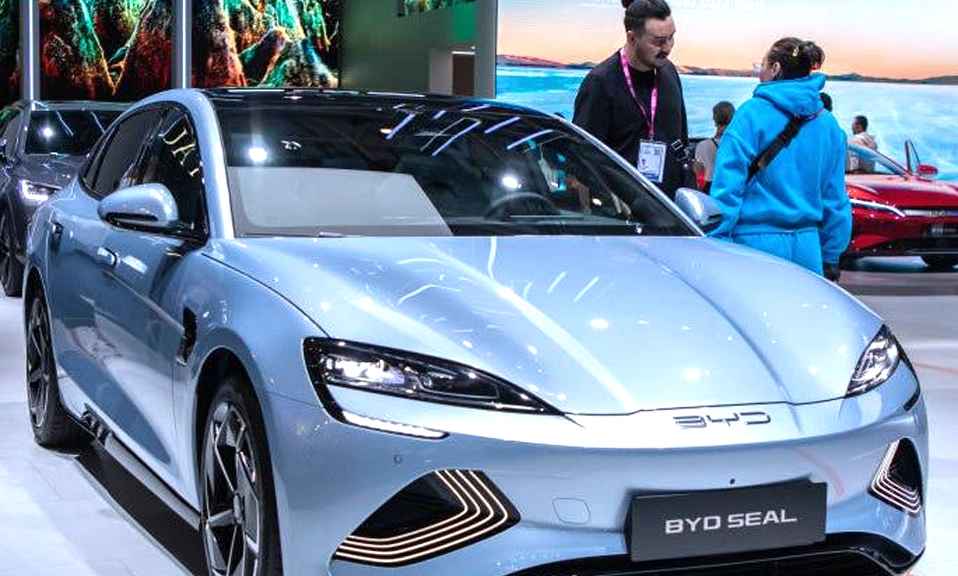
BYD’s European sales mix has shifted. Originally, the company introduced the C-segment SUV Seal U to the European market. But in recent years, PHVs have rapidly grown to account for more of BYD’s European sales volume than BEVs. The company is expanding its product lineup with models like the Dolphin Surf, ATTO 2 DM-i, and Dolphin G DM-i, designed to meet consumer needs, charging infrastructure limitations, and the xEV policies in each European country.
This is a strategic masterstroke. Hybrids are exempt from the EU’s countervailing duties on Chinese BEVs. They appeal to consumers who aren’t ready to go fully electric. And they allow Chinese brands to build market share and brand awareness while the charging infrastructure matures.
Why it matters: Chinese carmakers aren’t betting everything on a single technology. They’re meeting European consumers where they are — and using hybrids to build the customer base that will eventually transition to fully electric vehicles.
The Chinese challenge
to Europe’s automotive industry is not a temporary disruption. It is a structural shift in the global balance of automotive power.
Chinese brands now hold more than 10% of Western European car sales, over 15% of the BEV market, and are building factories, R&D centers, and supply chains across the continent. They’re led by companies that think like tech firms, not traditional automakers — and they’re competing on cost, software, and speed.
The European response has been largely defensive: tariffs, investigations, and political pressure. Those measures may slow the Chinese advance, but they cannot reverse the underlying dynamics. As one analyst put it: “The biggest mistake that the developed world is making is believing that the transition is only about electric cars. It’s about who will lead the next generation of mobility technology” .
The question for Europe’s biggest automakers is no longer whether they can stop the Chinese advance. It’s whether they can adapt fast enough to compete in a market that is being redefined by the very companies they once dismissed as imitators.
The global car market is being reshaped. And China is doing the reshaping.