The FAA grounded every flight in the United States on Friday afternoon. College football’s Week 12 was three hours from disaster. What happened next was a masterclass in improvisation—and a reminder of how fragile the entire enterprise really is.
The Federal Aviation Administration issued a nationwide ground stop for all departing flights on Friday, November 13, 2026, citing “extraordinary circumstances and for reasons of safety”. The cause was a communications outage affecting the 22 regional air traffic control centers that direct planes between airports across the country. The stop lasted more than four hours before flights were allowed to resume late Friday night.
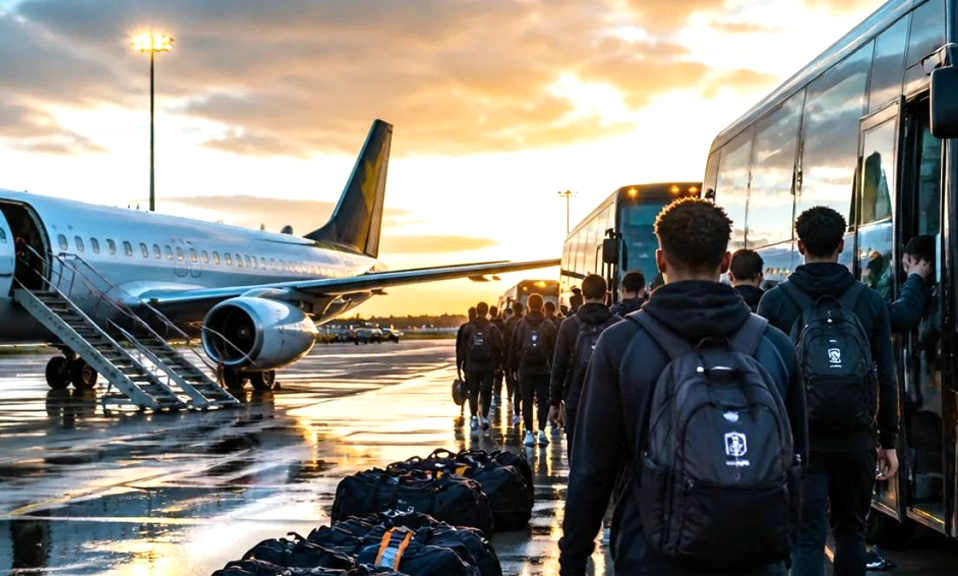
By then, the damage to college football’s travel plans was already done. Most teams playing on Saturday travel the day before. That meant dozens of programs were stranded at airports, on tarmacs, or still on campus when the ground stop hit—with kickoffs less than 24 hours away.
The Scale: 19 Teams, Four Hours, One Scramble
According to reporting from On3, 19 Division I college football teams were unable to fly for their Saturday games. ESPN confirmed that at least 10 Power 4 conference teams had their travel plans disrupted. The list of affected programs read like a who’s-who of the sport’s biggest brands:
No. 2 Utah (at No. 22 Arizona)
No. 8 Texas (at No. 24 LSU)
No. 9 Tennessee (at Texas A&M)
No. 19 Ole Miss (at Oklahoma)
Baylor (at No. 12 BYU)
Kansas State, Arizona State, Washington, Minnesota, Purdue, Auburn, UNLV, Colorado State, Tulane, Florida Atlantic, Oregon State, and others
The Big Ten confirmed to Front Office Sports that Minnesota, Purdue, and Washington were all affected. Minnesota was scheduled to play at Penn State, Purdue at Iowa, and Washington at Michigan State.
Some teams got lucky. Missouri (flying to No. 1 Georgia), Duke (at No. 5 Miami), Texas Tech (at Oklahoma State), Kansas (at West Virginia), and Northwestern (at Ohio State) all landed before the ground stop went into effect. The ACC confirmed that all of its visiting teams had reached their destinations before the stoppage.
The rest were left waiting.
The Fallout: Games Moved, Kickoffs Shifted, Buses Chartered
The most significant scheduling change was the Ole Miss at Oklahoma game, which was moved from Saturday to Sunday at 1 p.m. ET / noon CT. Ole Miss was unable to leave Oxford on Friday night, and its charter company could not accommodate a late-night departure after the ground stop was lifted. The team’s flight was delayed until Saturday afternoon.
The decision was not without controversy. Oklahoma athletic director Roger Denny issued a scathing statement, saying the SEC had informed him that “our failure to play on Sunday at the directed time would result in a forfeit.” Denny called the decision “not fair to our athletes” and said Oklahoma had “been given no other choice”.
Other games were adjusted rather than postponed:
Utah at Arizona was pushed back three hours to a 10:30 p.m. ET kickoff
Baylor at BYU was moved back 3.5 hours to a 7 p.m. ET kickoff
Auburn at Mississippi State was moved from noon ET to 4:15 p.m. ET to give the Tigers time to travel by bus
Arizona State at UCF was pushed back from 2:30 p.m. to 5:30 p.m. ET, giving the Sun Devils an additional three hours after their flight from Arizona was delayed
Washington at Michigan State was moved back 75 minutes to 5:30 p.m. ET
Kansas at West Virginia was moved from 5:30 p.m. to 3:30 p.m. ET because the Jayhawks had arrived early
Several teams abandoned air travel entirely. Purdue bused to Iowa. Auburn bused to Mississippi State. Oregon State, which initially began traveling to Boise by bus, turned around and headed back to the airport Friday evening to fly once the ground stop was lifted.
The Broader Chaos: Not Just Football
The ground stop didn’t just affect college football. NBA, NHL, and NFL teams were also scrambling. The Brooklyn Nets were on the team plane in New Orleans when their flight to Memphis was halted. The San Jose Sharks were left waiting to leave for their game in Utah. The USC women’s basketball team was grounded in Los Angeles ahead of a Sunday game against South Carolina.
There were also concerns about referees, who typically fly to their assignments the day before games. The Big Ten confirmed that all of its officials had arrived for their scheduled assignments.
What Caused the Ground Stop?
Transportation Secretary Sean Duffy said the issue was a communications problem affecting the regional air traffic control centers that handle flights between airports nationwide. FAA technicians were investigating. The FAA advisory listed an effective period from 3:54 p.m. ET to 11:30 p.m. ET, but the directive called for all flights to remain grounded “until further notice”.
It was the first nationwide ground stop since January 2023, when a pilot notification system failed. Before that, the last nationwide grounding was after the September 11 attacks in 2001.
The Aftermath: A Weekend of Improvisation
By Friday night, the ground stop had been lifted. But the scramble was far from over. Teams that had been stranded at airports or on campus were rebooking flights, chartering buses, and adjusting game plans on the fly. Washington returned to campus when its flight was grounded, stayed in contact with airline partners, and eventually departed late Friday for Michigan State. Tennessee and Texas both returned to their campuses during the stoppage and began making plans to fly out as soon as possible.
Colorado State held a walk-through at Northern Colorado Regional Airport while waiting to fly to Pullman for its game at Washington State. The image of a football team practicing in an airport terminal is a fitting symbol of a weekend that was defined not by preparation, but by adaptation.
A Reminder of Fragility
College football is a multi-billion-dollar industry built on a foundation of chartered planes, meticulously planned travel schedules, and the assumption that the logistics will work. Friday’s ground stop exposed how thin that foundation really is.
No games were outright postponed except Ole Miss-Oklahoma, which was moved to Sunday. But the ripple effects were felt across the sport—in altered kickoff times, in teams arriving at their hotels at 3 a.m., in players suiting up on less sleep than usual. The games went ahead. They just happened in a world where the planes didn’t.
The FAA’s ground stop was a communications failure, not a security threat. But for the teams stranded on tarmacs and in airports across the country, it was a stark reminder that even the most powerful sport in America is, in the end, at the mercy of the systems that move it.
The games were played. The chaos was contained. But the weekend will be remembered for the moments when the machine stopped—and the people who had to start it again.