For decades, the engine of computing has been the electron. We have spent sixty years squeezing more and more of them through ever-smaller transistors, and the result has been the greatest technological revolution in human history. But that engine is now sputtering. Moore’s Law is slowing, Dennard scaling is dead, and the insatiable demand of artificial intelligence is pushing electronic chips to their physical limits—not just in speed, but in the two things that matter most for the future of computing: energy and heat.
Photonic computing offers a radically different answer. Instead of pushing electrons through wires, it uses particles of light—photons—to perform computations. Light is faster, carries more data, and, crucially, generates far less heat. In 2026, after decades of laboratory promises, photonic computing is no longer a science experiment. It is a shipping product, a funded industry, and a genuine challenger to the silicon status quo. The question is no longer whether light can compute. It is whether it can do so reliably, affordably, and at the scale the AI era demands.
The Promise: Why Light?
The case for photonics rests on a few fundamental physical advantages. Electronic chips are limited by capacitive charging losses and electrical crosstalk—the energy wasted simply moving electrons around and the interference that occurs when wires are packed too closely together. Photons do not suffer from these problems. They can travel through waveguides with low loss, cross paths without interfering, and carry vastly more information through multiplexing across different wavelengths of light.
The performance implications are staggering. Photonic neuromorphic systems promise sub-nanosecond latency and terahertz-range bandwidth, with energy costs potentially dropping below one picojoule per multiply-accumulate (MAC) operation—a threshold that electronic hardware has never achieved at scale. One 2017 Princeton study cited in the literature reported a 294× speed acceleration over electronic benchmarks for certain operations. These are not incremental gains. They are the kind of step-change that could redraw the map of the semiconductor industry.
The Products: Photons in the Real World
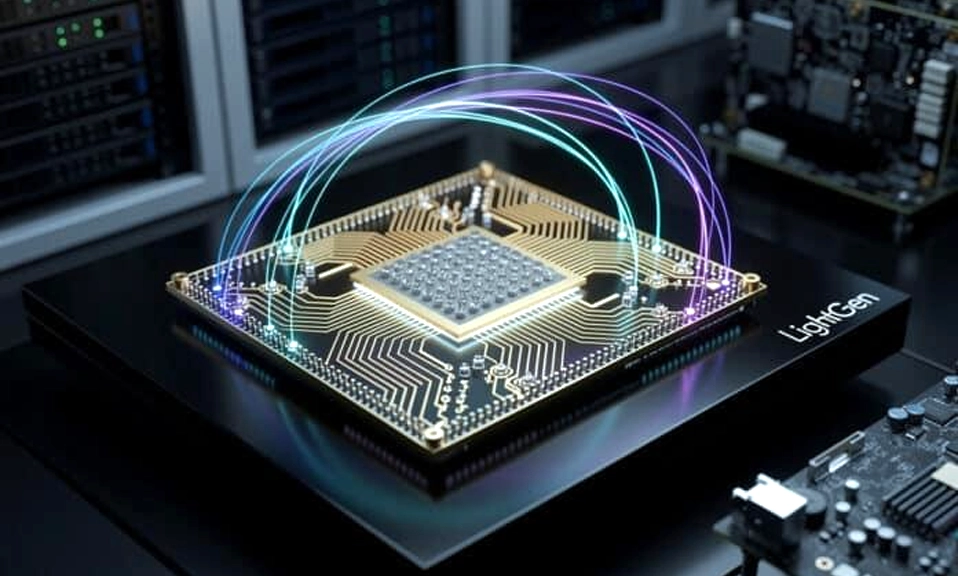
The most concrete evidence that photonic computing has arrived comes from Lightmatter, which in November 2026 unveiled a six-chip photonic AI processor that represents the most advanced commercial photonic accelerator yet built. The system integrates six chips into a single 3D-packaged module, each containing photonic tensor cores and control dies, combining approximately 50 billion transistors with one million photonic components interconnected via high-speed optical links.
The performance figures are striking. The processor achieves 65.5 trillion 16-bit ABFP operations per second while consuming just 78 watts of electrical power and 1.6 watts of optical power. For context, a high-end electronic GPU running comparable AI workloads can draw hundreds of watts. More importantly, Lightmatter claims the chip can run unmodified AI models with near-FP32 accuracy—including ResNet, BERT, and DeepMind’s Atari reinforcement learning algorithms—without specialized retraining or quantization-aware techniques. It is, according to the company, the first commercially available photonic AI accelerator capable of running off-the-shelf models without fine-tuning.
Alongside Lightmatter, research groups are demonstrating that the underlying technology is maturing. A team publishing in Nature Communications in April 2026 presented a photonic tensor processor fabricated in imec’s iSiPP50G silicon photonics platform—a standard, high-volume manufacturing process. The chip integrates electro-absorption modulators and photodiodes, uses an integrated microcomb for stable multi-wavelength carriers, and is packaged as a 19-inch rack-mounted system with a PyTorch interface. It achieved 98.1% accuracy on MNIST and 72.0% on CIFAR-10, demonstrating that photonic inference can work on real neural networks with standard software tooling.
The Challenges: Why It Is Not Yet Ubiquitous
If photonic computing is so much better, why is your laptop still electronic? The answer lies in a set of engineering problems that are as stubborn as they are fundamental.
Manufacturing is the first hurdle. Photonic chips require materials and processes that are not yet standard in CMOS foundries. A 2026 IEEE paper on foundry-compatible photonic neuromorphic computing identified materials, device integration, and process design kit (PDK) constraints as critical barriers to realizing manufacturable circuits at scale. Silicon’s low emission efficiency remains a major barrier to integrating light sources directly onto chips, which is why many systems still rely on external lasers.
Thermal stability is the second. Photonic systems are acutely sensitive to temperature. Thermal phase drift and residual stress from coefficient of thermal expansion (CTE) mismatches between bonded layers create instability that must be continuously corrected. Analog noise accumulation across deep optical meshes and limited electro-optic DAC/ADC conversion resolution further complicate the path from laboratory demonstration to production-grade accelerator.
The precision problem is the third. Light is analog. Computing with it means accepting some level of noise and imprecision, which is acceptable for many AI inference tasks but not for all. The industry has made progress—Lightmatter’s ABFP format with analog gain control is a clever workaround—but photonic computing is not yet a general-purpose replacement for digital logic. It is a specialized accelerator for the linear algebra operations that dominate AI workloads.
The Industry: Money Is Flowing
The capital markets have noticed. In January 2026, Neurophos, a photonic AI chip startup developing Optical Processing Units (OPUs), raised a $110 million Series A** led by Bill Gates’ Gates Frontier, with participation from Microsoft M12, Aramco Ventures, and Bosch Ventures—bringing its total funding to **$118 million. In China, Zhizi Guangyuan, founded by a Shanghai Jiao Tong University associate professor, secured five consecutive funding rounds within six months and has sent chips for tapeout. Another startup, Wanxiang Constant, raised tens of millions of yuan in angel funding in November 2026 to develop glass-based high-dimensional optical computing chips that bypass traditional lithography equipment.
Lightmatter itself has attracted investment from Google’s venture arm and is positioning its Passage photonic interconnect platform as a way to create “single-brain” data centers linking thousands of processors at the speed of light. The company’s roadmap points to co-packaged optics (CPO) entering mass shipment between late 2028 and 2029, with near-packaged optics and laser sources shipping in 2027. This is not a research moonshot. It is a supply chain being built.
A Revolution in Progress, Not Yet Complete
Is photonic computing the next big revolution? The honest answer is that it is already a revolution—but a targeted one, not a total replacement. Photons are not going to replace electrons in your phone’s processor or your laptop’s CPU anytime soon. The manufacturing infrastructure, the precision requirements, and the sheer inertia of the $500 billion semiconductor industry are too great.
But for the workloads that matter most in 2026—AI inference, tensor operations, and the movement of massive datasets between chips—photonic computing has crossed the threshold from laboratory curiosity to commercial product. Lightmatter’s processor is real, it runs real models, and it does so at a fraction of the energy cost of electronic alternatives. The research pipeline is deep, the funding is flowing, and the fundamental physics advantages of light are not going away.
The most likely future is not a photonic computer on every desk. It is a hybrid architecture: electronic logic and memory for control and storage, photonic fabric for data movement and dense linear algebra—each doing what it is physically best at. The computer of 2035 will not be a light-based machine that replaced silicon. It will be a silicon machine that learned to use light where light is better. And that, in its own quiet way, is a revolution.