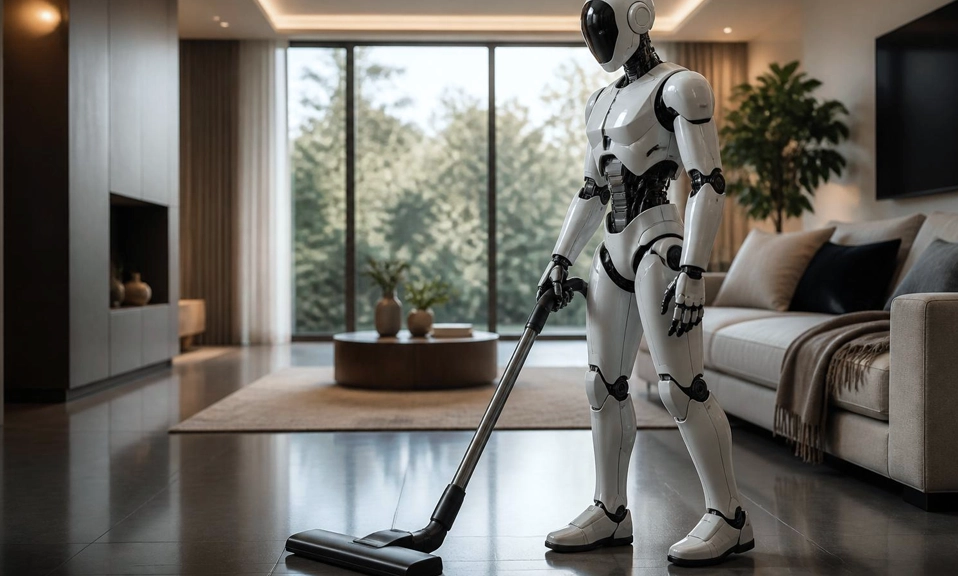
The housekeeper robot has been the great unfulfilled promise of consumer technology for decades—a vision of a machine that would quietly tidy our homes while we got on with our lives. Amazon has spent years chasing that vision, and for most of that time, it has failed. But in 2026, the company is trying again, with a new strategy, a new robot, and a new sense of urgency. The question is whether your next housekeeper really could be a machine—or whether this is another chapter in a long history of ambitious robots that never quite deliver.
Amazon’s first attempt was the Astro, a $1,450 wheeled robot unveiled in 2021. It was pitched as a roving security monitor and Alexa-on-wheels, capable of navigating a home, recognizing faces, and patrolling when you were away. But Astro never escaped beta. It shipped to just **a few thousand invite-only customers**, and the business version was discontinued less than a year after launch. By 2026, Astro’s price had climbed to **$1,599.99**, it remained invite-only, and fans of the device were beginning to believe “the robot’s days are numbered”. Amazon had built a robot that could watch your home. It had not built a robot that could clean it.
The Pivot: From Wheels to Legs
Amazon’s second attempt is fundamentally different. In March 2026, the company acquired Fauna Robotics, a New York startup founded in 2024 by former engineers from Google and Meta, for an undisclosed sum. Fauna’s flagship product is the Sprout, a compact bipedal humanoid that walks on two legs, stands about 1 metre tall, weighs 22–23 kg, and can get up on its own if it falls.
Sprout is not designed to carry heavy loads or scrub floors. It is designed for the “small annoyances of daily life” : picking up scattered toys, fetching items from the pantry, helping with groceries. It has a soft-bodied design without sharp edges, a low centre of gravity for safe mobility, and LED screens and articulated eyebrows that allow it to display emotional responses and perform playful movements like dancing. The pitch is a robot that feels like a friendly presence in a home with children, not a threat.
The price tells you who this is for. Sprout costs $50,000—a figure that places it firmly in research labs and academic institutions, not suburban living rooms. Early customers include Disney, Boston Dynamics, UC San Diego, and New York University. Fauna has also built an open developer platform with a full SDK, allowing buyers to create custom applications and integrate capabilities with Alexa. The 50-person Fauna team has been absorbed into Amazon’s new Personal Robotics Group, which is staffed with much of the original Astro team and an unnamed MIT roboticist.
The Kid-Sized Humanoid: The $999 Bet
Sprout is the flagship, but it is not the only robot in Amazon’s expanded vision. In March 2026, the company also unveiled a kid-sized humanoid robot standing approximately 3 feet tall, designed to be “less intimidating and more approachable” for household use. It features up to 8 hours of battery life, seamless integration with smart home devices, and a starting price of $999—an aggressive entry point that positions it as a mass-market product rather than a research tool.
The kid-sized robot is designed for tasks like assisting with homework, monitoring children’s activities, and performing light chores, powered by generative AI models similar to those behind Alexa. It is a different proposition from Sprout: cheaper, more consumer-facing, and explicitly positioned as a family device. Amazon has reportedly allocated over $500 million in robotics R&D in 2025 alone, and the kid-sized humanoid is the clearest signal that the company intends to build a ladder of home robots across price points.
The Technology: What Makes Sprout Different
The technical shift from Astro to Sprout is significant. Astro was a wheeled tablet on a base—a device that struggled with thresholds, stairs, and complex manipulation. Sprout is bipedal, with legs that allow it to navigate the uneven, cluttered terrain of a real home. Amazon plans to integrate its in-house Olympus large language model into Fauna’s hardware, combining natural language understanding with the spatial adaptability of a humanoid form factor. The goal, as one report put it, is a robot that can “understand instructions, see the environment, and physically execute tasks” —a true home assistant rather than a mobile screen.
Sprout’s soft-bodied design is also a deliberate safety choice. In a home with children or pets, a rigid metal robot is a liability. Fauna’s robot uses flexible electric actuators and a low centre of gravity to reduce the risk of injury during interaction, and its expressive features are designed to make it feel less like a machine and more like a companion.
The Privacy Problem: A Robot That Watches
The elephant in the room—or rather, the robot in the living room—is privacy. A home robot with cameras, microphones, and the ability to navigate every room in your house is a surveillance device by design, whether Amazon intends it to be or not. The privacy invasion required for such a robot to function “goes far beyond your smart speaker listening into your conversations, your automatic pet feeder capturing footage, or your Roomba mapping the inside of your home and sharing it with Amazon”.
The concerns are not hypothetical. In the US, prosecutors have sought data from smart home devices in criminal cases, and Amazon has resisted subpoenas for Echo recordings. Amazon’s attempt to acquire iRobot partially collapsed under regulatory scrutiny and public concern about what a tech giant would do with two decades of home mapping data—data that subsequently ended up being sold to a Chinese company. A humanoid robot that follows family members around the house, recognises faces, and captures continuous video raises the stakes considerably.
Current technological limitations make the privacy question even sharper. Early home robots often rely on teleoperation—human operators remotely controlling the robot through a VR headset when it cannot complete a task on its own. That means a remote employee could, in principle, see inside your home and control the machine in your living room. Amazon has not disclosed whether Sprout or the kid-sized humanoid use teleoperation, but the practice is common in the industry, and it is a red flag for privacy-conscious buyers.
The Competition: A Crowded Field
Amazon is not alone in chasing the home robot dream. The field is crowded, and the competition is formidable.
1X Technologies’ NEO is a bipedal humanoid designed for home use, priced at $20,000—less than half the cost of Sprout. It is backed by OpenAI and has generated significant buzz, though it has also faced criticism for its reliance on remote human operators. LG’s CLOiD, unveiled at CES 2026, features a head, torso, and two arms mounted on a wheeled base—a more conservative design that prioritises stability over agility. Tesla’s Optimus is the highest-profile humanoid programme, but it is focused primarily on factory work, with consumer applications still speculative. And a wave of Chinese manufacturers, including SwitchBot and UBTech, are bringing increasingly capable home robots to market at aggressive price points.
Amazon’s advantage is not hardware. It is the ecosystem. Alexa is already in millions of homes. Amazon’s retail network, logistics infrastructure, and cloud services give it a distribution and integration platform that no standalone robotics startup can match. As one analysis put it, Amazon’s humanoid bet “isn’t about competing with Tesla’s factory robots. It’s about quietly building the operating system for the home”.
A Housekeeper, or a Companion?
So, could your next housekeeper be a machine? The honest answer is: not yet, and not in the way you might imagine.
The robot that will fold your laundry, scrub your floors, and cook your dinner does not exist at a consumer price point. Sprout costs $50,000 and is designed for research labs. The kid-sized humanoid at $999 is an entry point, but its capabilities are modest—homework help, light chores, and family interaction rather than heavy domestic labour. Astro, the closest thing Amazon has to a shipping home robot, is a security monitor on wheels, not a housekeeper.
What Amazon is building is something more incremental: a platform for home robotics, anchored by Alexa and powered by large language models, that will start with simple tasks and gradually expand. The company’s own job listings describe a product capable of navigating “dynamic home environments” and “autonomous operation alongside family members”—a vision of a robot that coexists with humans rather than replaces a cleaner.
The housekeeper robot is coming. But it will arrive in stages, at prices that start high and fall slowly, with capabilities that grow year by year. Amazon’s bet is that the home is the next great frontier of consumer technology, and that the company that builds the platform—the operating system, the ecosystem, the trust—will own the category. Whether that platform is a bipedal humanoid named Sprout or a smaller, cheaper machine that quietly picks up toys and reminds you to buy milk, the machine in your living room is no longer a question of if. It is a question of when, and what it will be allowed to see.