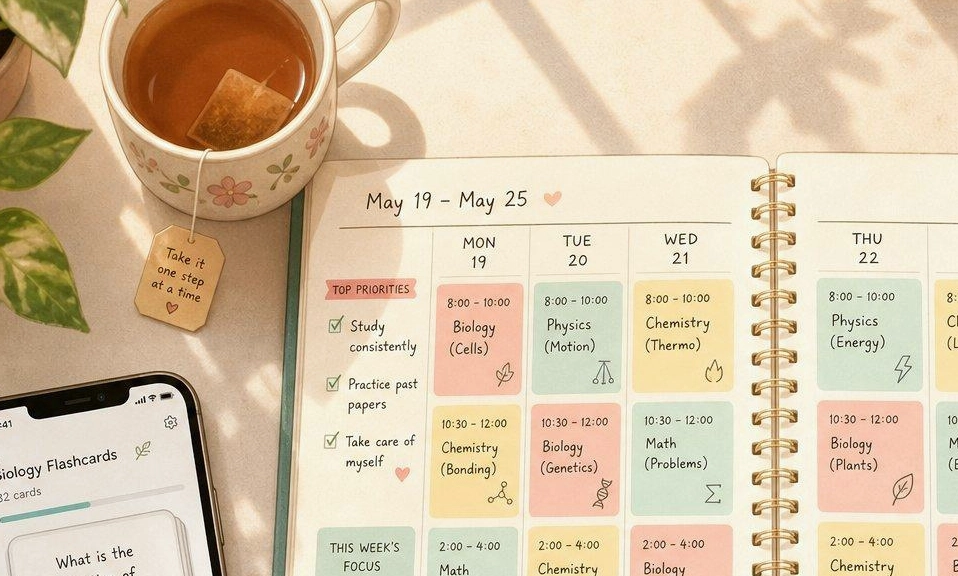
You make a beautiful timetable. Color-coded. Perfect handwriting. You stick it on your wall.
By Wednesday, you have already broken it.
Sound familiar? It is not because you are lazy. It is because most timetables are built wrong. They are built like a wish list, not like a real plan.
A useful study schedule is not a calendar filled with the word “study.” It is a sequence of specific learning tasks spread over time.
To make a study schedule, list your subjects and deadlines, work out how many hours you realistically have each week, then assign specific subjects to specific time slots. Space out your revision so you return to each topic several times, test yourself instead of just rereading, and review the plan weekly so it keeps up with real life.
Here is how to build a timetable you will actually follow, step by step, with templates you can copy today.
Why Most Timetables Fail
Most timetables fail for 3 reasons:
1. They are too vague. “Monday: Study Biology.” What does that mean? Read? Test? Which chapter? Your brain does not know where to start, so you procrastinate.
2. They are too perfect. 6am to 10pm, every hour filled, no breaks, no life. You miss one block, you feel like a failure, you quit the whole timetable.
3. They ignore how memory works. They put “Biology Chapter 5” once, and never again. That is how you forget.
Research summarised by the U.S. Institute of Education Sciences shows that distributing the same study time across multiple shorter sessions can double long-term recall.
Schedule each major subject on three separate days per week instead of one big block.
Spaced practice means revisiting material in multiple sessions separated by time instead of concentrating all repetitions in one sitting.
The perfect timetable is not the prettiest one. It is the one that uses spaced repetition, active recall, and real life.
Step 1: Find Your Real Hours (Not Your Fantasy Hours)
Before you write a single subject, do this math. It takes 5 minutes and it will save your timetable.
1. How many days until your exam?
Example: 28 days.
2. How many hours can you REALLY study per day?
Be honest. Not “I will study 8 hours.” Look at your real life.
- School / work: 7 hours
- Sleep: 8 hours
- Eating, travel, family, rest: 4 hours
- Left: 5 hours
If you have school, 2 to 3 focused hours on weekdays is realistic. On weekends, 4 to 5 hours is realistic. That is 20 to 25 hours per week. That is plenty, if you use them right.
3. How much do you have to learn?
To make a study timetable that works, plan by pages and study rate, not by subject per day.
Count your total pages, chapters, or topics.
Example:
- Biology: 10 chapters
- Math: 8 chapters
- English: 5 chapters
- History: 6 chapters
Total: 29 chapters in 28 days. That is about 1 chapter per day, plus review time.
4. Find your study rate.
Time one real study session.
If it takes you 45 minutes to learn 1 chapter properly, with active recall, then 29 chapters = 29 x 45 minutes = 22 hours of learning time. Plus review time = about 30 hours total. That fits in 28 days.
If it takes you 90 minutes per chapter, you need 43 hours. You need to start earlier, or cut something. That is why this step matters. It stops you from lying to yourself.
Step 2: List Your Subjects By Priority, Not By Liking
Most students study what they like first. Smart students study what matters most first.
Make a table:
Subject | Exam Date | Difficulty (1-5) | Weak Topics | Hours Needed |
|---|---|---|---|---|
Math | May 20 | 5 – Hardest | Trigonometry, Calculus | 10 hours |
Biology | May 18 | 4 | Genetics, Respiration | 8 hours |
History | May 22 | 3 | WWII, Cold War | 6 hours |
English | May 25 | 2 | Essay structure | 4 hours |
Rule: Hardest subject gets your best energy time, not your leftover time. If you are a morning person, Math goes in the morning. If you are a night owl, Math goes at night when you are most awake.
Match hard subjects to high-energy hours.
Medium energy → structured work. Homework, note organization, flashcard reviews, spaced-repetition sessions.
Step 3: Build The Backbone – Spaced Repetition
This is the single most powerful study technique backed by cognitive science, and most students ignore it completely.
Instead of cramming Chapter 5 for three hours the night before the exam, study it in shorter sessions spread across multiple days:
- Day 1: Learn the material (30 minutes)
- Day 3: Review it briefly (15 minutes)
Use a simple 1-3-7 method: revise a topic once on the same day, again after three days, and again after a week.
Do not revise a topic once and move on. Come back to it after a day or two, then after about a week, and again before the exam. This spaced repetition is one of the most effective ways to make knowledge stick.
Cognitive science proves that long-term retention relies on two evidence-based principles: Spaced Repetition (distributing study sessions across multiple days or weeks) and Interleaved Practice (switching between different subjects or problem types rather than blocking a single topic for days).
How to put this in your timetable:
Never write “Biology Chapter 5” once. Write it 3 times:
- Monday: Biology Ch 5 – LEARN
- Wednesday: Biology Ch 5 – RECALL QUIZ (15 min)
- Next Monday: Biology Ch 5 – RECALL QUIZ (15 min)
Short reviews: 20–30 minutes for spaced repetition.
That is how you remember for the exam, not just for tomorrow.
Step 4: Replace “Study” With A Specific Task
This is the secret that makes timetables actually work.
Block time, don’t list tasks.
Bad timetable:
- 4pm: Study Biology
Good timetable:
- 4pm – 4:50pm: Biology Ch 5 – Read, then close book and write 10 recall questions, then do 5 past paper questions
UC San Diego’s guidance on effective studying recommends distributing exam preparation over multiple sessions and starting weeks ahead when possible.
An effective timetable is built around your school assessment calendar, protects time for rest, and uses short, focused study blocks with active revision – practice questions, past papers and self-testing – rather than passive re-reading.
Every block should say WHAT you will do, not just WHAT subject.
Use this formula for every block:
[Subject] + [Topic] + [Method]
Examples:
- Math + Trigonometry + 10 practice questions, timed
- Biology + Genetics + Feynman explain to AI, then flashcards
- History + WWII + Write 1 essay plan from memory
If you cannot write the method, you do not have a plan. You have a wish.
Step 5: Use 50-Minute Blocks, Not Marathons
Divide your study time into sessions of 30 to 50 minutes with short breaks, for example with the Pomodoro technique.
Work in Pomodoro sprints, not marathons. Each study block should run on Pomodoro sprints — 25 minutes of deep work, 5-minute break, repeat — rather than a solid hour of unfocused work.
The Perfect Block:
- 50 minutes: One task, phone in another room, no music with lyrics
- 10 minutes: Stand up, water, stretch, look out window. No phone scrolling.
- Repeat max 3 times, then take a 30-minute break.
3 focused blocks beat 6 hours of distracted studying.
Never study more than 3 blocks in a row without a long break. Your brain stops learning after that. You are just staring at pages.
Step 6: Build In Buffer Days And Rest
This is what separates timetables that survive real life from timetables that die on Wednesday.
Build one ‘Buffer Half-Day’ per week.
A buffer day is not a day off. It is a catch-up day. If you missed Tuesday because you were sick, or you were slow on Math, you use Saturday morning to catch up. If you did not miss anything, you use it for extra spaced review or for rest.
Also, protect these:
- Sleep: 7 to 9 hours. No timetable that cuts sleep will work.
- One full rest evening per week: No study. See friends, watch a movie, rest. Your brain consolidates memory when you rest.
- Exercise: 20 minutes walk counts. It is not wasted time. It makes the next block better.
Start simply: divide the day into morning, afternoon, evening blocks plus a weekly planning slot.
If your timetable has no white space, it is not a timetable. It is a fantasy.
Step 7: The Weekly Review – 15 Minutes That Saves Your Timetable
Every Sunday evening, do a 15-minute review. This is non-negotiable.
Ask 3 questions:
- What did I actually complete this week? (Not what I planned, what I DID)
- What did I miss, and why? (Was it too hard? Too much? No energy?)
- What is the ONE adjustment for next week?
Then rewrite next week’s timetable based on reality, not hope.
If you missed Math twice, do not just copy the same timetable. Move Math to your high-energy time. Cut 30 minutes from English. Add a buffer block.
A timetable is a living document, not a prison.
The Perfect Timetable Templates – Copy These
Template 1: School Student, 4 Weeks Before Exams
Weekday (School Day):
- 7:00 – 8:00: Morning routine, breakfast, review flashcards for 15 min
- 8:00 – 3:00: School
- 4:00 – 4:50: Block 1 – Hardest subject, Active Recall, Past Questions
- 5:00 – 5:50: Block 2 – Second subject, Spaced Review (15 min) + New Topic (35 min)
- 6:00 – 7:00: Dinner, rest, family
- 7:00 – 7:50: Block 3 – Light subject, Flashcards, Feynman
- 8:00 – 9:00: Free time
- 9:30: Sleep, no phone 30 min before bed
Weekend:
- 9:00 – 9:50: Block 1 – Hardest subject, Timed Past Paper
- 10:00 – 10:50: Block 2 – Spaced Review of Week’s Topics
- 11:00 – 12:00: Break, exercise
- 12:00 – 12:50: Block 3 – Second subject, Mistake Log Review
- Afternoon: FREE, rest, social
- 5:00 – 5:50: Block 4 – Light review, Plan Next Week
Total: 15 hours weekday + 5 hours weekend = 20 hours per week. That is enough to ace most exams.
Template 2: 1 Week Before Exams – The Crunch Week
This week is different. No new learning. Only review, recall, and past papers.
Every Day:
- Morning Block: Timed past paper for Subject 1
- Afternoon Block: Mark it, log mistakes, re-learn only the mistakes
- Evening Block: Spaced recall flashcards for Subject 2, 30 min + 1 essay plan from memory
Aim to get through all your work at least once before the first exam begins.
Do not learn new chapters in the last week. It will panic you. Trust your spaced repetition.
Template 3: The 1-3-7 Tracker
Use this for every topic:
Topic | Learn Day 0 | Review Day 1 | Review Day 3 | Review Day 7 | Exam Ready? |
|---|---|---|---|---|---|
Biology Ch 5 | Mon | Tue (15m) | Thu (15m) | Next Mon (15m) | Yes |
Math Trig | Tue | Wed (15m) | Fri (15m) | Next Tue (15m) | No, need more |
There is no single perfect schedule. The research supports the principle of growing gaps, not a magic set of days. A simple, practical pattern is: Learn on Day 0, Study the topic and make question cards or a question list, then review with growing gaps.
Spaced repetition means reviewing the same material several times with growing gaps between sessions, instead of cramming it all in one sitting.
5 Mistakes That Kill Timetables
1. Making it too detailed. If your timetable has 15 colors and 30 rules, you will spend more time making it than studying. Keep it simple: Subject + Topic + Method + Time.
2. Studying the same subject all day. That is blocking, not interleaving. Your brain gets bored and stops learning. Mix 2 subjects per day minimum.
3. No active recall. If your timetable says “Read Chapter 5,” you will forget Chapter 5. Change it to “Recall Chapter 5 from memory, then check.”
4. Copying someone else’s timetable. Your friend is a morning person. You are a night owl. Your timetable must match YOUR energy, YOUR school, YOUR subjects.
5. Not having a Plan B. What if you get sick? What if school gives extra homework? If your timetable has no buffer, one bad day kills the whole week. Always have a buffer half-day.
How To Start Today – In 20 Minutes
Do not wait until Monday. Do it now.
Minute 1-5: Write your exam dates and subjects. Count days left.
Minute 5-10: Count your real hours per day. Be honest.
Minute 10-15: List your weak topics for each subject. Those go first.
Minute 15-20: Fill in tomorrow only. Just tomorrow. 2 blocks. Subject + Topic + Method. That is it.
Tomorrow, do those 2 blocks. On Sunday, plan the full week.
A perfect timetable is not made in one day. It is built, tested, and fixed every week.