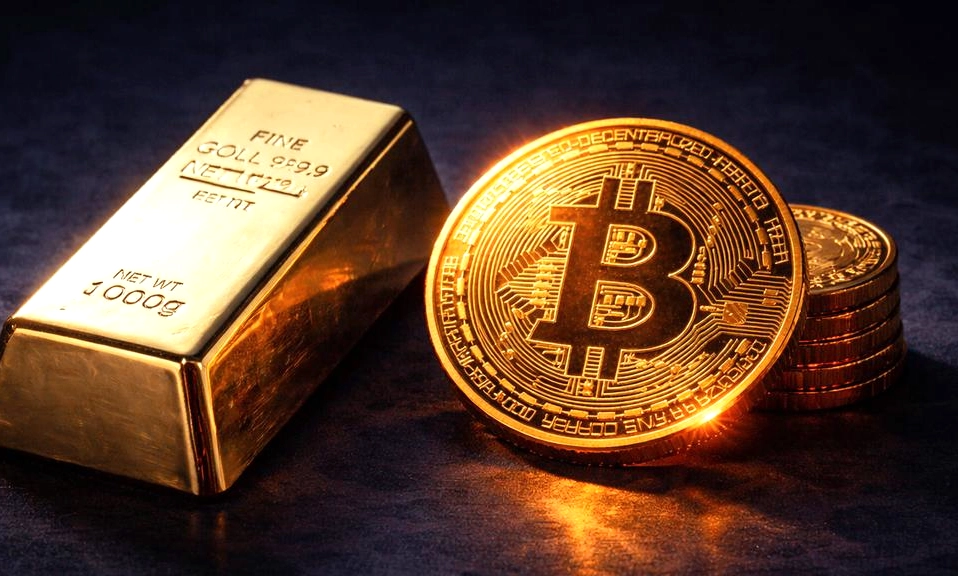
The debate between cryptocurrency and gold as a store of value has often been framed as a binary choice: the ancient, tangible anchor versus the digital, decentralized upstart. But 2026 has shattered that simple narrative. This year has delivered a masterclass in the fundamental differences between the two, revealing that they don’t compete for the same job—they serve entirely different purposes in a portfolio.
The year began with a dramatic divergence. Gold surged to an all-time high above $5,500 per ounce** in January, while Bitcoin, having peaked at **$126,000 in late 2025, pulled back sharply, trading in the $65,000 to $72,000 range by early 2026. This wasn’t a random fluctuation; it was a “Great Decoupling,” a realization that institutional capital treats these two assets as fundamentally different instruments.
Here is a breakdown of how they compare in 2026, and which one might be the better store of value for you.
📊 The Core Difference: A Fear Asset vs. A Liquidity Asset
The most important takeaway from 2026 is that gold and Bitcoin react to entirely different monetary triggers.
Gold is the “Bunker” Asset. It functions as a geopolitical shock absorber and a hedge against immediate confidence loss. When the Strait of Hormuz was blocked in February 2026, sparking an energy shock, institutions reflexively rotated into gold. It is the asset you want when the world feels like it is falling apart.
Bitcoin is the “Liquidity Sponge.” Despite the “digital gold” narrative, Bitcoin has struggled to act as a short-term safe haven. During market panics, it often falls alongside tech stocks. Its correlation with the Nasdaq and S&P 500 spiked to between 0.55 and 0.75 during early 2026 stress events, while its correlation with gold plummeted to a historic low of -0.9 in March. Bitcoin thrives on cheap money and high risk appetite; it is a long-duration hedge against the slow, mathematical debasement of fiat currency, not a shield against immediate crisis.
📈 Performance and Volatility: The Tortoise and the Hare
The performance metrics tell a story of stark contrasts.
| Feature | Gold | Bitcoin |
|---|---|---|
| 2026 Performance | Up roughly 7-18% YTD by early 2026 | Down roughly 13-14% for the year |
| Historical Volatility | 15-20% annualized | 59-80%+ annualized in active years |
| Market Capitalization | $16 trillion (May 2026) | $1.9 trillion (May 2026) |
| Supply Growth | ~1.5-2% per year from mining | <1% per year since the 2024 halving, trending to absolute scarcity |
The volatility gap is crucial. A position in Bitcoin carries several times the risk exposure of an identically sized position in gold. However, 2026 also showed that this gap can narrow. Gold’s own volatility spiked to 47% in February after its rapid ascent, highlighting that no asset is immune to turbulence.
🏛️ The Institutional Landscape: Central Banks vs. ETFs
The type of institutional money flowing into each asset is a defining feature of 2026.
Gold’s bedrock is sovereign demand. Central banks bought over 1,000 tonnes annually since 2022, and purchases accelerated to 321 tonnes in Q3 2026 alone—a 42% year-over-year increase. This is a structural shift by reserve managers diversifying away from US dollar assets.
Bitcoin’s growth engine is Wall Street. US spot Bitcoin ETFs, which launched in January 2024, now hold over $105 billion in assets. Corporate treasuries have also become a major force, with over 180 listed companies holding a combined ~1.1 million BTC. Companies like Strategy (formerly MicroStrategy) now hold 846,000 BTC, representing about 4% of the total supply.
⚖️ The Verdict: Do You Need One, the Other, or Both?
The honest answer is that the “either/or” framing misses the point. Gold and Bitcoin are not competing for the same job.
Choose gold if your priority is capital preservation. It is the proven, low-volatility anchor. Its 5,000-year track record, deep regulated market, and status as a crisis asset make it the reliable choice for protecting wealth against immediate geopolitical and economic shocks. The trade-off is a lower ceiling on returns.
Choose Bitcoin if you are seeking asymmetric upside and can stomach the volatility. Its fixed supply of 21 million coins, portability, and potential to capture even a fraction of gold’s $16 trillion market value present a compelling long-term growth story. The trade-off is a history of 75-85% drawdowns and a much shorter track record.
Most sophisticated investors are choosing both. A “macro barbell” strategy—holding physical gold for absolute security while accumulating Bitcoin for exponential upside—is becoming a common approach. The two assets have a historically low correlation (averaging 0.1 since 2014), making them complementary diversifiers rather than substitutes.
💎 In 2026, the debate between
cryptocurrency and gold as a store of value is no longer about picking a winner. It is about understanding their distinct roles. Gold is the asset that protects you when the world is on fire. Bitcoin is the asset that rewards you if you can weather the fire and wait for the recovery. The “digital gold” thesis has not been proven wrong; it has been refined. Bitcoin is not a safe haven in a crisis, but it remains a powerful instrument for long-term wealth creation. The most resilient portfolios of the future will likely hold both, not because they are the same, but precisely because they are different.