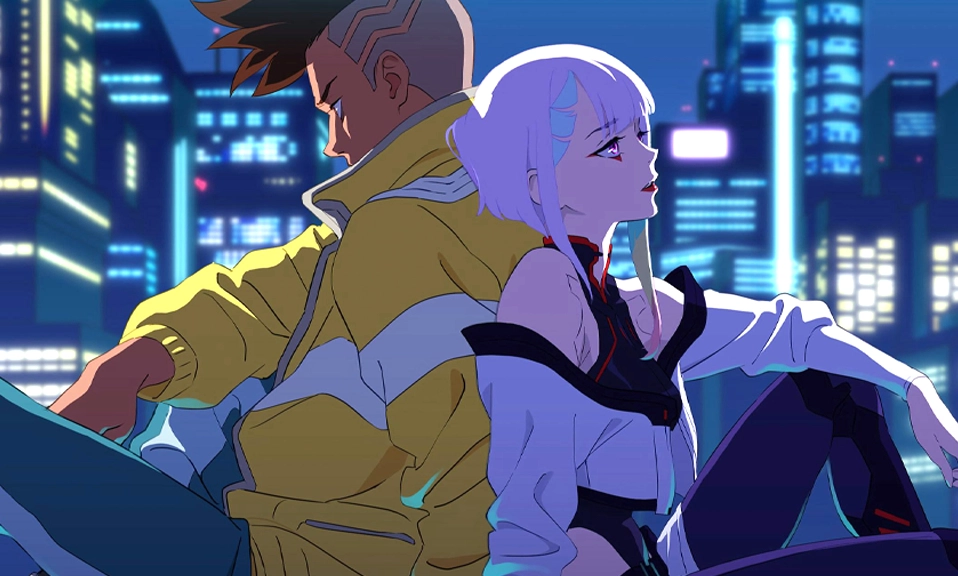
Four years ago, Cyberpunk: Edgerunners broke hearts and set a new benchmark for video game anime. Now, Studio Trigger and CD Projekt Red are back in Night City with an entirely new crew, a radically different structure, and a question hanging over every frame: can lightning strike twice?
Cyberpunk: Edgerunners 2 premiered on October 20, 2026, exclusively on Netflix, with all 10 episodes available at once. It is a standalone sequel — a new story with new characters, set in the same unforgiving world. And according to the first wave of reviews, the answer to that question is more complicated than a simple yes or no.
What’s New in Night City?
The original Edgerunners was a tight, tragic romance between David Martinez and Lucy — a story that hurt precisely because it was so intimate. Season 2 deliberately refuses to repeat that formula.
Instead, it’s an ensemble story orbiting four interconnected protagonists:
Weak Kingsley (Clancy Brown), a washed-up edgerunner who survives going cyberpsycho and has all his chrome stripped away. He’s a legend reduced to a shell, searching for purpose in a world that has moved on.
D (Nazeeh Tarsha), a nomad netrunner on a revenge mission after the massacre of his tribe — a path that pulls him into corporate secrets he was never meant to find.
Talia (Kimoy Lee), a gravely ill teenager who has replaced nearly every part of her body with cyberware, becoming more machine than human.
Roman Carax (Valeria Rodriguez), a 12-year-old aspiring filmmaker who clings to analog cameras and believes braindances have stripped the soul out of storytelling.
The showrunner is Bartosz Sztybor, returning from the first season, with Kai Ikarashi directing and Kanno Ichigo handling character design. Studio Trigger is once again producing alongside CD Projekt Red.
The Reviews: A Worthy Follow-Up, But Not a Replacement
The critical response has been largely positive, with a clear caveat: Season 2 is excellent television, but it does not — and perhaps cannot — replicate the seismic emotional impact of the original.
GamesRadar+ put it plainly: Edgerunners 2 is “another nova Night City story,” with “retina-melting animation” and “major implications for the world of Cyberpunk.” But it also noted that “nothing here can quite top the impact of David’s tragic arc in season 1”.
IGN agreed. Its verdict: the sequel “doesn’t feel as monumental as its predecessor, but it still delivers a spectacular season of television”.
Gizmodo was more critical, arguing that the new season struggles to “outrun the long shadow cast by David Martinez” — though it praised the animation as “absolutely stunning” and “rougher, rawer, and unruly”.
But not everyone sees it that way.
Mashable declared that Edgerunners 2 is “even better than its heartbreaking predecessor” — “darker, more tender, and unexpectedly hopeful”. The review argues that the measure of a great Cyberpunk story isn’t how thoroughly it breaks your heart, and that Season 2 finds its emotional power somewhere else: in the relationships between its ensemble, rather than the doom of a single romance.
Polygon went further, calling it “downright better” than the first season. It praised the “extraordinary ensemble” and the “warmer, more hopeful heart” at its centre, arguing that the original’s focus on David and Lucy left little room to invest in the supporting cast, while the sequel gives its characters space to develop relationships worth caring about.
What’s Different — and Why It Matters
The biggest structural change is the shift from a single-protagonist tragedy to an interconnected ensemble drama. Season 1 followed David’s descent; Season 2 weaves together four separate threads that slowly converge.
This is a deliberate choice, and it’s the source of both the show’s strengths and its weaknesses.
The strengths: The ensemble allows for a wider range of tones and themes. Talia’s storyline — a teenager who has maxed out her cyberware capacity and is now more machine than human — is described as “deeply somber and sad”. Weak’s redemption arc, tied to his connection with Talia’s mother, offers “a rare glimmer of hope and decency in a cruel world”. And the show’s thematic focus shifts from class warfare to corporate manipulation — corporations “purposely messing with people’s lives for their own gain”.
The weaknesses: The sprawling structure means the big picture takes time to become clear, and the many storylines can feel “convoluted and sprawling at first”. Some characters — particularly Roman — are described as more of a “storytelling device” than a fully realised protagonist. And the show lacks the “propulsion and greater intimacy” that came from following a single character across ten episodes.
Does It Live Up to the Original?
Yes — but not in the same way.
If you’re looking for another David and Lucy, you won’t find them here. Season 2 is not a rehash of the doomed romance that made the first season a phenomenon. It’s a different kind of story: an ensemble drama about family, obsession, legacy, and the stories we tell about ourselves.
And that’s exactly why it works. As Mashable put it, the measure of a great Cyberpunk story isn’t how thoroughly it breaks your heart. Season 1 broke hearts. Season 2 asks a different question: what happens after the heartbreak? What keeps people going in a world that has already taken everything from them?
The animation is, by all accounts, stunning — a 1990s cinema homage filtered through Studio Trigger’s signature style, with camcorder footage, lens distortion, and abstract art woven into the visual language. The voice cast is strong. And the world-building deepens the Cyberpunk 2077 universe in ways that will reward longtime fans.
It doesn’t top the original. But it doesn’t need to. It’s a worthy successor to one of the best anime of the decade — and a reminder that Night City still has stories worth telling.
All 10 episodes of Cyberpunk: Edgerunners 2 are streaming now on Netflix.