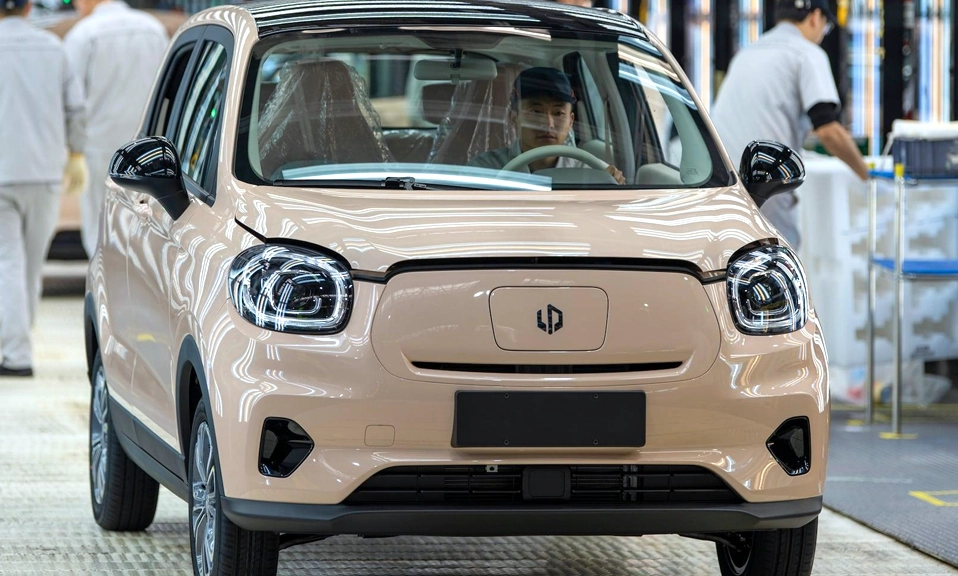
Europe’s affordable EV market is about to get a lot more crowded. Stellantis and China’s Leapmotor are deepening their partnership in a move that could reshape the continent’s electric car landscape — and it’s happening faster than anyone predicted.
The two companies announced in May 2026 that they were taking their strategic partnership “to the next level,” and by October, the first fruits of that deal were already rolling off the line. Production of Leapmotor’s B10 SUV has officially started at Stellantis’ Zaragoza plant in Spain, marking a major milestone in the joint venture’s localization strategy .
Here’s what’s happening, why it matters, and what it means for European car buyers.
The Partnership: A 51/49 Joint Venture
To understand how we got here, you need to go back to October 2023. Stellantis — the Franco-Italian-American giant behind Peugeot, Citroën, Opel, Fiat, and Jeep — acquired approximately 21% of Leapmotor, becoming the Chinese company’s largest single shareholder. At the same time, the two formed Leapmotor International (LPMI) , a joint venture in which Stellantis holds 51% and Leapmotor holds 49% .
LPMI holds the exclusive rights to sell and manufacture Leapmotor products outside Greater China . Since launching the T03 city car and C10 SUV in 2024, LPMI has expanded to more than 850 sales and service points across Europe, with over 40,000 shipments in 2025 .
The results have been staggering. In March 2026, Leapmotor registrations in Europe exceeded 11,000 units — a 754% increase compared to March 2025 . By May, that growth rate had climbed to 447.3% year-on-year . Leapmotor is now outselling established European brands in several markets.
What’s Being Built: The B10, the Opel C-SUV, and More
The expanded partnership centers on three key initiatives.
The Leapmotor B10: Production Starts in Spain
The B10 is a compact all-electric SUV that has already become Leapmotor’s second-best-selling model in Europe, with 16,664 units sold to date . Production officially commenced at Stellantis’ Zaragoza plant in October 2026 .
This is a big deal. Building the B10 in Spain allows Leapmotor to bypass EU tariffs on Chinese-built EVs, which range from 7.8% to 35.3% on top of the standard 10% import duty. It also means the B10 qualifies for European subsidies that require local manufacturing — including France’s “made in Europe” bonus, which excludes Chinese-built vehicles.
The Opel C-SUV: A Jointly Developed EV for Europe
In addition to the B10, Stellantis and Leapmotor are developing an all-new electric Opel C-SUV that will also be built at Zaragoza. The model is expected to start production in 2028, alongside the current Peugeot 208 and Lancia Ypsilon .
Crucially, the Opel C-SUV will use LPMI-sourced components — essentially, Chinese EV technology integrated into a European brand. Stellantis says this will “significantly enhance affordability for European customers” .
The Madrid Plant: Future Leapmotor Models
Stellantis’ Villaverde plant in Madrid will also benefit. The facility, which employs about 1,500 people, was due to stop manufacturing the Citroën C4. Under the new agreement, it will be allocated future Leapmotor products for European and global markets, with a new vehicle expected in the first half of 2028 .
Stellantis intends to transfer ownership of the Madrid plant to LPMI’s Spanish subsidiary, allowing it to qualify for the EU’s upcoming “Made-in-Europe” requirements. Vehicles produced there will be sold across the EMEA region .
The Strategy: Chinese Tech, European Factories
The partnership is a textbook example of a trend that’s reshaping the global auto industry: Chinese EV technology, European manufacturing.
Stellantis CEO Antonio Filosa described the deal as “a genuine benefit for both parties,” saying it would “support production and drive progress in localising the manufacture of world-class electric vehicles in Europe, at affordable prices and to meet customers’ real needs” .
Leapmotor’s founder and CEO, Zhu Jiangming, called it “a unique and powerful partnership,” noting that LPMI had “quickly demonstrated its benefits for both partners” by launching the brand on all five continents in less than three years .
The logic is simple. Leapmotor brings low-cost EV technology and China’s highly efficient supply chain. Stellantis brings European factories, an established dealer network, and the ability to navigate EU regulations. Together, they can build EVs that are genuinely affordable — something most European automakers have struggled to do.
Danilo Annese, CEO of Leapmotor International, said the joint venture sees a potential EU-China deal to cap hybrid imports as an “interesting alternative to tariffs,” and confirmed LPMI would comply with any agreement reached . He also noted that EV demand in Europe is gaining more traction than expected a year ago, particularly in countries like Italy and Spain where EV penetration has traditionally been lower .
What It Means for European Car Buyers
The most immediate impact is price.
Leapmotor’s European lineup is already among the most affordable on the market. The T03 city car starts at €15,900 in Italy . The B10 is positioned as a “relatively low-cost all-electric car” . And the upcoming Opel C-SUV, which will share Leapmotor technology, is expected to be significantly cheaper than comparable European EVs.
Stellantis is also planning a compact electric vehicle for Italy, to be produced from 2028 at the Pomigliano plant, targeting the €20,000 range . That would make it one of the cheapest EVs on the European market — and a direct competitor to the likes of the Citroën ë-C3 and the upcoming Renault Twingo.
The broader strategy is to use LPMI’s joint purchasing power to drive down costs across Stellantis’ mass-market brands — Fiat, Opel, and Peugeot included. By tapping into China’s new-energy vehicle ecosystem while using European supply chain capabilities, Stellantis hopes to “boost price competitiveness” and “accelerate time-to-market for new models” .
The New Models: B03 and D19
At the 2026 Paris Motor Show, Leapmotor unveiled two new models that expand its European lineup.
The B03 is an urban hatchback built on Leapmotor’s Compact Electric Platform. It delivers up to 390 km of WLTP range and supports 2.5C fast charging, allowing a 10-to-80% recharge in just 21 minutes. Inside, it features a 14.6-inch floating touchscreen, wireless Apple CarPlay and Android Auto, and heated seats — features rarely found in the B-segment .
The D19 is a flagship SUV that showcases “the next evolution of Leapmotor technology,” combining “flagship luxury vision with state-of-the-art intelligent features” .
Both models signal that Leapmotor isn’t just competing on price. It’s competing on technology, too.
The Bigger Picture: Europe’s EV Market Is Changing
The Stellantis-Leapmotor partnership is part of a broader shift in the European auto market. Chinese brands now hold more than 10% of Western European car sales and over 15% of the BEV market. BYD, Geely, and others are building factories, forming joint ventures, and integrating into the European industrial ecosystem.
For Stellantis, the partnership is a lifeline. The company’s Zaragoza plant’s annual output fell from roughly 470,000 vehicles in 2019 to 304,000 in 2023 . The Madrid plant was facing closure. By allocating Leapmotor production to these facilities, Stellantis is securing jobs, filling capacity, and positioning itself for an electric future it couldn’t afford to build alone.
For Leapmotor, it’s a shortcut to European credibility. The company gets access to Stellantis’ factories, dealers, and regulatory expertise — without having to build its own infrastructure from scratch.
And for European consumers, it means more choice, lower prices, and faster access to the kind of affordable EVs that have been slow to arrive from legacy manufacturers.
Stellantis and Leapmotor
are proving that the future of European EVs might not be purely European. By combining Chinese technology with Spanish factories, they’re building cars that are affordable, locally made, and eligible for subsidies — a combination that few competitors can match.
The B10 is already rolling off the line in Zaragoza. The Opel C-SUV is coming in 2028. And the Madrid plant has a new lease on life.
Europe’s next wave of affordable electric cars isn’t coming from Germany or France. It’s coming from China, built in Spain.