Android 17’s Bubbles feature is the multitasking upgrade you didn’t know you needed. It lets you turn any app into a floating, moveable window—and stack up to five of them at once. Here’s how to run multiple apps simultaneously without ever touching the Recents screen.
For years, Android multitasking has been a compromise. Split-screen mode felt cramped on a phone. App-switching meant losing your place. And floating windows were a feature reserved for Samsung’s One UI or third-party apps. Android 17 changes that with Bubbles—a universal, built-in system that turns any app into a floating bubble you can access from anywhere [citation:0][citation:4].
What Are Android 17 Bubbles?
Bubbles are floating app windows that overlay whatever is currently on your screen. They’re not limited to messaging apps anymore—any app can be turned into a bubble [citation:7]. You can have up to five bubbles active at once, grouped together in a stack that you can tap to expand and switch between [citation:1][citation:5].
The feature rolled out to all Pixel devices running Android 17 as part of the June 2026 Pixel Drop, and it’s now part of the stable Android 17 release [citation:5][citation:8].
How to Create a Bubble (The Basic Method)
Creating a bubble takes two seconds. Here’s the universal method that works on any Android 17 device:
Find the app you want to bubble—either on your home screen or in the app drawer.
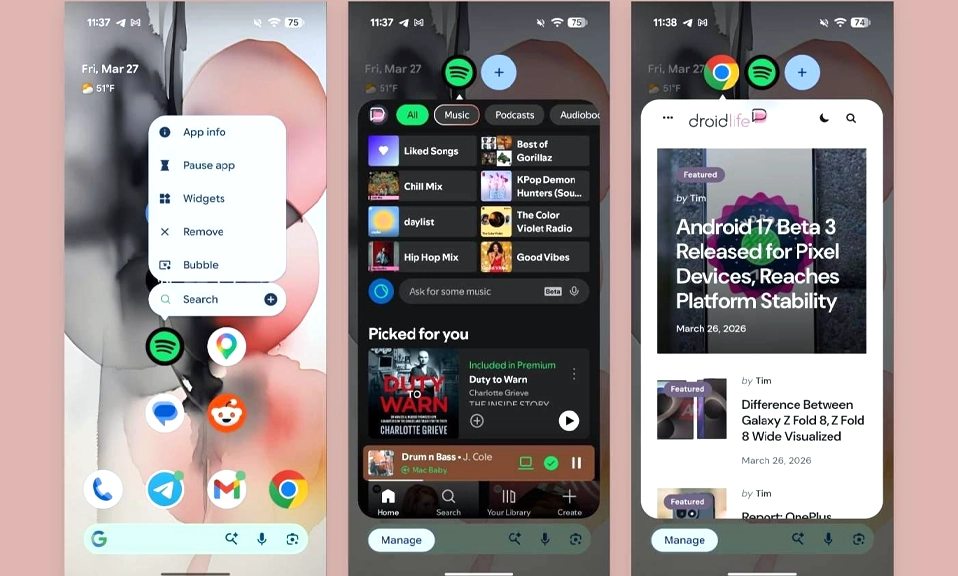
Long-press the app icon until a context menu appears.
Tap “Bubble” from the menu [citation:1][citation:2][citation:3].
The app will immediately launch in a floating, resizable window. You can drag it around the screen, resize it by pulling the corner, and tap outside the window to collapse it back into a small floating bubble [citation:5].
How to Stack Multiple Apps in a Bubble Group
This is where Bubbles becomes genuinely powerful. You don’t have to create each bubble separately every time. Android groups your bubbles into a stack that you can manage as a single unit.
To add more apps to your group:
Repeat the long-press-and-tap-Bubble process for each app you want to add.
The system will automatically group them into a bubble stack [citation:8].
If the automatic grouping doesn’t happen, tap the plus (+) icon in the bubble panel at the top of the screen and manually select apps from your recent bubbles [citation:1][citation:3].
The five-app limit:
You can have a maximum of five bubbles in your stack at any time. If you try to add a sixth, it will replace one of the existing bubbles [citation:8]. Choose your five wisely—these are your most-used apps for the session.
Switching between bubbles:
Tap the bubble stack to reveal all your active bubbles, then tap any bubble to bring that app to the foreground [citation:0][citation:5]. It’s faster than swiping through the Recents screen, and it doesn’t interrupt whatever you’re doing in your main app.
How to Use Bubbles for Real Multitasking
The true value of Bubbles isn’t in opening one floating window. It’s in the workflow it enables. Here are three scenarios where Bubbles genuinely shines:
The Research Workflow
You’re watching a YouTube video and need to fact-check a claim. Bubble YouTube, then bubble Chrome for search, and bubble Keep for notes [citation:4]. You can pause the video, search the web, jot down a note, and return to the video—all without losing your place or switching apps.
The Invoice Session
You’re sending invoices and need to cross-reference three Google Sheets, a Google Doc, and the Calculator app. Bubble all five. You can switch between them with a tap, without closing one sheet to open another [citation:4]. This is exactly the kind of repetitive, multi-app task where Bubbles saves real time.
The Messaging Overlay
You’re gaming or watching a livestream and need to reply to a text. Bubble your messaging app. It floats over the game. You reply, tap outside the window, and you’re back in the game without ever leaving it [citation:5][citation:7].
Tips and Tricks for Power Users
Bubbles remember your apps. Android keeps track of which apps you’ve used in Bubbles before. When you tap the plus icon to add a new bubble, your recent bubbles appear at the top for one-tap access—no need to long-press through the app drawer every time [citation:4].
On foldables, bubbles get a dedicated bar. If you’re using a device like the Pixel 10 Pro Fold, bubbles appear in a dedicated bubble bar at the bottom of the screen instead of a floating stack. This makes it easier to switch between apps, resize them, or maximize them for a fuller multitasking experience [citation:5][citation:6]. The experience is noticeably better on a larger screen.
Bubbles are ideal for media controls. Bubble your music app or podcast player. You can skip tracks, adjust volume, and check what’s playing without leaving your current app [citation:5].
Don’t overdo it. Five bubbles on a 6-inch phone screen can feel cluttered. Use the stack intentionally—keep your most essential apps in the group and dismiss the rest. On a regular phone, Bubbles work best as a two-to-three app workflow, not a five-app pile-up.
Bubbles aren’t a replacement for split-screen. Split-screen is still better when you need two apps side-by-side at full height. Bubbles are for quick access and overlay workflows—when you need to glance at something, reply to a message, or cross-reference information without leaving your main task [citation:4].
A Multitasking Feature That Actually Feels Right
Android 17’s Bubbles aren’t a gimmick. They’re a genuinely useful addition to the way you use your phone. The setup is trivial—long-press, tap Bubble, repeat—and the payoff is a workflow that doesn’t force you to choose between apps.
The five-app limit is a constraint, but it’s a sensible one. It forces you to be intentional about which apps deserve a permanent floating spot. And the automatic grouping and memory mean that once you’ve set up your bubble stack, it’s always one tap away.
If you’ve ever wished you could check a message without leaving a game, cross-reference a document without closing a spreadsheet, or fact-check a video without losing your place, Bubbles is the answer. It’s the multitasking upgrade Android has needed for years—and it’s finally here.