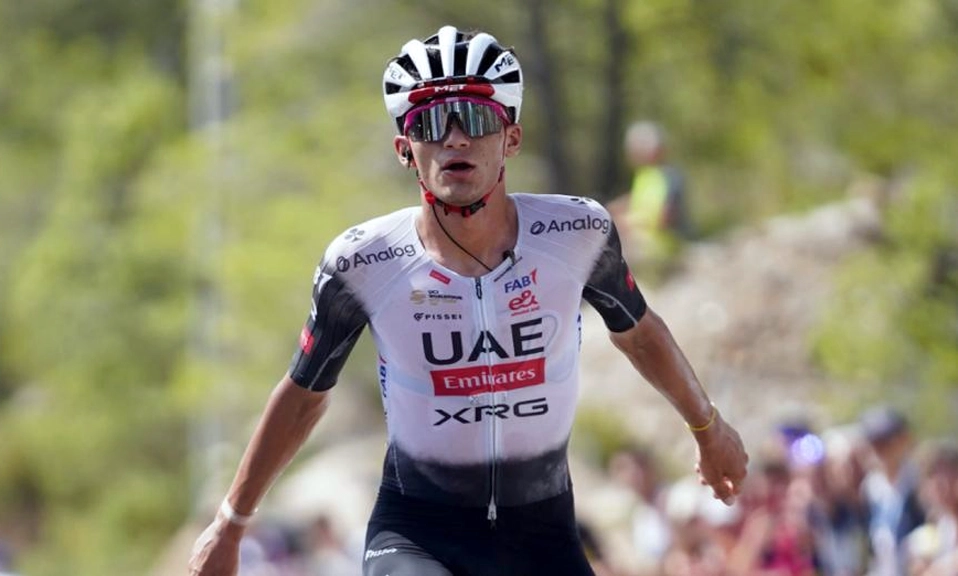
In the history of the Tour de France, 121 editions have produced champions from France, Belgium, Italy, Spain, Luxembourg, Switzerland, the Netherlands, the United States, Denmark, Germany, Ireland, Australia, and Slovenia. Not once has a Mexican rider worn the final yellow jersey in Paris. Isaac del Toro wants to be the first.
It is not an idle dream. At 23, the Ensenada-born climber has already established himself as one of the most complete young stage racers in the world—a rider with the climbing legs to survive the Alps, the time-trialling ability to limit his losses against the clock, and the kind of fearless, attacking instincts that the Tour de France rewards. In 2026, he finished on the podium of a Grand Tour for the first time. In 2027, he intends to target the biggest prize of all.
The question is not whether Del Toro believes he can win the Tour. It is whether Mexico—a country with a rich cycling culture but a thin history in the sport’s biggest race—can produce a champion, and what it would take for him to get there.
The Dream: A Mexican Maillot Jaune
Del Toro has never hidden his ambition. In interviews, he speaks about the Tour de France with the reverence of a rider who grew up watching it on television in Baja California, dreaming of the Champs-Élysées. “For me, the Tour de France is the biggest race in the world,” he said. “Every cyclist dreams of it. I want to be the first Mexican to win it.”
The dream is not merely personal. It is national. Mexico has a long and proud cycling tradition—the Vuelta a México, the country’s passionate fanbase, the production of talented riders like Raúl Alcalá, who in the 1980s became the first Mexican to compete in the Tour de France and finished in the top 10. But no Mexican has ever come close to the yellow jersey. Del Toro wants to change that.
“Raúl Alcalá opened the door,” Del Toro said. “He showed that a Mexican can compete at the highest level. Now I want to go further.”
The Rise: From Ensenada to the WorldTour
Del Toro’s path to the WorldTour was not conventional. He grew up in Ensenada, a coastal city in Baja California known more for its vineyards and beaches than its cycling. His father was a keen amateur cyclist, and Del Toro began riding with him at a young age, developing a love for the sport that would take him far from home.
His breakthrough came in 2024, when he won the Tour de l’Avenir—the prestigious under-23 stage race often described as the “mini Tour de France.” The victory announced him as one of the most promising young climbers in the world, and it caught the attention of UAE Team Emirates, the dominant team in professional cycling.
He joined UAE in 2025 and quickly proved he belonged. In his first season, he won a stage of the Volta a Catalunya and finished in the top 10 of the Tour de Suisse—a performance that suggested he was ready for Grand Tour leadership. In 2026, he delivered. He finished third overall in the Giro d’Italia, winning the young rider classification and a mountain stage in the Dolomites that showcased his ability to attack the best climbers in the world.
The performance was not a flash in the pan. He followed it with a strong showing at the Vuelta a España, where he won two stages and finished fifth overall. By the end of the season, he was ranked fourth in the UCI World Ranking—the highest position ever achieved by a Mexican rider.
The Obstacles: Why It Will Be Difficult
Del Toro’s talent is undeniable. But winning the Tour de France is not just about talent. It is about surviving a three-week race that punishes weakness in every discipline, and it is about beating a field that includes some of the greatest riders of the modern era.
The competition is brutal. Tadej Pogačar and Jonas Vingegaard have won the last six Tours between them. Both are in their prime. Both are surrounded by the strongest teams in the world. Del Toro would need to beat them—not just once, but over three weeks—and that is a task that no rider of his generation has yet managed.
The time trials are a challenge. The modern Tour de France is often decided in the race against the clock, and Del Toro is not yet an elite time triallist. He has improved significantly since joining UAE, but he would need to reach a level where he can limit his losses to Pogačar and Vingegaard to under a minute over two time trials. That is a significant ask.
The pressure is immense. No Mexican rider has ever carried the hopes of a nation at the Tour de France. The media scrutiny, the expectations, the weight of history—these are not small things. Del Toro has handled pressure well so far, but the Tour is a different level entirely.
The team dynamic is complicated. UAE Team Emirates is built around Pogačar. If Del Toro is to lead the team at the Tour, he would need either to beat Pogačar in a head-to-head or to wait for the Slovenian to step aside. Neither is guaranteed. There is also the possibility that Del Toro could move to another team to pursue his own ambitions—a decision that would carry its own risks.
The Precedent: Can Mexico Produce a Champion?
The question of whether Mexico can produce a Tour de France champion is really a question about infrastructure, opportunity, and belief.
Mexico has produced world-class athletes in many sports—boxing, football, baseball, athletics. Cycling has always been a niche pursuit, but the success of riders like Alcalá and, more recently, Del Toro has sparked a surge of interest. The Vuelta a México has grown in stature, and youth cycling programs are expanding.
But producing a Tour de France champion requires more than interest. It requires a system that can identify talent, nurture it, and provide the resources and competition that young riders need to develop. It requires teams that are willing to invest in Mexican riders and give them opportunities at the highest level. And it requires a cultural shift—a belief that a Mexican rider can compete with the best in the world.
Del Toro’s success is already changing that belief. “When I was young, I didn’t see Mexican riders in the Tour de France,” he said. “Now I want to be the one that young Mexican kids see. I want them to believe that it’s possible.”
What Would It Mean?
A Mexican victory in the Tour de France would be more than a sporting achievement. It would be a cultural moment—a validation of Mexican cycling, a source of national pride, and an inspiration for a generation of young riders.
It would also be a significant moment for the sport itself. The Tour de France has become increasingly global in recent decades, with winners from Slovenia, Denmark, and Australia. A Mexican champion would extend the sport’s reach into Latin America, a region with a passionate cycling culture and a growing fanbase.
For Del Toro, it would be the culmination of a dream that began in Ensenada, watching the Tour on television with his father. “I want to win it for Mexico,” he said. “I want to show that a Mexican can be the best in the world.”
Isaac del Toro
is not yet a Tour de France favourite. He is a rising star with a Grand Tour podium, a young rider’s jersey, and the kind of talent that suggests he could one day challenge for the yellow jersey. But the path from contender to champion is long, and the obstacles are significant.
The competition is fierce. The time trials are a challenge. The pressure is immense. And the question of whether Mexico can produce a Tour de France champion is not just about one rider—it is about a system, a culture, and a belief.
Del Toro believes. And in 2027, he will have his first real opportunity to prove that a Mexican can wear the yellow jersey in Paris. The dream is alive. The question is whether it can become reality.
Do you think Isaac del Toro can become Mexico’s first Tour de France champion—and what would it take for him to beat Pogačar and Vingegaard?