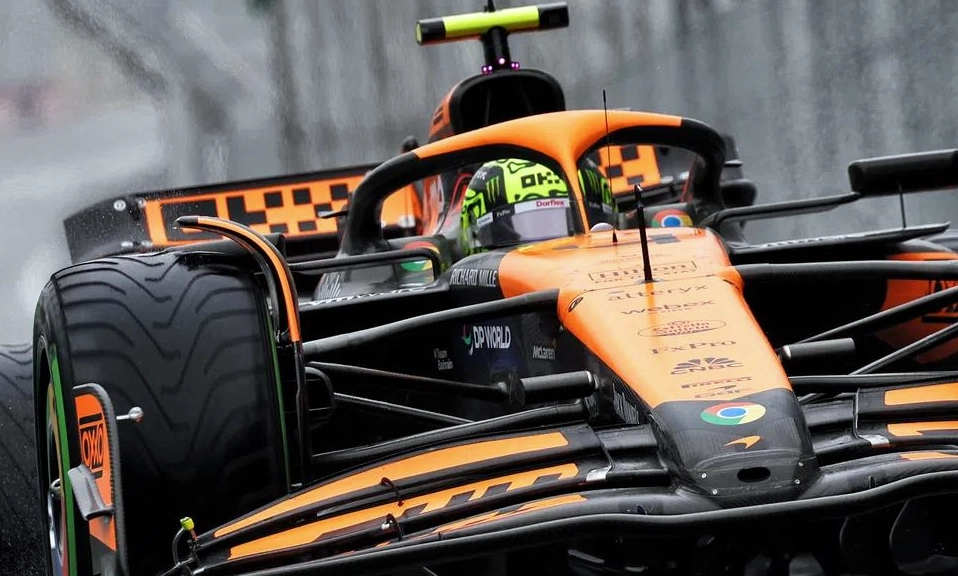
SÃO PAULO — The rain came down in sheets at Interlagos, turning the track into a treacherous ribbon of water and spray. It was the kind of qualifying session that separates the good from the great, the brave from the reckless. And when the chequered flag fell, it was Lando Norris who emerged at the top of the timesheets, claiming pole position for the São Paulo Grand Prix with a lap that was part precision, part bravery, and entirely remarkable.
The McLaren driver, who has described his 2026 car as “horrible” to drive in dry conditions, found something else entirely in the wet. His final lap—a 1:12.847—was over half a second clear of his nearest rival, Max Verstappen, and nearly a full second ahead of the newly crowned World Champion, Kimi Antonelli. It was Norris’s fourth pole position of the season and arguably the most impressive of his career.
The question now is simple: can anyone stop him in the race?
The Session: Chaos, Red Flags, and a Late Charge
Qualifying at Interlagos was always going to be a lottery. The forecast had predicted rain, but the intensity of the downpour that arrived just before Q1 caught everyone off guard. The first session was interrupted by two red flags—one for a spin from Alex Albon at Turn 4, another for a crash from Lance Stroll at the Senna S—and several drivers, including Charles Leclerc and George Russell, were eliminated before they could set a representative time.
Q2 was no less chaotic. The track was improving, but the rain was still falling, and the timing of the switch to intermediate tyres was critical. Norris timed it perfectly, bolting on a fresh set of intermediates with five minutes remaining and immediately going fastest. Verstappen, who had been quickest in Q1, could not match him. Antonelli, who had been circumspect in the wet, was third.
But Q3 was where the real drama unfolded. The rain eased slightly, and the track began to dry—but not enough for slicks. The final shootout was a test of nerve. Several drivers, including Oscar Piastri and Carlos Sainz, ran wide at the exit of Turn 12, losing valuable time. Verstappen aborted his first run after a massive slide at Turn 3, forcing him to rely on a single flying lap. Norris, by contrast, was immaculate.
His lap was a masterclass in wet-weather driving. He was fastest in the first sector, fastest in the second, and fastest in the third. He carried more speed through the Senna S than anyone else, braked later into Turn 1, and got on the power earlier out of the final corner. It was the kind of lap that wins championships—and it put him in the perfect position to win a race.
The Wet-Weather Specialist
Norris’s performance in the rain was not a surprise. He has long been regarded as one of the best wet-weather drivers on the grid, with a natural feel for grip that few of his rivals can match. His first F1 win, at the 2024 Miami Grand Prix, came in mixed conditions. His victory at the 2025 British Grand Prix was in a downpour. And his pole position at the 2026 Canadian Grand Prix was in similar circumstances.
What made this lap different was the car. The McLaren MCL40 has been a handful all season—Norris himself described it as “horrible” and “on a knife-edge” in the dry. But in the wet, the car’s weaknesses are masked by the lower grip levels and the need for a smoother, more deliberate driving style. The MCL40’s mechanical balance, which is so difficult to manage in the dry, becomes an asset in the rain. It allows Norris to feel the limit of grip without the violent snaps that characterise the car in dry conditions.
“The car is actually quite good in the wet,” Norris said after qualifying. “It’s still not easy, but it’s predictable. I can feel what it’s going to do, and that allows me to push. In the dry, it’s a lottery. In the wet, it’s a tool.”
The Rivals: Who Can Challenge Him?
Norris starts from pole, but the race is far from decided. Interlagos is a track that rewards overtaking, and the forecast for Sunday is for more rain—which could level the playing field or favour the brave.
Max Verstappen starts second, and he is the most obvious threat. The Dutchman has won the last two races and has been the form driver of the second half of the season. He was quickest in Q1 and Q2, and his aborted first run in Q3 cost him a shot at pole. Verstappen has a history of strong wet-weather drives at Interlagos—his charge from 16th to third in 2016 is one of the great wet-weather performances of the modern era. He will be aggressive, and he will be fast.
Kimi Antonelli starts third, and the newly crowned champion has nothing to lose. The 20-year-old has been the standout driver of the season, and while he has been careful in the wet this weekend, he has the pace to challenge. He will be looking to end his championship-winning season with a victory.
Charles Leclerc starts fourth after a superb recovery in Q2, and the Ferrari driver is always a threat in mixed conditions. Oscar Piastri starts fifth, and the second McLaren driver will be desperate to support his teammate and secure valuable constructors’ points. Lewis Hamilton starts sixth, and the seven-time champion is always a factor in the wet.
The biggest unknown is the weather. If the rain continues, the race will be a test of nerve and strategy. If it dries, the McLaren’s inherent weaknesses could be exposed, and Verstappen and Antonelli could close the gap. The forecast suggests a 70% chance of rain for the race, which means the wet-weather specialists will have the advantage.
The Championship Context
Norris is not in the championship fight—Antonelli has already sealed the title—but the battle for constructors’ positions is still alive. McLaren are fourth, 17 points behind Red Bull in third. A strong result for Norris, combined with a poor result for Verstappen, could close that gap. And Norris himself is fighting for sixth in the drivers’ standings, with a chance to move ahead of Leclerc and Russell with a strong performance.
But for Norris, the motivation is simpler. He has been through a difficult season, with a car that has not been to his liking and a series of missed opportunities. A win in Brazil would be a statement—a reminder that he is still one of the best drivers in the world, and that the rain is his ally.
Lando Norris took pole
position in the heaviest rain of the season, on a track that demands bravery and precision in equal measure. It was a lap that reminded everyone why he is considered one of the finest wet-weather drivers of his generation. The race is far from over—Verstappen, Antonelli, and the weather itself will have something to say—but the advantage is his.
Can anyone stop him? The honest answer is: maybe. Verstappen has the pace and the aggression. Antonelli has the confidence of a champion. The rain could favour either of them. But on the evidence of qualifying, Norris has the edge. He has the car, the conditions, and the form. And in the rain, that might be enough.
The São Paulo Grand Prix starts at 14:00 local time on Sunday. The rain is expected to be heavy. And Lando Norris is starting from the front. The stage is set for something special.
Do you think Norris can convert pole into victory, or will Verstappen and Antonelli fight back in the rain?