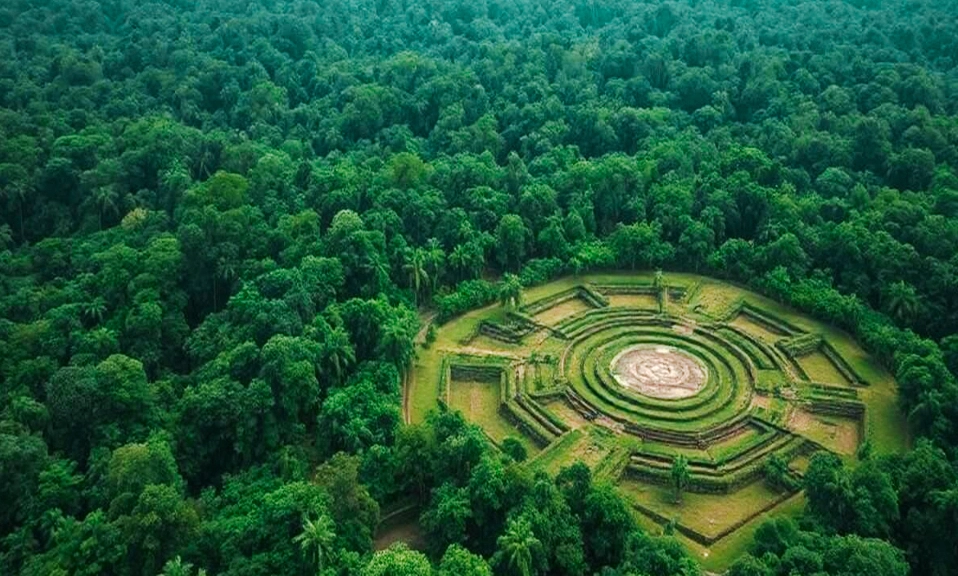
The Amazon rainforest has long been imagined as a pristine, untouched wilderness — a place where nature reigned supreme and human presence was fleeting. That myth is now in tatters. A stunning LiDAR survey has revealed hundreds of monumental earthworks hidden beneath the canopy in southwestern Brazil, built by a sophisticated civilization that may have numbered in the millions.
The discovery, published in Nature in July 2026, identifies 432 geometric earthworks — known as geoglyphs — across a region spanning the southern Amazonas state and parts of Acre. Only 36 of these structures had been previously documented. The builders were the Aquiry, a civilization that thrived in the region between 600 BCE and 850 CE.
Here is what the lasers uncovered, who built these monuments, and why their story rewrites the history of the Amazon.
The Technology That Sees Through the Forest
The breakthrough was made possible by LiDAR (Light Detection and Ranging). Mounted on aircraft, LiDAR fires rapid laser pulses toward the ground. These pulses filter through the dense leaves, bounce off the forest floor, and return to the sensor, allowing scientists to map the terrain beneath the canopy without ever setting foot in the jungle or cutting down a single tree.
In 2024, a team led by archaeologist Martti Pärssinen of the University of Helsinki and Alceu Ranzi of the University of Acre flew over 4,400 kilometres of airborne laser surveys, covering an area of 4,500 square kilometres. It was, as Pärssinen noted, “the first ambitious LiDAR assessment in the Amazon”.
The results were staggering. Satellite imagery had missed nearly 80% of the structures. The LiDAR revealed a landscape carved by human hands: geometric outlines of circles, squares, and octagons, defined by deep trenches and raised outer embankments. Most span around seven acres, though some stretch as large as 123 acres, with ditches up to 15 metres wide and five metres deep.
Who Were the Aquiry?
The Aquiry were not a single, homogeneous group. Researchers describe them as a multicultural civilisation — a network of communities that shared a common worldview and constructed ceremonial centres in a variety of monumental geometric forms.
Their territory was vast. Based on the LiDAR data and satellite imagery, the researchers estimate the Aquiry occupied an area of approximately 183,000 square kilometres — larger than Uruguay, and triple previous estimates. At its peak, between 100 and 300 CE, the region may have supported between 1.25 million and 3 million people.
“This people practiced monumental geometry in the Amazon at the same time that Pythagoras was developing his theorem in Greece,” Ranzi said.
This was not a scattered population of hunter-gatherers. It was a civilisation capable of organising labour on an enormous scale. The researchers estimate that building and maintaining each geoglyph would have required a community of around 300 people. Across the region, they believe there may be between 20,000 and 30,000 earthworks in total.
What Were the Structures For?
The initial hypothesis was that the geoglyphs served a defensive purpose — forts or fortifications built to protect against invasion. But the consensus has shifted.
The structures are now believed to have been ceremonial and political gathering hubs. They were not permanent residential villages. Instead, they were used for political decision-making, ritual dancing, feasting, and athletic contests. “The geoglyphs were used for meetings, for making political decisions and for organising religious ceremonies, as well as for parties, dances, and music,” Pärssinen explained.
The absence of defensive features — and the sheer effort required to build the monuments — suggests a society that was not consumed by warfare. “If it is really confirmed that they are ceremonial structures, this people lived in peace,” Ranzi speculated, “because to dedicate so much effort, so much work, that means there were no enemies to worry about”.
The Aquiry were also sophisticated land managers. They cleared areas of bamboo forest and cultivated crops including maize, squash, manioc, beans, and peanuts. But they did not destroy the forest. “They never transformed the tropical forest into a savanna,” Pärssinen noted. Unusually dense stands of Brazil nut and peach palm trees still grow in the region today, suggesting ancient farmers helped design the modern Amazon’s ecosystem.
The geoglyphs were connected by a network of roads — 350 kilometres of which have been mapped so far.
The Mystery of Their Disappearance
The Aquiry flourished for over a millennium. Then, sometime between 850 and 950 CE, they abandoned their geoglyphs.
No one knows why. The collapse may be related to the decline of other civilisations across the Americas — the Classic Maya in Central America, the Tiwanaku and Wari in the Andes. It could have been climate change, resource depletion, or social upheaval. The humid Amazon destroys organic evidence — bodies, food remains, wooden structures — within decades, leaving archaeologists with only the enduring earthworks as clues.
What is clear is that the Aquiry were not alone in building complex societies in the Amazon. LiDAR has also revealed the Casarabe culture in the Bolivian Amazon (circa 500–1400 CE), who built 22-metre-tall earthen pyramids and kilometres of elevated roadways. And in Ecuador’s Upano Valley, laser scans uncovered a network of roads, platforms, and settlements hidden beneath the canopy for over 2,000 years.
The Amazon was never empty. It was home to millions of people who shaped the landscape in profound and enduring ways.
The lasers did more than
reveal buried structures. They dismantled a myth.
For centuries, the Amazon has been framed as a pristine wilderness — a place untouched by human history. The Aquiry geoglyphs tell a different story: a story of a civilisation that built monumental architecture, managed forests, cultivated crops, and gathered in ceremonial centres for over a thousand years. A civilisation that may have been home to millions of people. A civilisation that deserves to be remembered not as a footnote to European conquest, but as one of the great societies of the ancient world.
“That old idea of a pristine Amazônia falls apart,” Ranzi said.
The lasers revealed the structures. The Aquiry built them. And the forest, it turns out, has been holding their story all along.