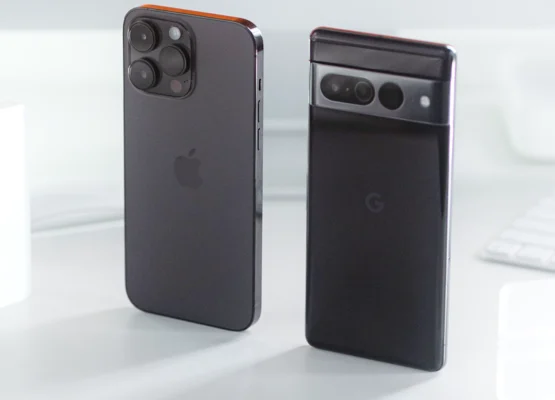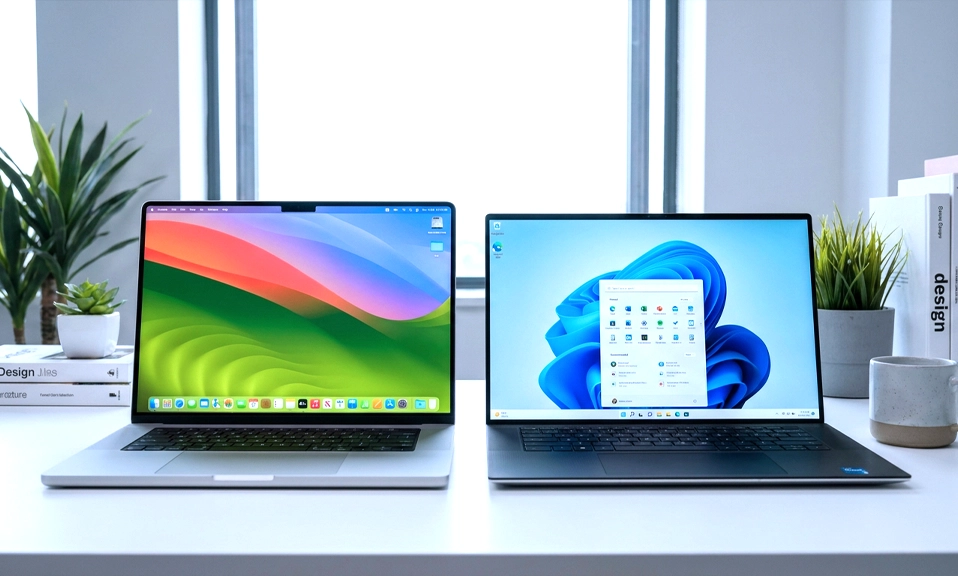
Walk into any college dorm, corporate office, or coffee shop, and you will see the great divide: the glowing Apple logo on one side, and the illuminated Windows key on the other.
For decades, the answer to “Which is better?” was entirely dependent on what you needed to do. But today, the lines are blurrier than ever. Apple’s transition to its own M-series silicon has given MacBooks unprecedented battery life and performance, while Windows laptops have fought back with stunning OLED screens, innovative form factors, and powerful AI integrations.
So, which one should you buy? The truth is, there is no single “best” laptop. There is only the best laptop for you.
Here is the ultimate, no-nonsense breakdown of the MacBook vs. Windows laptop debate to help you make the right choice.
💻 Round 1: The Operating System (The Soul of the Machine)
macOS: Apple’s operating system is built on a foundation of simplicity, stability, and aesthetics. It is incredibly intuitive, rarely crashes, and is tightly optimized for the hardware it runs on. Features like AirDrop, Universal Control (using one mouse/keyboard across a Mac and an iPad), and seamless iPhone integration make it a dream for people already in the Apple ecosystem. However, it is a “walled garden.” You do things the Apple way, and you can’t customize the core interface.
Windows 11: Windows is the ultimate generalist. It is highly customizable, deeply integrated with enterprise environments, and offers a familiar interface to billions of users. With the recent push for “AI PCs” and features like Windows Copilot, Microsoft is aggressively trying to make the OS smarter and more proactive. The downside? Because it has to run on thousands of different hardware configurations, it can occasionally suffer from driver issues, bloatware, or random update hiccups.
Winner: MacBook for simplicity and ecosystem synergy. Windows for customization and familiarity.
🛠️ Round 2: Hardware & Build Quality (The Chassis)
MacBook: Apple makes its own hardware, which means the fit and finish is consistently world-class. From the machined aluminum unibody to the industry-leading trackpads, brilliant Mini-LED (Liquid Retina XDR) displays, and excellent speakers, a MacBook feels like a premium device from the moment you open the lid. The downside? Zero upgradability. The RAM and storage you buy on day one are soldered to the board forever.
Windows: This is where Windows shines through sheer variety. Do you want a 2-in-1 convertible with a touchscreen and stylus? A rugged laptop for field work? A sleek ultrabook that weighs under 2 pounds? A massive 18-inch desktop replacement with mechanical keyboard switches? Windows OEMs (like Dell, Lenovo, HP, ASUS, and Razer) offer a machine for every niche. You can also still find Windows laptops with user-upgradeable RAM and storage.
Winner: MacBook for consistent, premium build quality. Windows for sheer variety, innovation, and upgradability.
🎮 Round 3: Software, Gaming, & Compatibility
MacBook: Macs are the undisputed kings of certain creative industries. If you are a video editor (Final Cut Pro), music producer (Logic Pro), or graphic designer, macOS is deeply entrenched in those workflows. However, gaming on a Mac, while improving thanks to Apple’s Game Porting Toolkit, still lags far behind. If you want to play the latest AAA titles at max settings, a Mac is not your friend.
Windows: Windows is the default platform for PC gaming, period. With full support for NVIDIA and AMD graphics cards, DirectX, and platforms like Steam and Xbox Game Pass, a Windows gaming laptop will utterly destroy a MacBook in raw gaming performance. Furthermore, Windows has 100% compatibility with legacy business software, engineering programs (like SolidWorks), and niche applications that simply don’t have Mac versions.
Winner: Windows, by a landslide, especially for gamers, engineers, and users of niche software.
🔋 Round 4: Battery Life & Portability
MacBook: Since the introduction of Apple Silicon (M1, M2, M3, and beyond), Apple has held a massive, almost unfair advantage in power efficiency. A MacBook Air or Pro can routinely deliver 15 to 20 hours of real-world battery life without losing performance when unplugged. The fans rarely (if ever) turn on, and the laptop stays cool.
Windows: Historically, Windows laptops sacrificed battery life for performance. However, the landscape is changing. The new generation of laptops powered by Qualcomm’s Snapdragon X Elite chips (and Intel’s latest Core Ultra processors) are finally delivering 15+ hour battery lives that rival the MacBook Air. But outside of these specific new models, most high-performance Windows laptops still need to be tethered to a wall to reach their full potential.
Winner: MacBook (though high-end Windows laptops are finally catching up).
💰 Round 5: Price & Value (The Wallet Test)
MacBook: Apple does not make “budget” laptops. The MacBook Air starts at a respectable price, but the moment you want to upgrade the RAM or storage, Apple’s upgrade fees are notoriously steep (often $200 for a bump that costs $20 to manufacture). You are paying a premium for the brand, the build quality, and the longevity (Macs routinely last 5–7 years with strong resale value).
Windows: You can buy a perfectly functional Windows laptop for $300, or you can spend $4,000 on a premium creator rig. The price spectrum is massive. While cheap Windows laptops can feel plasticky and sluggish, the mid-range ($700–$1,200) Windows market is incredibly competitive, offering phenomenal performance-per-dollar that Apple simply cannot match.
Winner: Windows for budget and mid-range value. MacBook for long-term resale value.
⚖️ The Final Verdict: Who Should Buy What?
Buy a MacBook if:
- You already own an iPhone, iPad, or Apple Watch and want seamless ecosystem integration.
- You prioritize all-day battery life, silent operation, and a premium, lightweight design.
- You work in creative fields (video editing, design, music production) where macOS is the industry standard.
- You want a laptop that will hold its resale value and last for many years without slowing down.
Buy a Windows Laptop if:
- You are a PC gamer and want to play the latest titles without compromise.
- You need specific software that only runs on Windows (engineering, accounting, legacy business apps).
- You want a touchscreen, a 2-in-1 convertible design, or the ability to upgrade your RAM/storage later.
- You are on a strict budget and want the best possible specs for your dollar.
The “MacBook vs. Windows”
war is a false dichotomy. Both platforms are better today than they have ever been.
Apple offers a refined, cohesive, and highly efficient experience that “just works.” Windows offers boundless choice, raw power, and the flexibility to mold the machine to your exact needs.
Don’t buy a laptop based on brand loyalty or what your friends use. Look at your daily workflow, your budget, and your dealbreakers. The best laptop is the one that disappears into the background and lets you do your best work.
Are you Team Mac or Team PC? Did you recently make the switch from one to the other, and how has the experience been? 💻🍎🪟