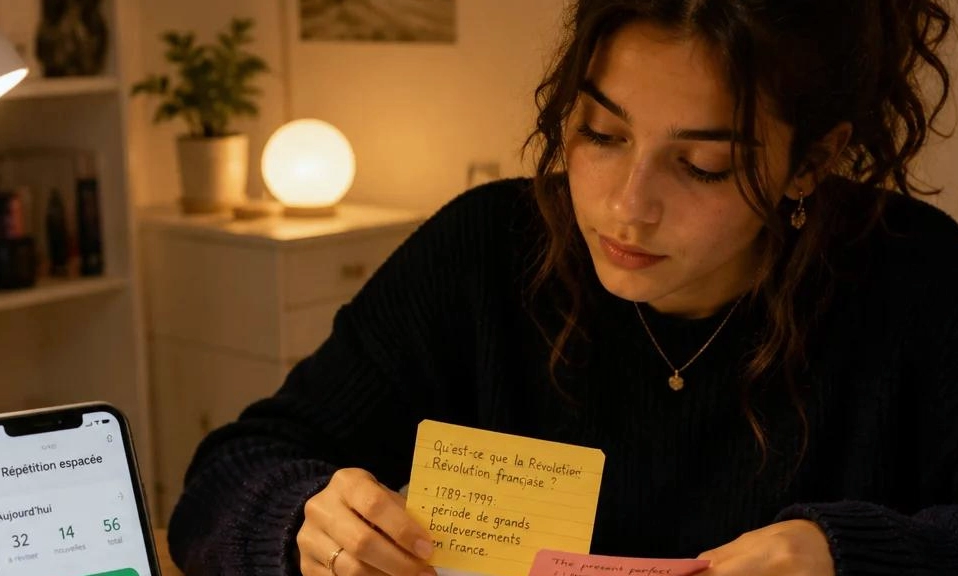
You have 200 flashcards. You spent 3 hours making them. You flip through them the night before the exam.
And you still forget half of them.
It is not because flashcards do not work. It is because most flashcards are made wrong.
Most students copy their textbook onto a card. Front: “Photosynthesis.” Back: A whole paragraph. They flip it, they read it, they say “yeah, I knew that,” and they move on.
That is not studying. That is re-reading with extra steps.
Done well, flashcards combine the two most powerful study techniques we know of — active recall and spaced repetition — into a fast, portable system you can use on the bus, between lessons, or in five spare minutes before dinner.
Flashcards work because they make you pull an answer out of your memory instead of reading it again. That effort, called active recall, is what builds lasting memory.
Two principles — active recall and spaced repetition — explain why some decks stick and others end up forgotten in a drawer.
Effective flashcards force your brain to work. They are built on two principles: active recall (you must retrieve the answer from memory, not just recognise it) and spaced repetition (you review cards at widening intervals).
Here is how to make flashcards that actually work, with examples for every subject, and the exact system to review them so they stick until exam day.
Why Most Flashcards Fail: The 5 Deadly Mistakes
1. The Copy-Paste Card
Front: “Mitochondria”
Back: “The mitochondria is a double-membrane-bound organelle found in most eukaryotic organisms that generates most of the chemical energy needed to power the cell’s biochemical reactions…”
You did not learn. You copied.
2. The “Yeah I Knew That” Card
You look at the front, you peek at the back after 1 second, you say “yeah, I knew that.” You did not retrieve. You recognized. Recognition feels like learning. It is not.
3. The 10-Facts-In-One Card
Front: “List all causes of WWII, dates, leaders, and outcomes.”
That is not one card. That is an exam. Your brain cannot retrieve 10 things at once.
4. The Statement Card
Front: “Photosynthesis is important.”
Back: “Yes.”
What are you supposed to answer? There is no question to answer.
5. The One-And-Done Deck
You make cards, you review them once, you never see them again until the exam. That is cramming, not spaced repetition.
If your cards do any of these, they will not help you remember. Let us fix them.
The 7 Golden Rules For Flashcards That Work
Rule 1: One Idea Per Card. No Exceptions.
Each flashcard should test exactly one piece of information.
Each card should test exactly one fact, concept or relationship.
Make each card test one fact, split lists or multi part answers, and keep it until you recall it correctly about three times in spaced sessions.
Effective flashcards are atomic, tested from memory, and practiced across spaced sessions until you recall each one correctly more than once.
Bad: “What are the 5 causes of WWII?”
Good: Make 5 cards. One for each cause.
- Card 1: “What was the Treaty of Versailles punishment that made Germany angry?”
- Card 2: “How did the Great Depression help Hitler rise to power?”
- Card 3: “What was Hitler’s policy of Lebensraum?”
Yes, you will have more cards. That is good. More cards = more retrieval practice = more memory.
Rule 2: Front = Question, Not A Topic
To make effective flash cards, limit each card to one atomic fact or concept, phrase the front as a clear, answerable question (not a statement), require active recall (not recognition), and schedule reviews using spaced repetition.
Bad Front: “Photosynthesis”
Good Front: “What is the chemical equation for photosynthesis? Write it from memory.”
Bad Front: “Trigonometry”
Good Front: “In a right triangle, if opposite = 3 and hypotenuse = 5, what is sin(theta)? Solve it.”
If you cannot answer the front in one sentence, one formula, or one image, your front is too vague.
Rule 3: Write It In Your Own Words
Instead, read the source, then write the card in your own words.
Write one idea on each card, in your own words.
Do not copy the textbook. Close the book. Write what you understood. If you cannot write it in your own words, you do not understand it yet. That is the point. The card exposes the gap.
Example:
Textbook: “Osmosis is the spontaneous net movement of solvent molecules through a selectively permeable membrane from a region of higher water potential to a region of lower water potential.”
Your card: “What is osmosis? Why does water move from dilute to concentrated?”
Simpler is better. Your brain remembers your words, not the textbook’s words.
Rule 4: Back = Short, Testable Answer
To study with flashcards effectively, put one clear question on the front and one short answer on the back, try to recall the answer before you flip, rate yourself honestly, and review every day with spaced repetition so each card returns just before you would forget it.
Your back should be short enough to check in 3 seconds.
Bad Back: A paragraph.
Good Back: “6CO2 + 6H2O -> C6H12O6 + 6O2” + one small diagram.
If your back is long, split it into 2 cards.
Rule 5: Make The Brain Work – Say It Before You Flip
Flashcards work best when you use them for active recall, not passive rereading. Write one concept per card, attempt to retrieve the answer before flipping, and review using spaced repetition so difficult cards appear more often than easy ones.
Use Active Recall: When you look at the front of the flashcard, try to recall the answer without peeking at the back.
Say the answer before you turn the card over.
The Rule: No peeking. Say it out loud. Out loud is 2x better than in your head, because your head will lie to you. Your mouth will not.
If you got it right, say it with confidence. If you got it half right, that is WRONG. Mark it wrong. Be harsh. Being harsh now saves marks in the exam.
Flashcards promote active recall, which means you’re actively retrieving information from memory rather than passively reading it.
Rule 6: Space Your Reviews – Do Not Review Everything Equally
Use spaced repetition. Do not review the whole deck equally every time. Show cards you know less often and cards you struggle with more often. This is how spaced-repetition systems work, and it is dramatically more efficient.
Spaced repetition means that you come back to the same cards after gaps, and make the gaps longer over time.
Space your reviews: Review a new card after a day, then a few days, then a week. Spaced repetition gives more time to hard cards and less to easy ones.
Spaced repetition — Reviewing at expanding intervals (e.g., 1 day, 3 days, 1 week) so you see items again just before you would forget it.
The Simple System:
- Day 0: Make the card
- Day 1: Review it
- Day 3: Review it again
- Day 7: Review it again
- Day 14: Final check
A review found spaced retrieval beat cramming, with an aggregate effect of g = 0.74; lengthening each gap offered no overall advantage over even spacing.
You do not need a perfect algorithm. You need growing gaps.
Rule 7: Use Images, Not Just Words
Your brain remembers pictures 6x better than words.
- For Anatomy: Draw the heart, label it from memory. Do not just write “heart has 4 chambers.”
- For Geography: Use a blank map. “Where is the Sahara? Point to it.”
- For Chemistry: Draw the molecule, do not just write its name.
If you are using paper cards, draw a tiny sketch. If you are using Anki or Quizlet, add an image from your textbook. Image Occlusion is even better: Cover the labels on a diagram, and recall each label one by one.
The 5 Types Of Flashcards You Actually Need
Do not make only definition cards. Exams test different skills. Make different cards for each skill.
1. The Definition Card – For Facts
Front: “What is osmosis?”
Back: “Movement of water from high water concentration to low water concentration through a semi-permeable membrane.”
Use for: Definitions, vocabulary, dates, formulas.
2. The Cloze Deletion Card – For Sentences You Must Remember
Front: “Photosynthesis takes place in the ___ of the plant cell, and produces ___ and ___.”
Back: “Chloroplast, glucose, oxygen.”
Cloze cards force you to fill the blank, not just recognize the sentence. They are perfect for processes, sequences, and lists.
3. The Process Card – For How Things Work
Front: “What are the 3 steps of respiration? Draw the flow.”
Back: “1. Glycolysis, 2. Krebs Cycle, 3. Electron Transport Chain. Draw it.”
Use for: Biology processes, History timelines, Math methods, Chemistry reactions. Your answer is a diagram, not a paragraph.
4. The Application Card – For Exams That Ask “Why” And “How”
Front: “A plant is placed in salty water. It wilts. Why? Explain using osmosis.”
Back: “Salty water has lower water concentration than plant cells. Water moves OUT of plant cells by osmosis. Cells lose turgor, plant wilts.”
This is the card most students never make. And it is the card that gets you an A, because exams do not ask “What is osmosis?” They ask “Why did the plant wilt?”
5. The Mistake Card – For Your Personal Weak Spots
Front: “I ALWAYS get this wrong: What is the difference between mitosis and meiosis? I mix up chromosome number.”
Back: “Mitosis: 2 identical cells, 46 chromosomes. Meiosis: 4 different cells, 23 chromosomes. Remember: Meiosis = Makes eggs/sperm, so half.”
Make a card every time you get a past paper question wrong. That card is worth 10 normal cards.
Flashcards By Subject – Copy These Examples
Biology:
- Bad: “Cell”
- Good: “What is the function of the mitochondria? What happens if it stops working?”
Math:
- Bad: “Pythagoras”
- Good: “A triangle has sides 3 and 4, right angle between them. What is the hypotenuse? Solve it without calculator.”
History:
- Bad: “WWII”
- Good: “What year did WWII start, and what event triggered it? What was Britain’s response?”
Languages – French / Spanish:
- Bad: “Bonjour = Hello”
- Good: “How do you say ‘I would like to go to the library because I need to study’ in French? Say it out loud.”
Medicine / Nursing:
- Bad: “Diabetes”
- Good: “Patient has high blood sugar, thirst, frequent urination. What is the diagnosis? What is the first-line treatment? What are 2 complications?”
Flashcards with spaced repetition excel at discrete, testable knowledge: definitions, formulas, dates, vocabulary, named concepts, and processes with specific steps.
Flashcards are NOT good for essays, deep understanding, or “discuss” questions. For those, use Feynman Technique and past papers. Use flashcards for the facts you need to write the essay.
How To Study With Flashcards: The 15-Minute Daily System
Do not sit for 2 hours flipping cards. You will burn out. Use this system:
Run 10 to 25 cards in 5 to 15 minutes, mix topics.
The Daily Routine:
- New Cards (5 min): Make 10 new cards from today’s lesson. Close book, write in your own words.
- Review Cards (10 min): Review today’s due cards. Say answer out loud before flipping. Mark Honest: Right or Wrong.
- Shuffle: Mix topics. Do not do all Biology, then all Math. Mix them. That is interleaving, and it makes you remember better.
Done properly, flashcards combine two of the most well-evidenced revision techniques there are: active recall (testing yourself rather than re-reading notes) and spaced repetition (reviewing information at increasing intervals so it sticks in long-term memory). The tool that ties these together is the Leitner System, a simple box-based method for deciding which cards to review and when.
The Leitner System – For Paper Cards
The Leitner System, developed by German science journalist Sebastian Leitner, sorts flashcards into a series of boxes.
You need 5 boxes or envelopes. Label them Box 1, 2, 3, 4, 5.
- All new cards start in Box 1. Review Box 1 every day.
- If you get it right, it moves to Box 2. Review Box 2 every 2 days.
- If you get it right again, it moves to Box 3. Review every 4 days.
- If you get it wrong at ANY box, it goes back to Box 1. Review tomorrow.
This is spaced repetition without an app. Hard cards stay in Box 1 and you see them every day. Easy cards move up and you see them less often.
Review daily with spaced repetition. Failed cards come back soon; successful cards get pushed further out.
For Digital Cards: Anki vs Quizlet
Use Spaced Repetition: There are various apps, such as Anki or Quizlet, that use spaced repetition algorithms.
Use Anki if: You have 500+ cards, you are studying medicine, law, or a long course, and you want the best algorithm. Anki does Leitner automatically. It is ugly, but it works.
Use Quizlet if: You want to find cards other students made, you like games, and you want it pretty and easy. Quizlet Learn Mode uses spaced repetition too.
Do not use AI to make all your cards for you. Making the card is studying. If AI makes 100 cards, you skipped the learning. Use AI to check your cards, not to make them all. Prompt: “Here are my 10 flashcards on photosynthesis. Are any answers wrong? Are any fronts too vague?”
When To Make Flashcards, When To Delete Them
Make them:
- Right after you learn a topic, same day. Not 2 weeks later.
- After you get a past paper question wrong.
- For any list, definition, formula, date, or process you must memorize.
Delete them:
- When you get a card right 3 times in a row, spaced out, and you can answer it in under 3 seconds. That card is learned. Archive it. Do not keep reviewing it forever.
- If a card is too vague, rewrite it. Do not keep a bad card.
- If you have more than 300 cards for one subject, you have too many. You are making cards for everything, not for what matters. Keep only the high-value cards.
How many cards per subject?
- For a school exam: 50 to 100 cards per subject is plenty.
- For a university exam: 100 to 200 cards.
- For medicine: 1000+ is normal, but you need Anki for that.
Quality beats quantity. 20 perfect cards beat 200 copy-paste cards.
The Flashcard Test: 3 Questions To Check Your Deck
Before you study, check 3 random cards. Ask:
- Can I answer this without looking? If the front is a topic, not a question, rewrite it.
- Is the answer short? If the back is a paragraph, split it.
- Is it in my own words? If you copied it, rewrite it.
If your deck passes, it will help you remember. If it fails, fix it before you waste time reviewing it.
A review of learning techniques by Dunlosky et al. (2013) rated practice testing as one of the highest-utility techniques. Flashcards are practice testing in your pocket.
Flashcards do not work
because you have them. They work because you retrieve from them, spaced out, honestly, every day.
One idea per card. Question on front. Short answer on back. Say it before you flip. Space your reviews. Delete what you know.