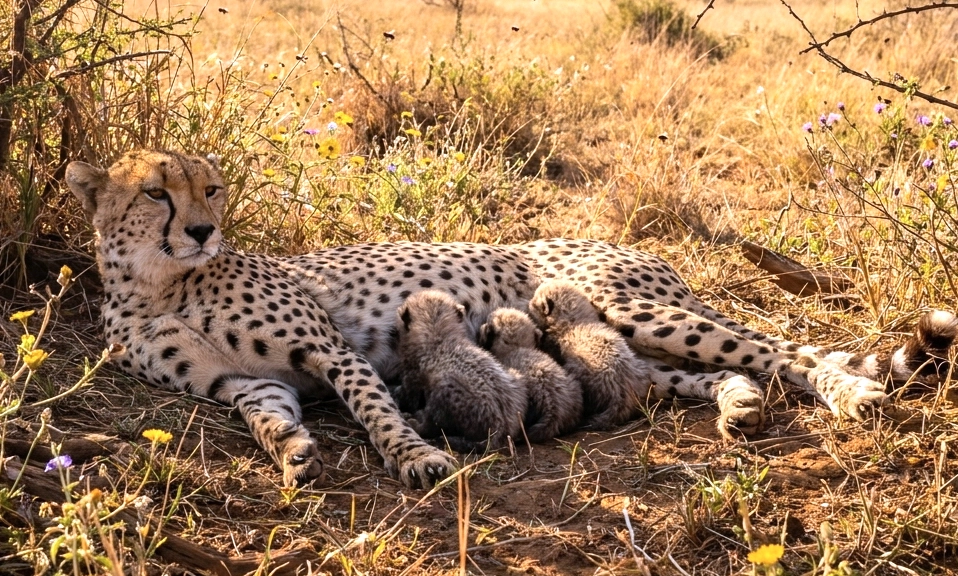
There are fewer than 7,000 cheetahs left in the wild. On October 5, five tiny, spotted cubs opened a new chapter for a species that has been disappearing for a century.
The cubs were born on Monday, October 5, 2026, at the Smithsonian’s Conservation Biology Institute (SCBI) in Front Royal, Virginia — about an hour’s drive from the National Zoo in Washington, D.C. Their mother is Zura, a 5-year-old first-time mom. Their father is Flash, a 9-year-old male whose genetic lineage is considered especially valuable to the North American cheetah population.
Keepers say the cubs are healthy, strong, and active. They started climbing on their mother on day one.
“Because there’s five of them, somebody’s usually nursing,” said Adrienne Crosier, curator of carnivores at SCBI and leader of the Cheetah Species Survival Plan. “Somebody’s always hungry. Somebody always needs to be groomed. Somebody always needs a bath”.
Zura, for her part, has taken it all in stride.
“She’s an incredibly calm and attentive parent,” Crosier told Smithsonian magazine. “She’s dedicating almost every moment of her time to the cubs”.
A Full-Circle Family Story
For the keeper team, this litter represents something more than a successful birth. It’s a milestone fifteen years in the making.
Zura herself was born at SCBI in 2021 — and she and her littermates were featured on the Cheetah Cub Cam that same year. Before her, Zura’s mother Rosalie was born at the facility in 2015. And before that, Rosalie’s mother Sanurra was born there as well.
Both Rosalie, now 11, and Sanurra, now 16, are still living at SCBI. They are currently housed together.
“With these cubs, we now have four generations of the same cheetah family with us,” Crosier said. “It’s a testament to the high level of care our team is able to provide for these animals”.
Great-grandmother, grandmother, mother, and now five cubs — all in one facility. It’s a rare and remarkable achievement for a species that is notoriously difficult to breed in human care.
Why Cheetahs Are So Hard to Breed
Cheetahs present unique challenges for breeding programs. Female cheetahs cycle unpredictably, and the behavioral signals that indicate readiness are subtle enough that even experienced biologists can miss them. A facility can do everything right for years and still see no results.
That’s why the work is pooled. SCBI is one of ten cheetah breeding centers across the United States that make up the Cheetah Breeding Center Coalition, a group dedicated to creating and maintaining a self-sustaining North American cheetah population under human care. The mechanism is the Species Survival Plan, run with the Association of Zoos and Aquariums’ population management center. Scientists and animal care staff evaluate the genetic makeup, health, and temperament of individual animals across all participating institutions and determine which pairings should happen.
Flash was selected for Zura because his lineage is not well represented in the overall North American population. That makes these five cubs genetically valuable additions to the breeding program — not just for SCBI, but for the species as a whole.
With this litter, SCBI has now welcomed 90 cheetah births across 21 litters since 2007. This is the second litter in under a year at the campus; four cubs were born to a different mother, Amabala, in November 2025.
Watch Them Grow: The Cheetah Cub Cam Is Live
The cubs won’t be on public view — the Front Royal campus is closed to visitors — but you can watch them grow on the Cheetah Cub Cam, a live den camera feed available on the National Zoo’s website.
The stream gives viewers around the world a window into the cubs’ earliest weeks. For now, the care staff is hands-off, allowing Zura and her litter to bond without interference. But they’re monitoring the family closely through the camera.
The cubs were born with their eyes closed and ears flat against their heads. They typically open their eyes after four to seven days, and their ears will stand up a few days later. They’ll gain about 50 grams of weight daily — roughly the size of a golf ball to an egg. After three or four weeks, they’ll start growing curious when Zura leaves the den to eat or drink, gathering at the door when she exits.
“They’re going to want to start following her outside,” Crosier said.
The cam is expected to remain active for about six to seven months, at which point the cubs will naturally prefer not to sleep together in the same den. After a year or two at SCBI, they’ll likely move to partner facilities to support future breeding efforts.
The Bigger Picture: A Species on the Edge
The birth of five cheetah cubs is a moment of joy. But it’s also a reminder of how fragile the species has become.
At the start of the 20th century, cheetahs numbered around 100,000 across Africa and Asia. Today, fewer than 7,000 remain in the wild. The species is classified as “Vulnerable” on the International Union for Conservation of Nature’s Red List, and its population continues to decline.
The threats are familiar and relentless: habitat loss, fragmentation, human-wildlife conflict, poaching, and the loss of prey species. Cheetahs now occupy only about 9% of their historical range — making them Africa’s most endangered big cat.
The Asiatic cheetah, a subspecies that once roamed across the Middle East and India, is in even more dire straits. Fewer than 30 individuals are estimated to remain in the wild in Iran, making it the world’s most endangered big cat.
Against that backdrop, every surviving cub matters. Every successful breeding, every genetic line preserved, every cub that grows up to reproduce is a small victory against extinction.
“For a species that is difficult to breed in human care, each surviving cub represents a triumph,” Crosier said. “Having four generations in our care is proof-positive of our coordinated efforts to preserve this imperiled species”.
What Comes Next
For now, the priority is simple: keep the cubs healthy and let Zura do what she does best. The first few weeks are critical. Staff will remain hands-off, intervening only if necessary.
In a few months, the cubs will be vaccinated, microchipped, and introduced to the wider world. In a year or two, they’ll move to partner facilities, where they’ll hopefully contribute to the next generation of cheetahs.
And if you want to watch them grow — if you want to see five tiny, spotted bodies curl up together in a den, one stretching an arm and leg in a big yawn while another stumbles over its siblings to nurse — the Cheetah Cub Cam is live right now.
They’re small. They’re fragile. They’re five reasons to hope that the cheetah’s story doesn’t have to end the way so many others have.
The cubs are here. The camera is rolling. And for one threatened species, five tiny heartbeats are beating a little louder today.