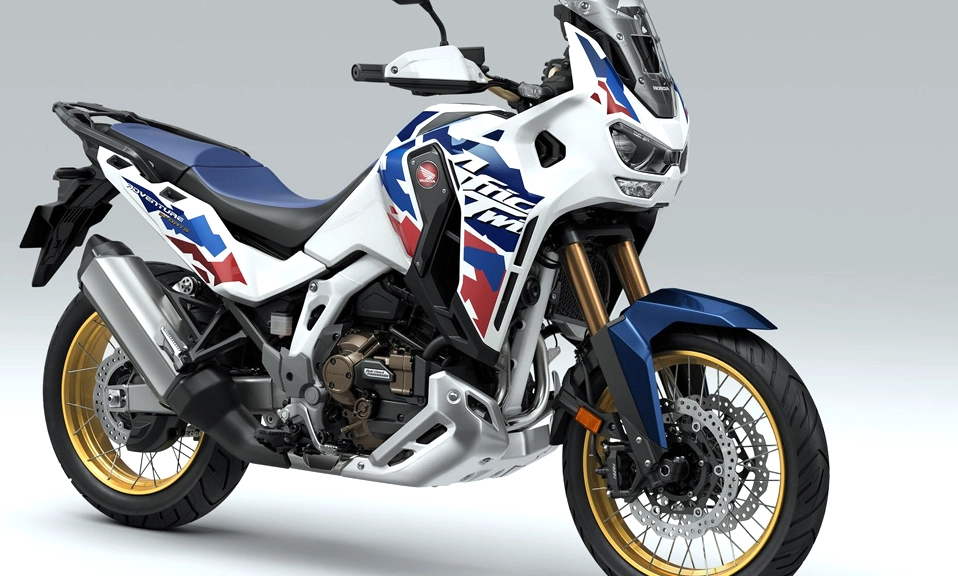
The 2027 Honda Africa Twin is not a facelift. It is Honda’s most comprehensive overhaul of its flagship adventure machine in a decade, and it arrives with a clear message: the Japanese giant is done watching from the sidelines while European rivals set the pace in the high-tech, high-performance ADV segment.
Revealed at EICMA 2026 in Milan, the new CRF1150L family is built on the concept of “Shaped by You. True Adventure for All”. It brings a larger engine, a lighter and lower chassis, radar-based rider assistance, and—for the first time—a dedicated off-road-focused variant. This is not just an update. It is a redefinition of what the Africa Twin is, and who it is for.
The Engine: More Than Just a Bigger Bore
The heart of the 2027 Africa Twin is a new 1,131cc parallel-twin, up from 1,084cc. The increase comes from a 2mm larger bore (now 94.0mm), while the stroke remains unchanged at 81.5mm. But the headline numbers only tell part of the story.
Peak power rises by 16.5 per cent to 87.5kW (119 horsepower) at 7,500rpm, while peak torque climbs to 119Nm at 5,750rpm—an increase of 7Nm. The gains were achieved through a higher compression ratio of 12.1:1 (up from 10.5:1), a redesigned intake with 52mm throttle bodies, revised cam timing and valve-lift profiles, and new pistons, connecting rods, and crankshaft.
Honda says the result is “noticeably stronger acceleration and improved roll-on response through gears one to five,” while revised gearing drops cruising rpm for more relaxed motorway miles. Crucially, the characteristic 270-degree crankshaft has been retained, so the Africa Twin keeps the distinctive uneven firing pulse and traction feel that long-standing owners will recognise immediately.
The six-speed manual gearbox is standard, with the six-speed Dual Clutch Transmission (DCT) continuing as an option across the range.
The Chassis: Lighter, Lower, and More Agile
Honda has redesigned the steel semi-double cradle frame and aluminium swingarm, revising their rigidity balance to improve handling and overall ride feel. Together, the new frame and swingarm assembly is 1.4kg lighter than the previous generation, with wall-thickness revisions and a reworked engine head hanger shaving 0.8kg from the frame alone.
The most interesting development is the fuel sub-tank beneath the rider’s seat, a layout inspired by the legendary NXR750 Paris-Dakar racer. This lowers the main tank’s fuel level and pulls mass down and towards the centre of the bike, resulting in a motorcycle that feels more agile at low speed and more composed at pace.
The ergonomics have been revised as well: the handlebars sit 10mm higher and 10mm further forward, while the footpegs move 20mm narrower and 10mm rearward. Seat height is adjustable between 850mm and 870mm, with a new Minimum setting that pulls that figure a further 10mm lower when needed.
The Suspension: Electronic as Standard
Previously an option, Showa Electronically Equipped Ride Adjustment (EERA) is now fitted as standard across the Africa Twin range. For 2027, it incorporates Honda Skyhook Control, which continuously calculates and applies damping force based on real-time inputs from the ECU, the IMU, and a fork stroke sensor—adjusting damping in just 1 millisecond.
The system includes a new Minimum setting that drops seat height by 10mm and remains active even after the ignition is switched off. Alongside Solo, Solo with Luggage, Pillion, and Pillion with Full Luggage configurations, damping can be fine-tuned per riding mode via USER adjustments.
New 49mm Showa USD forks replace the previous 45mm units, with 220mm of front travel and 210mm at the rear.
Honda SENSING RIDE: Radar Comes to the Africa Twin
The most significant technological leap is the introduction of Honda SENSING RIDE, which makes its production debut on the Africa Twin Adventure Sports. It is Honda’s first motorcycle application of the radar-based assistance technology already used in its cars, and it brings a suite of features that were previously the preserve of premium European tourers.
The system uses front and rear millimetre-wave radar to detect the surrounding environment and provide information, alerts, and active assistance. The functions include:
Adaptive Cruise Control (ACC) , which maintains a preset speed and automatically adjusts the distance to the vehicle ahead.
ACC with Stop & Go, which—thanks to the DCT—can bring the bike cleanly to a halt in traffic and pull away again automatically.
Forward Collision Warning and Emergency Braking Assistance.
Blind Spot Information and Rear Distance Warning.
The Adventure Sports variant equipped with Honda SENSING RIDE is DCT-only, reflecting the integration required for Stop & Go functionality.
The New Variant: Enduro Sports
For riders who found the standard Africa Twin too road-biased and the Adventure Sports too touring-focused, Honda has added a third option: the Africa Twin Enduro Sports.
This is the most off-road-focused Africa Twin yet. It rides on 21-inch front and 18-inch rear wheels (compared to the Adventure Sports’ 19/18 setup), with mechanically adjustable suspension, 260mm of ground clearance, and a wet weight starting from 228kg—9kg lighter than the standard model. It also gains dedicated off-road riding modes and a rally-derived front suspension setup.
Honda Australia has confirmed the Enduro Sports is “the Africa Twin Australian riders have been requesting,” and it will sit alongside the standard Africa Twin and Adventure Sports in the 2027 lineup.
What It Means: The Africa Twin Grows Up
The 2027 Africa Twin is Honda’s answer to a segment that has been transformed by the likes of the Ducati Multistrada V4, the BMW R 1300 GS, and the KTM 1390 Super Adventure. Where the previous CRF1100L was a capable, reliable, and likeable all-rounder, the new CRF1150L is a technologically sophisticated, performance-focused adventure machine that can compete on specification as well as character.
The decision to make electronic suspension standard, to introduce radar-based rider assistance, and to offer a genuinely off-road-focused Enduro Sports variant shows that Honda is no longer content to rely on the Africa Twin’s reputation for durability and accessibility. It is building a bike that can challenge the best in the class on every front—tarmac, trail, and technology.
The new range is scheduled to arrive in Australia in late 2027, with pricing and final specifications to be announced closer to launch. European deliveries are expected to begin in early 2027.
For a model that has been a fixture of the adventure scene for decades, the 2027 overhaul is not before time. But Honda has not rushed it. The CRF1150L is a considered, comprehensive evolution—one that respects the Africa Twin’s heritage while equipping it for the next decade of adventure riding.
The king of the middleweight-to-heavyweight ADV class has been sharpening its claws. And on this evidence, it is ready to fight for the crown.