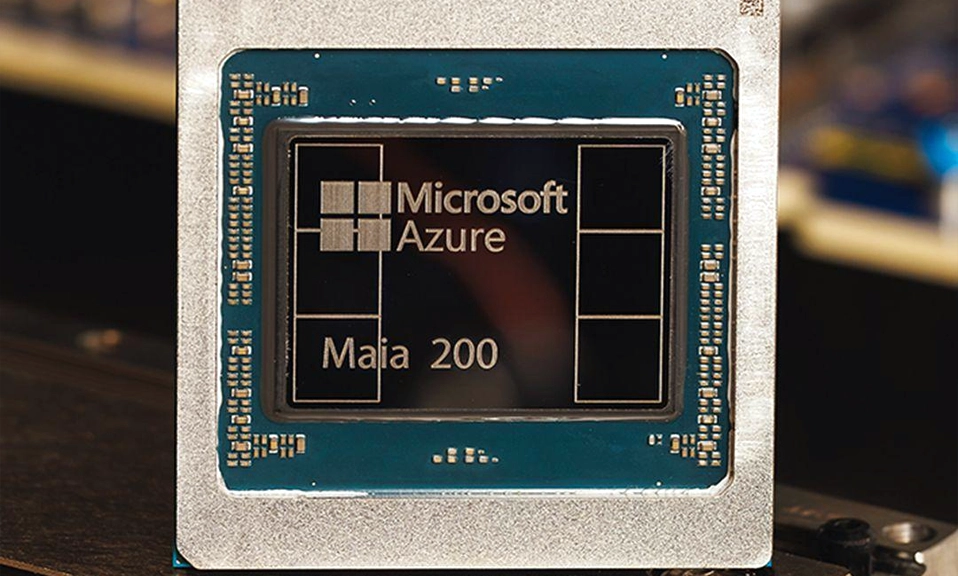
Could Maia 300 Challenge Nvidia’s Dominance?
Microsoft just made its biggest bet yet on breaking free from Nvidia. And it’s not a small one.
On October 12, 2026, at the OCP Global Summit, Microsoft unveiled the Maia 300, its third-generation custom AI accelerator. The company didn’t hedge. Scott Guthrie, Microsoft’s executive vice president of Cloud + AI, declared that Microsoft will scale the Azure Maia family to “multi-gigawatt deployments starting in 2027, making Maia the primary AI inference system for Microsoft products and services”.
That single sentence represents one of the most consequential strategic shifts in the AI infrastructure race. Microsoft isn’t just experimenting with custom silicon anymore. It’s going all in. And the question everyone in the industry is asking is whether Maia 300 can actually challenge Nvidia’s iron grip on the AI chip market.
What Maia 300 Actually Is
The Maia 300 is not a general-purpose GPU. It’s an inference-first architecture, purpose-built for the workloads that dominate Microsoft’s AI services today: long-context reasoning, latency-sensitive conversational experiences, and sustained, multi-step agentic tasks.
At the hardware level, each Maia 300 accelerator packs eight HBM4 memory stacks providing 288 GB of memory and 18 TB/s of peak memory bandwidth within a 950-watt thermal design power envelope. At rack scale, 96 accelerators fit inside a 167-kilowatt power envelope, delivering 27.6 TB of combined HBM capacity and 1.7 PB/s of aggregate memory bandwidth.
The chip uses a chiplet-based design with compute elements fabricated on TSMC’s N2P process node, separating compute, memory controller, and I/O functions into distinct dies. Microsoft says this increases the silicon area dedicated to compute performance and allows each function to use the technology best suited to its role. The architecture also introduces a software-defined dataflow approach and AI-assisted kernel optimization to maximize data locality and reduce unnecessary data movement across compute, memory, and networking resources.
The Efficiency Gambit: 40% More Tokens Per Megawatt
Microsoft’s central claim is bold: Maia 300 delivers 40% more tokens per megawatt compared to leading GPU-based systems. And in a full 96-accelerator configuration, it delivers up to seven times the rack-scale token throughput of its predecessor, Maia 200.
Those numbers matter because the AI industry’s bottleneck is shifting. For years, the race was about raw compute power. Now, as AI inference workloads scale and data centers face power constraints, the metric that matters is how much useful AI you can generate per watt. Microsoft is betting that Maia 300’s efficiency advantage will be its wedge into the market.
ABI Research notes that a key driver behind the multi-gigawatt deployment is improving the ROI of compute running Microsoft’s own AI applications and services. Replacing legacy hardware to improve token efficiency will help maximize returns on the data center build-out.
How It Compares to Nvidia’s Rubin
The most direct comparison is between Maia 300 and Nvidia’s upcoming Rubin platform. But the comparison isn’t straightforward, and both companies know it.
| Specification | Microsoft Maia 300 | Nvidia Rubin NVL72 |
|---|---|---|
| Primary workloads | AI inference | AI training and inference |
| Memory per accelerator | 288 GB HBM4 | 288 GB HBM4 |
| Peak memory bandwidth | 18 TB/s per accelerator | 22 TB/s per GPU |
| Accelerators per rack | 96 | 72 |
| Total HBM4 per rack | 27.6 TB | 20.7 TB |
| Power per accelerator | 950W | Not publicly listed |
Source: TechRepublic, October 2026
On memory capacity, the two are identical at 288 GB per accelerator. On bandwidth, Nvidia’s Rubin holds an edge at 22 TB/s per GPU versus Maia 300’s 18 TB/s. But Maia 300 packs more accelerators per rack—96 versus 72—giving it greater total memory capacity at the rack level. Microsoft also claims Maia 300 delivers 40% more tokens per megawatt than leading GPU systems, though the company hasn’t disclosed exactly which systems it used for the comparison.
TechRepublic’s analysis is careful to note that “no independent, workload-matched Maia 300 vs Rubin benchmark is available, so the comparison does not assign a performance winner”. The two platforms also target different primary workloads: Maia 300 is designed for inference, while Rubin supports both training and inference. They’re not directly substitutable products—at least not yet.
Why Microsoft Is Doing This
The strategic logic is simple: every dollar Microsoft spends on Nvidia hardware is a dollar leaving Microsoft. A homegrown chip allows Microsoft to own more of the value chain itself.
Satya Nadella’s internal frustration has been well documented. In an email revealed during court proceedings, he wrote that Microsoft was “just a thin layer on top of Nvidia” and that “all the IP is owned by OpenAI”. That awareness—that Microsoft was ceding margin and control to both its chip supplier and its model partner—has been the driving force behind the Maia program.
Maia 200, which entered production earlier this year, is already serving real workloads including Microsoft Copilot, GitHub Copilot, Microsoft Foundry, and Microsoft’s own MAI models. It deploys across data centers in the United States, Europe, and Australia, delivering up to 1.7 times more tokens per watt compared to leading GPU infrastructure.
The insights from running Maia 200 at scale directly informed Maia 300’s design. “We have to work across the full stack, all the way down to the silicon,” said Mustafa Suleyman, CEO of Microsoft AI. “At that scale we need a platform that we own, and that we co-design with our models”.
The External Customer Test
Internal adoption is guaranteed. Microsoft will run its own services on Maia 300 regardless. The real test is whether anyone outside Microsoft will use it.
Microsoft is pitching Maia 300 to external customers, including Anthropic. The company is in talks with TSMC to secure manufacturing capacity for more than 300,000 units in 2027, with a longer-term goal of over one million units. That’s a massive ramp compared to Maia 200’s limited deployment.
But the external customer question is complicated. Anthropic is both a potential customer and a future competitor—it has confirmed it is building its own internal chip design team. And Nvidia’s CUDA software ecosystem remains the industry standard. As one analysis put it, “The real question isn’t whether Microsoft can build a chip. It’s whether anyone with a real choice will use it”.
Even if external adoption is slow, Microsoft has a fallback: it can shift more internal AI workloads to Maia while continuing to rent Nvidia chips to Azure customers at premium prices, improving its own margins and Maia utilization in the process.
The Analyst View: Gradual Pressure, Not a Knockout
Analysts are cautious about near-term disruption to Nvidia. Evercore ISI estimates that by early 2027, Maia will account for only about 10% of Microsoft’s AI chip spending. Wedbush expects limited near-term pressure on Nvidia, citing Nvidia’s superior ability to secure chip supplies.
But the longer-term trajectory is clear. As one analysis put it, “The future data center will have multiple computing platforms simultaneously—Nvidia GPUs handling general-purpose AI computing, Maia handling Microsoft-optimized AI workloads, with different chips scheduled based on task requirements”.
This isn’t about replacing Nvidia overnight. It’s about reducing dependency, improving margins, and building leverage.
The Broader Context: Everyone Is Building Custom Silicon
Microsoft isn’t alone in this race. Google’s TPU line is bifurcating between training and inference optimization. Amazon Web Services has its Inferentia and Trainium stack. OpenAI is developing its Jalapeno chips in collaboration with Broadcom. Anthropic is rumored to be exploring custom accelerators.
All three hyperscalers—Microsoft, Google, and Amazon—are increasing the volume of in-house custom silicon running production workloads. The drivers vary, but efficiency relative to available data center power is a main force, alongside cost pressures.
The shift reflects a broader realization across the industry: as AI becomes a foundational layer of every application and business process, the companies that control the silicon control their own destiny. Microsoft spent years ceding that control to Nvidia. Maia 300 is its attempt to take it back.
Can Maia 300 challenge
Nvidia’s dominance? The honest answer is: not yet, and maybe never in the way people imagine.
Maia 300 is an inference chip. Nvidia’s Rubin handles both training and inference, and its CUDA ecosystem remains deeply entrenched. Microsoft’s own analysts estimate Maia will account for only about 10% of its AI chip spending by early 2027. Nvidia isn’t going anywhere.
But that’s not the point. The point is that Microsoft now has a credible alternative. Maia 300’s efficiency advantage—40% more tokens per megawatt—gives Microsoft leverage it didn’t have before. It gives the company a way to serve its own AI workloads more cheaply, to improve margins on Azure, and to negotiate with Nvidia from a position of strength rather than dependency.
The AI infrastructure market is not a winner-take-all game. It’s becoming a multi-platform ecosystem where different chips serve different workloads, and the companies that control both their models and their silicon will have a structural advantage. Maia 300 is Microsoft’s play to be one of those companies.
Whether it succeeds will depend on factors that go far beyond benchmark numbers: software maturity, developer adoption, TSMC’s manufacturing capacity, and the willingness of external customers to bet on an alternative to the industry standard. Microsoft has made its bet. Now the market will decide if it pays off.