Let’s be honest: modern air travel has become an exercise in endurance.
You pack a bag, drive 45 minutes to an airport on the outskirts of the city, stand in a snaking security line, take off your shoes, pay $8 for a bottle of water, sit in a cramped metal tube, and then wait on the tarmac for 20 minutes. For a two-hour flight, the entire ordeal takes five hours.
Now, imagine an alternative.
You take a 15-minute subway ride to a gleaming, modern terminal right in the heart of the city. You walk through a security checkpoint that takes 90 seconds. You board a spotless, spacious train with legroom that would make a first-class airline seat jealous. You plug in your laptop, watch a movie, and 2.5 hours later, you step off the train directly into the downtown core of your destination city.
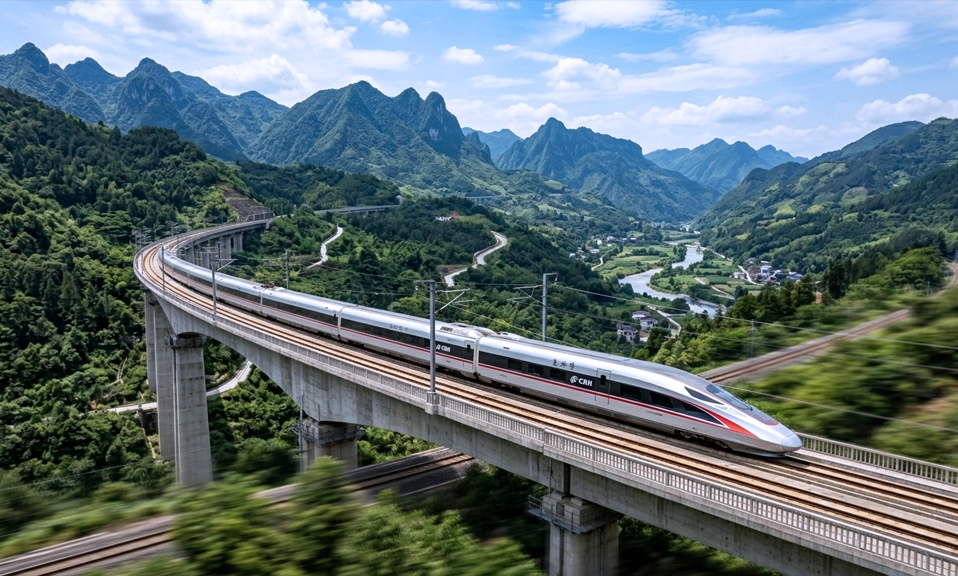
Welcome to China’s High-Speed Rail (HSR) network. And once you experience it, the idea of taking a short-haul flight feels downright archaic.
Here is why China’s bullet train network is making planes look obsolete for medium-distance travel.
🚄 1. The Scale is Unfathomable
To understand the impact, you have to look at the sheer scale of the network. China has built over 45,000 kilometers (28,000 miles) of high-speed rail tracks.
To put that in perspective: that is more than the rest of the world’s high-speed rail networks combined. You can travel from the frozen north of Harbin to the tropical south of Hainan, or from the bustling metropolis of Shanghai to the mountainous terrain of Chengdu, entirely on dedicated high-speed tracks. It is a feat of civil engineering that reshaped the geography of an entire continent in just 15 years.
⏱️ 2. The “Door-to-Door” Time Illusion
Airlines love to advertise “flight time.” A flight from Beijing to Shanghai takes about 2 hours and 15 minutes. Sounds fast, right?
But the real travel time includes:
- 1 hour to get to the airport (which is usually far outside the city).
- 1.5 hours for security, boarding, and taxiing.
- 2.25 hours in the air.
- 1 hour to get from the destination airport to the city center. Total time: ~5.5 hours.
The Fuxing bullet train covers the same Beijing-Shanghai route (1,318 km) in 4.5 hours. But because the train stations are located in the city centers and security takes minutes, the total door-to-door time is often under 5 hours. You arrive at your destination faster, with a fraction of the stress.
💺 3. The Passenger Experience is Lightyears Ahead
If you’ve ever tried to work on a laptop in economy class, you know the struggle of the tray table, the lack of legroom, and the spotty Wi-Fi.
Chinese high-speed trains are designed for comfort and productivity:
- Space: Second-class seats offer generous legroom and recline comfortably. First-class and business-class cabins are akin to premium airline lounges, with lie-flat seats and complimentary meals. are power outlets and USB ports at every single seat.
- Connectivity: 5G Wi-Fi is standard on newer trains, allowing you to work or stream seamlessly.
- Freedom: You can stand up, walk to the dining car, use a clean restroom, and stretch your legs whenever you want. No “fasten seatbelt” signs confining you to your chair for hours.
⏲️ 4. Punctuality That Puts Airlines to Shame
Air travel is notoriously fragile. A thunderstorm in Chicago can delay a flight in Miami due to air traffic control bottlenecks.
High-speed rail is remarkably resilient. While extreme weather can cause delays, China’s HSR network boasts an on-time performance rate of over 95%. When a train says it departs at 10:00 AM and arrives at 1:00 PM, it departs at 10:00 AM and arrives at 1:00 PM. For business travelers, this reliability is priceless.
🌍 5. The Environmental and Economic Edge
Short-haul flights are the most carbon-intensive form of travel per passenger mile. Trains, especially those running on China’s increasingly green electrical grid, produce a fraction of the carbon emissions of an equivalent flight.
Economically, it’s a no-brainer. A second-class high-speed rail ticket from Beijing to Shanghai costs around $90 USD. A comparable domestic flight, once you add baggage fees and airport transfers, often costs significantly more.
⚠️ The Caveat: Planes Still Have Their Place
Does this mean airplanes are dead? Not quite.
High-speed rail has a “sweet spot.” It is overwhelmingly superior for distances between 200 and 800 miles (300 to 1,300 km).
However, for ultra-long domestic routes (like Beijing to Urumqi, which is over 2,400 km) or any international travel, planes remain the only practical option. China’s HSR is not designed to replace the 777 on a transoceanic flight; it’s designed to dominate the regional and intercity travel market. And in that market, it is absolutely crushing the competition.
A Paradigm Shift in Travel
For decades, the world accepted that “fast travel” meant “air travel.” We accepted the hassles, the delays, and the discomfort as the necessary price of doing business or going on vacation.
China’s high-speed rail network proves that there is a better way. It demonstrates that when a government prioritizes long-term infrastructure over short-term profits, it can create a transportation system that is faster, cheaper, greener, and vastly more pleasant than flying.
As other countries (like those in Europe, and hopefully eventually the US) look to upgrade their transit systems, China’s HSR stands as the ultimate proof of concept. The future of medium-distance travel isn’t in the sky. It’s on the rails.
Have you ever experienced a high-speed rail system? Do you think your country should invest more in trains over expanding airports? 🚄✈️🌍