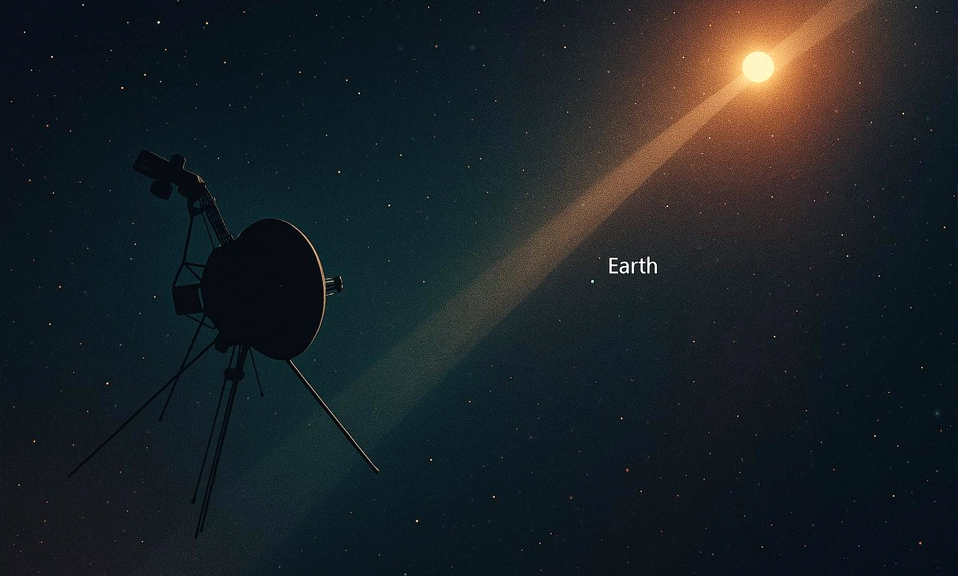
On November 18, 2026, humanity will quietly cross a threshold that no spacecraft has ever crossed before. Voyager 1, the little probe that left Earth in 1977, will become the first human-made object to be a full light-day away—so distant that a radio signal, travelling at the speed of light, will take exactly 24 hours to reach it.
The milestone is not marked by a photograph or a new discovery. It is a number—a distance of approximately 16.094 billion miles (25.902 billion kilometres) from Earth. But that number carries a weight that is difficult to overstate. It is a measure of how far we have thrown a piece of ourselves into the dark, and how long it now takes for our voice to reach it.
What Is a Light-Day?
A light-day is the distance light travels in 24 hours. Light moves at about 186,000 miles per second, so in a single day it covers roughly 16 billion miles—about 173 times the distance between Earth and the Sun.
To put that into perspective, consider the scale of the solar system we inhabit:
The Moon is about 238,855 miles away. Light crosses that gap in 1.3 seconds.
The Sun is about 93 million miles away. Sunlight takes 8 minutes and 20 seconds to reach us.
Mars, depending on where the two planets are in their orbits, is between 3 and 22 light-minutes away.
Neptune, the most distant planet, is about 4 light-hours from Earth.
Voyager 1 is now 24 light-hours away. It has left the neighbourhood of the planets far behind and is travelling through the interstellar medium—the space between the stars. Every signal it sends now is a message from a place that is, in the most literal sense, a full day removed from everything we know.
The Communication Challenge
The light-day milestone is not just symbolic. It changes the nature of the mission in a fundamental way.
From November 18 onward, every command sent from Earth will take more than 24 hours to reach Voyager 1. Every reply will take another 24 hours to return. A complete exchange—a question and an answer—will take a minimum of 48 hours, even before accounting for the time needed to process instructions and prepare a response.
This is not a new challenge for the Voyager team. The communication delay has been growing for decades, and the engineers at NASA’s Deep Space Network have long since adapted to operating a spacecraft in slow motion. But crossing the one-day threshold is a psychological boundary as much as a technical one. It is the point at which the conversation with Voyager 1 becomes genuinely interstellar—a dialogue measured not in minutes or hours, but in days.
Despite the age of the spacecraft and the challenges of operating it at such a distance, NASA has kept Voyager 1 alive through a series of remarkable engineering efforts. In recent years, the team has restored normal communications after technical problems, reactivated thrusters that had been considered unusable for roughly two decades, and continued to coax scientific data from instruments designed in the 1970s. The probe is powered by three radioisotope thermoelectric generators (RTGs), which convert the heat from decaying plutonium-238 into electricity, and that power source is slowly diminishing. But for now, Voyager 1 is still talking.
A Journey That Redefined Our Place in the Cosmos
Voyager 1 was launched on September 5, 1977, a few weeks after its twin, Voyager 2. Its primary mission was to explore Jupiter and Saturn, and it delivered discoveries that transformed our understanding of the outer solar system. It revealed volcanoes on Io, the first active volcanism found beyond Earth. It showed that Europa’s smooth surface hinted at a subsurface ocean that might harbour life. It captured the Pale Blue Dot—the iconic image of Earth taken from nearly four billion miles away, a portrait of our world as a tiny speck in a vast, empty darkness.
In 2012, Voyager 1 crossed the heliopause, the boundary where the Sun’s protective bubble of particles and magnetic fields gives way to the interstellar medium. It became the first human-made object to enter interstellar space. Since then, it has continued to travel outward at approximately 38,000 mph (61,000 km/h), sending back data about the conditions beyond the Sun’s influence.
The spacecraft carries the Golden Record, a phonograph record containing sounds and images selected to portray the diversity of life and culture on Earth, intended as a message to any extraterrestrial civilisation it might one day encounter. It is a gesture of hope and curiosity—a note in a bottle thrown into an ocean so vast that the odds of it being found are almost inconceivably small.
Where Is Voyager 1 Going?
Voyager 1 is not heading toward any particular destination. It is simply coasting outward, a tiny artifact of human ingenuity carried by its own momentum through the void.
In about 40,000 years, it will pass within 1.7 light-years of a star called Gliese 445 (also known as AC +79 3888), an obscure red dwarf in the constellation Ursa Minor. It will not enter the star’s system, and it will not be close enough to be captured by its gravity. It will simply pass by, a silent traveller on an endless journey, carrying its golden record and its memories of a world it left behind.
The one-light-day milestone
is not a finish line. It is a marker on a journey that has no end. Voyager 1 will continue to drift through the galaxy for billions of years, long after its power sources have failed, long after the last signal has faded into silence, long after the people who built it and the civilisation that launched it have become part of the deep past.
But for now, on November 18, 2026, it is still talking. It is still sending back data. And it is a full light-day away—so far that its voice takes a whole day to reach us. That is a distance that was unimaginable when it left Earth in 1977, and it is a distance that will only grow. The conversation is slowing down, but it is not over yet. And as long as Voyager 1 is out there, we will keep listening.