Is the Tennis Legend Preparing for One More Major Run?
Novak Djokovic does not need to prove anything to anyone. He has won 24 Grand Slam titles, spent more weeks at world No. 1 than any man in history, and built a case for being the greatest tennis player who ever lived. But in 2026, the 39-year-old has been searching for something far more elusive than another trophy: the feeling that he still belongs.
On Tuesday night in Beijing, he found it.
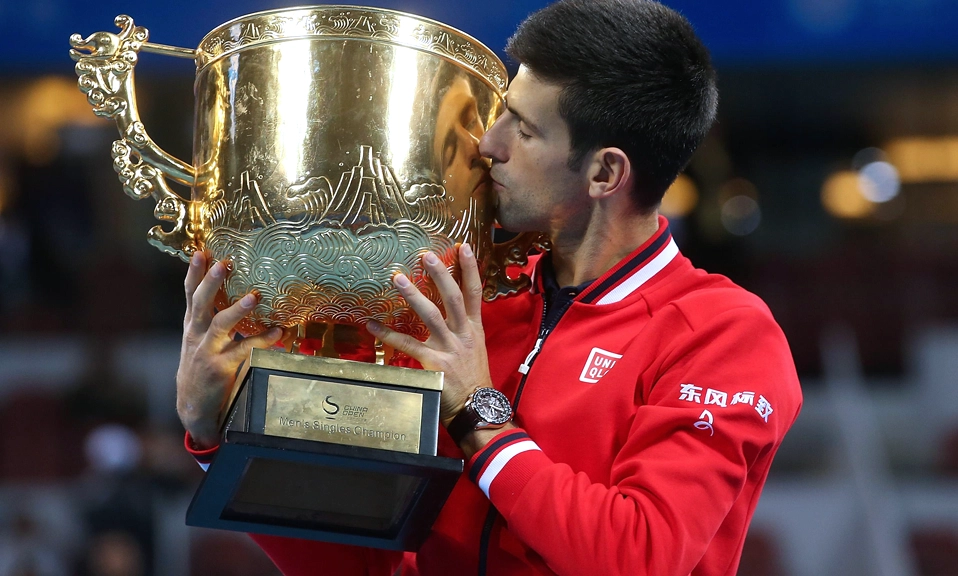
Djokovic defeated Alex de Minaur 7-6(3), 0-1 (ret.) to claim his record-extending seventh China Open title — his first since 2015, his first anywhere in over a year, and the 102nd of his career. The victory extended his perfect record in Beijing to an unprecedented 34-0, and moved him to within one title of Roger Federer on the all-time singles list.
But the scoreline — and the fact that De Minaur retired with a left adductor strain after a gruelling 68-minute opening set — only tells part of the story. The real significance of Beijing lies in what it means for a champion who has spent the past 12 months questioning whether he still has what it takes.
A Season of Struggle
To understand why Beijing matters, you have to understand the year that preceded it.
Djokovic’s 2026 campaign has been defined by near-misses and painful exits. He reached the Australian Open final in January, beating Jannik Sinner in the semifinals before losing to Carlos Alcaraz in the championship match. It was his 11th Grand Slam final since his last major title — a drought that now stretches back three years.
What followed was worse. A third-round exit at the French Open, falling to Brazil’s Joao Fonseca. A Wimbledon semifinal loss to eventual champion Sinner. And then, most painfully, a first-round loss at the US Open that left him in tears on court.
“This year has been quite challenging for me, lots of ups and downs and physical and health issues,” Djokovic admitted after Beijing. “So I was just trying to find a good feeling on the court”.
He had not won a title since the 2025 Athens Open. For a player who once dominated the sport with metronomic consistency, the drought was an unfamiliar and uncomfortable place.
The Week That Changed Everything
Beijing was supposed to be a low-stakes appearance — a chance to play in front of a crowd he hadn’t seen in 11 years, at a tournament he had never lost. What it became was a statement.
Djokovic’s path to the final was anything but easy. He battled back to beat world No. 2 Alexander Zverev in the quarterfinals — a match in which the German fired 19 aces and which Djokovic later described as one of his best of the year. He then led third seed Daniil Medvedev by a set and a break in the semifinals before the Russian was disqualified for accidentally striking a spectator with a ball.
And then came the final. De Minaur, 12 years Djokovic’s junior, pushed him to a 68-minute opening set that Djokovic won on his signature lockdown tiebreak. Both men needed medical timeouts before the second set. But it was the younger Australian who buckled first, retiring with a left adductor strain after just one more game.
The win secured a place in the record books that goes beyond the trophy. Djokovic became the oldest man to win a singles final since Ken Rosewall in 1977, and he ensured he will end the season with at least one title for the 21st consecutive year.
“This Week Has Proven Me Wrong”
The most revealing moment came in Djokovic’s post-match comments. This was not a routine victory speech. It was a confession.
“Many times I’ve questioned whether I want to keep on playing this way, feeling this way on the court,” he said. “But this week has proven me wrong once again and given me a great confidence boost”.
For a player of Djokovic’s stature, that admission carries weight. It confirms what his results have suggested all year: that the fire still burns, but the body and mind are no longer in perfect agreement about how much longer it can.
The crowd support in Beijing helped. Despite an 11-year absence, Djokovic was greeted with a level of adoration normally reserved for home favourites. He described it as “the best crowd support I have anywhere outside of Serbia”. In a season of empty stadiums and early exits, Beijing gave him something to play for.
The 2027 Question: One More Major?
The obvious question is whether Beijing is the beginning of a late-career resurgence or a final flourish. Djokovic’s own words on his future have been deliberately ambiguous.
After losing the Australian Open final in January, he refused to confirm whether he would return to Melbourne in 2027. “I don’t know if I will see you again or not,” he said. “I would like to play until the 2028 Olympics, and that could mean playing one tournament a year, or ten, or fifteen”.
He later clarified that he would “be back here next year for the 2027 Australian Open, but I don’t know in what capacity” — leaving open the possibility that he might attend as a former champion rather than an active player.
What Beijing has done is give him a reason to keep going. The victory snapped a 12-month title drought. It proved he can still beat top-10 opponents — Zverev, Medvedev, and De Minaur in three consecutive days. And it reminded him, in his own words, that he “can beat the best”.
The Obstacles That Remain
The path to a 25th Grand Slam title is steeper than it has ever been.
Jannik Sinner and Carlos Alcaraz have established themselves as the two dominant forces in men’s tennis. Sinner beat Djokovic at Wimbledon and withdrew from the US Open with a knee injury that may or may not affect his 2027 campaign. Alcaraz beat him at the Australian Open and remains the sport’s most complete player.
The physical toll is real. Djokovic has dealt with injuries and health issues throughout 2026. At 39, he cannot recover the way he once did. The Beijing final was decided partly because De Minaur’s body failed — a reminder that at this stage of his career, Djokovic’s greatest opponent may be attrition.
The motivation question remains unanswered. Djokovic has nothing left to prove. He has won everything there is to win. The only thing driving him now is the desire to win one more major — and the fear that he might walk away without it.
Novak Djokovic
won his seventh Beijing title on Tuesday night. It was his 102nd career title. It was his first in over a year. And it was, by his own admission, exactly what he needed.
Whether it leads to one more major run is impossible to predict. The Australian Open is three months away. The body will have its say. So will Sinner, Alcaraz, and the rest of a generation that has caught up to him.
But for one week in Beijing, the greatest player of all time looked like he belonged again. And that, for now, is enough.
The legend is not finished yet. The question is whether he has one more chapter left to write.