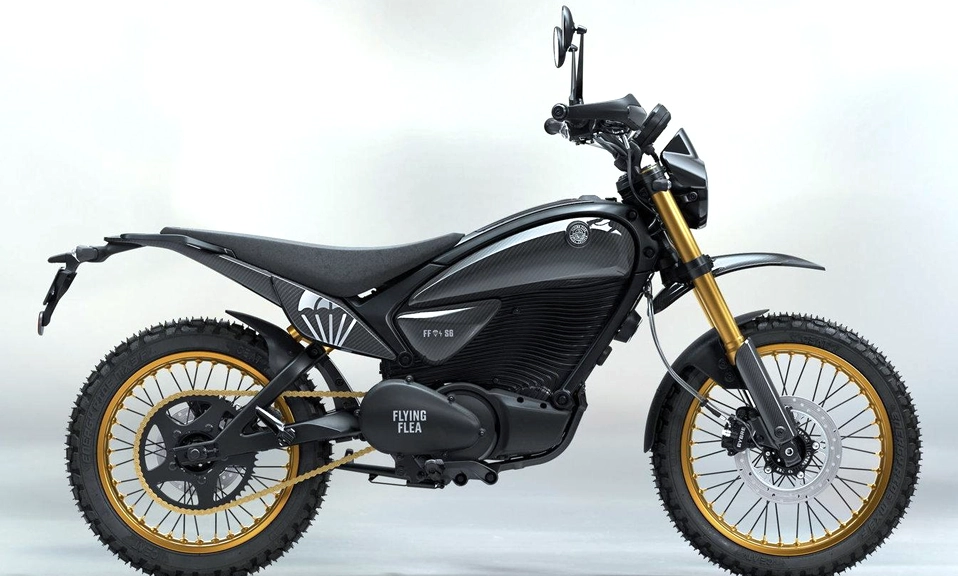
Royal Enfield’s first electric motorcycle, the Flying Flea S6, is not an attempt to reinvent the wheel. It is an attempt to electrify it in a way that feels utterly familiar. Unveiled at EICMA 2026, the S6 is a scrambler-styled electric motorcycle that deliberately rejects the futuristic, screen-heavy aesthetic of most EVs. Instead, it wraps electric propulsion in classic Royal Enfield design language—spoked wheels, a high enduro seat, and a finned battery casing—and bets that the best way to win over traditional riders is to make an electric bike that feels like a “real” motorcycle.
The strategy is both pragmatic and pointed. Royal Enfield has built its modern reputation on accessible, characterful machines that prioritize feel and affordability over raw specification. The Flying Flea S6 applies that philosophy to electric mobility. The question is whether it is enough to convince the skeptics.
The Design: A Scrambler First, an EV Second
The S6’s visual identity is its strongest asset. It is built on the lightweight, forged-aluminium chassis of its road-focused sibling, the Flying Flea C6, but reworked for a more rugged, dual-purpose stance. The differences are deliberate: where the C6 uses a girder fork, belt drive, and cast wheels, the S6 swaps in an inverted fork, chain final drive, and spoked 19-inch front and 18-inch rear wheels wrapped in dual-sport tyres. A high-mounted, long enduro-style seat replaces the C6’s single seat, and the frame is blacked out for a more military, utilitarian look.
The most distinctive detail is the finned magnesium battery casing, designed to dissipate heat and visually echo the cooling fins of an air-cooled combustion engine. It is a clever piece of design theater, but it also serves a functional purpose. The overall effect is a motorcycle that looks like it has been in Royal Enfield’s lineup for years—a scrambler that happens to be electric, not an electric bike pretending to be a scrambler.
The Technology: Smart, Not Overwhelming
The S6’s technology suite is modern without being intrusive. A round 3.5-inch touchscreen runs Royal Enfield’s in-house Fleaware.OS, offering integrated navigation, voice assist, app connectivity, and over-the-air updates. The safety package includes lean-sensitive ABS (switchable at both wheels) and traction control, along with a dedicated off-road riding mode that is exclusive to the S6. There is even a voice assist button to control navigation and music, and the bike can be unlocked via a smartwatch.
This is a sensible, rider-focused electronic architecture. It provides the conveniences modern riders expect—navigation, connectivity, safety aids—without turning the cockpit into a smartphone on wheels. It is a specification that respects the rider’s attention rather than competing for it.
The Performance Question: The Specs Are Still a Secret
Here is where the S6 becomes difficult to evaluate on its own terms. Royal Enfield has not released detailed power, torque, battery capacity, range, or charging figures for the S6. The company describes the performance as “sharp” and “punchy,” but that is marketing language, not data.
The most reliable benchmark comes from its sibling, the C6. That model produces a peak of 20bhp (11bhp continuous) from a 3.91kWh battery, weighs 124kg, and managed around 60 miles (approximately 96 km) of real-world range in MCN’s testing, with a 70mph top speed. The S6 is expected to be in a similar ballpark, albeit with “a little more weight” due to its scrambler hardware. Early estimates for the S6’s range have hovered around 150 km, but these are unconfirmed.
This is a 125cc-equivalent electric motorcycle. It is designed for urban commuting, extra-urban trips, and light off-road exploration—not for touring or high-speed highway work. The range is modest by electric vehicle standards, and the battery is not removable, which limits charging flexibility for riders without off-street parking. These are real limitations, but they are also consistent with the bike’s intended use case.
Can It Win Over Traditional Riders?
The answer depends on what “traditional riders” want.
If they want familiarity, the S6 delivers. The chain final drive is a deliberate choice that traditional motorcyclists will recognize and understand. As one analysis noted, “Traditional riders will find it’ll make the S6 feel more like a ‘real’ bike”. The scrambler ergonomics, the spoked wheels, the upright riding position, and the classic silhouette all signal that this is a motorcycle first. The absence of a clutch and gears is the only major departure from convention, and the automatic transmission makes the bike more accessible, not less.
If they want value, the S6 is competitive. The C6 launched in the UK at £5,300, and the S6 is expected to carry a premium of ₹20,000–30,000 over its sibling in India, with estimates placing it in the ₹2.3–3.9 lakh range. That is not cheap, but it is competitive with equivalent electric two-wheelers and significantly less than most premium electric motorcycles. For riders who want an electric bike that looks and feels like a motorcycle, rather than a mobility device, the S6 may be the most attainable option.
If they want range and performance, the S6 will disappoint. The C6’s real-world range of around 60 miles is modest, and the S6 is unlikely to dramatically exceed it. Riders accustomed to 200+ miles on a tank will find the S6’s limitations frustrating. The charging infrastructure in most markets is still not mature enough to make electric touring practical, and the non-removable battery is a barrier for riders without a garage or driveway.
The S6’s most likely buyers are not hardcore traditionalists. They are urban commuters, newer riders, and lapsed motorcyclists who want a stylish, approachable, low-maintenance machine for city riding and weekend exploration. Royal Enfield has explicitly positioned the Flying Flea brand as a “City+” proposition, and the S6 is designed to appeal to riders who might never have considered a motorcycle before. For that audience, the S6 is a compelling proposition.
A Bridge, Not a Revolution
The Royal Enfield Flying Flea S6 is not trying to convert the electric skeptic who demands 300 miles of range and 15-minute charging. It is trying to build a bridge between the motorcycle Royal Enfield knows how to make and the electric future it knows is coming. It does this by prioritizing the things that make motorcycling feel like motorcycling: the stance, the stance, the mechanical honesty of a chain drive, and the visual language of a scrambler.
The missing specifications are frustrating, and the delayed launch to summer 2027 suggests that Royal Enfield is still refining the formula. But the philosophy is sound. If the S6 rides as well as it looks, and if the price lands in the expected range, it could be the first electric motorcycle that feels like it was built for riders who love motorcycles—not for technologists who love gadgets.
The Flying Flea S6 will not replace the Classic 350 or the Himalayan in the hearts of traditional riders. But it might convince a new generation to join them. And for Royal Enfield, that may be enough.