For decades, Mars has been painted as a dead planet—a cold, silent world whose volcanic glory days ended billions of years ago. But a new discovery is challenging that picture in the most unexpected way: a stinky, vinegar-scented gas is seeping from cracks on the flanks of one of Mars’ largest volcanoes, and scientists believe it may be the strongest evidence yet that the Red Planet is not geologically dead, but merely sleeping.
The gas is hydrogen chloride (HCl) , and it was detected by the European Space Agency’s ExoMars Trace Gas Orbiter (TGO) , a spacecraft that has been circling Mars since 2016. The findings, published on November 4, 2026, in the journal Science Advances, have reignited a debate that has simmered for years: is Mars still volcanically active, and if so, what does that mean for the search for life?
The Discovery: A Gas That Shouldn’t Be There
Hydrogen chloride is not a gas that belongs in the Martian atmosphere in large quantities. On Earth, it is commonly found escaping from volcanic vents, where it is released from hot magma beneath the surface. On Mars, atmospheric HCl is known to follow a seasonal pattern, peaking in the northern hemisphere winter and largely disappearing in summer, driven by the planet’s dust and water cycles.
But in 2021, the TGO spotted something unusual: spikes of HCl above the northern hemisphere during early summer, exactly when the gas should have been absent. And these spikes were not random. They were localised in space and time, appearing repeatedly in the same place and the same season—above volcanic fissures on the flanks of Alba Mons, the largest volcano on Mars by surface area.
The team, led by Alexander Trokhimovskiy of the Space Research Institute at the Russian Academy of Sciences, then turned to the TGO’s CaSSIS camera to look at the surface beneath the gas. What they found was striking: fresh, narrow fissures, in some cases hundreds of metres long, associated with colour changes on the surface—cracks that had not been there before. “The Trace Gas Orbiter was able to find the smoking gun,” said co-lead author Daniel Mège of the Polish Academy of Sciences. “It was like looking for a needle in a haystack”.
The Case for Active Volcanism: A Sleeping Giant
The combination of fresh fissures and localised HCl emissions is compelling. The researchers suggest that magmatic gases are rising through these cracks from hot magma beneath the surface—a sign of dormant, possibly ongoing, volcanism. As Mège put it: “Our findings suggest that Mars has retained enough internal heat to support volcanic activity until recently, and possibly still does”.
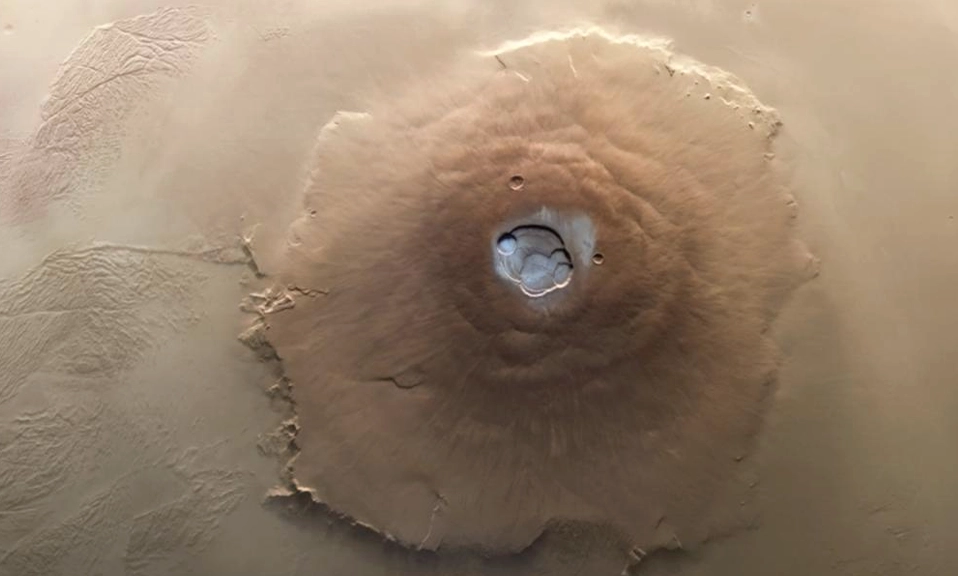
This is not the first hint that Mars is not geologically dead. NASA’s InSight lander detected marsquakes whose rumblings suggested active subsurface fluid or magma movement. Orbital imagery has shown lava flows that appear to be only a few million years old. And the largest volcano in the solar system, Olympus Mons, may have been active as recently as two million years ago—a blink of an eye in geological terms.
But the HCl discovery is different. It is not a relic of ancient activity. It is a live signal—a gas that is being released now, in a pattern that cannot be explained by atmospheric chemistry alone. “Our results are best explained by ongoing igneous processes in the Martian interior,” the researchers write.
The Caveats: Suspicion Is Not Proof
The scientific community is excited, but cautious. The evidence is strong, but it is not definitive. Nicolas Thomas of the University of Bern, a member of the team, is explicit about the limits: “Suspicion is one thing, proof is better, right? I’m a terrible sceptic. Until you put something down there and you actually sniff the stuff coming out of the ground, you haven’t got unambiguous proof”.
The atmosphere above Alba Mons is turbulent, filled with dust devils and chaotic wind patterns. Modelling the wind direction to link the gas to the fissures is difficult, and the team acknowledges that the source could, in theory, be something other than magma. The HCl spikes are intermittent, appearing in only a handful of the TGO’s observations. And no new lava flows or eruptions have ever been directly observed on Mars.
But the combination of evidence—the fresh fissures, the seasonal timing, the localisation—makes a volcanic origin the most plausible explanation. As Lena Noack of the Free University of Berlin put it, the finding is “highly interesting” and consistent with a growing body of research that has already been challenging the “dead Mars” narrative.
Why It Matters: The Search for Life
The implications of a volcanically active Mars extend far beyond geology. If there is magma beneath the surface, there is heat. And where there is heat, there is the possibility of liquid water—and potentially, the conditions for life.
“Looking for Martian life in the seeping fissures of the Alba Mons region would make a lot of sense,” Mège said. “If hydrothermal systems are active, they could contain the ingredients and energy needed for microorganisms to develop and shield microorganisms from the hostile and changing environment above the surface”.
Mars is a hostile place for life as we know it. Even at the equator, nighttime temperatures can plunge to −70°C to −80°C. But a continuous subterranean heat source—a magma chamber, a hydrothermal system—could provide a refuge. It could melt ice, circulate water, and create chemical gradients that microbes could exploit. It would not be proof of life. But it would be a place worth looking.
Mars is not the dead planet
we once imagined. The discovery of hydrogen chloride seeping from fresh fissures on Alba Mons is the strongest evidence yet that the Red Planet retains enough internal heat to support volcanic activity—and that the processes that shaped its dramatic landscape may not be entirely finished.
The finding does not mean an eruption is imminent. It does not mean we have found life. What it means is that Mars is geologically alive in a way we are only beginning to understand—a sleeping giant, not a corpse. And in the cracks of its ancient volcanoes, there may be warmth, water, and perhaps even the conditions for life.
The next step is to go there. A lander or rover sent to Alba Mons, equipped to sniff the gas and sample the fissures, would turn suspicion into proof. Until then, the mystery of Mars’ volcanic heart remains open—and more intriguing than ever.