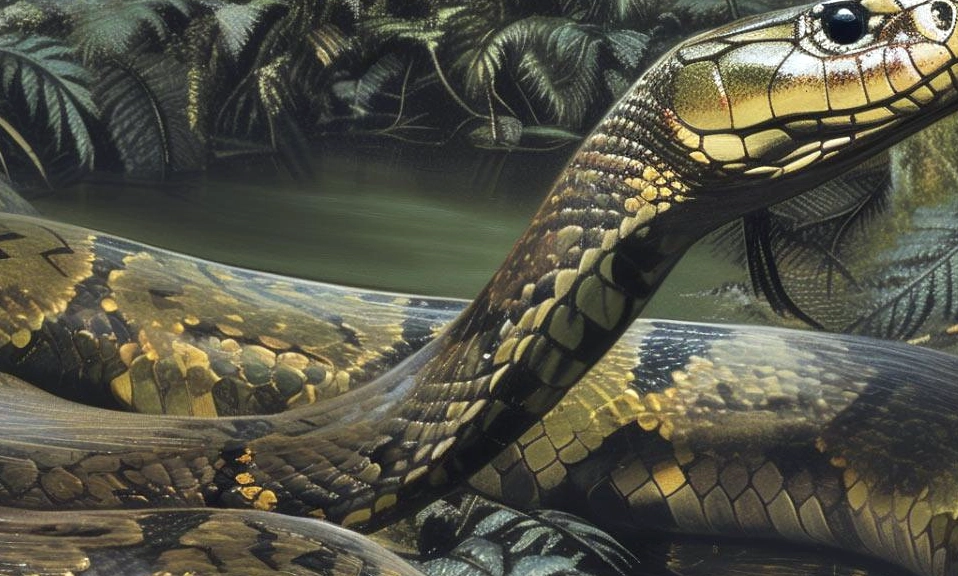
In a lignite mine in western India, paleontologists have unearthed fossil remains of a colossal snake that slithered through ancient swamps some 47 million years ago. Named Vasuki indicus, this prehistoric giant may have stretched up to 15.2 meters (nearly 50 feet) in length—putting it in direct competition with Titanoboa, the legendary snake long considered the largest to have ever lived.
The discovery, described in the journal Scientific Reports, offers a rare window into a time when the Indian subcontinent was a tropical haven for some of the largest reptiles in Earth’s history.
The Discovery: 27 Vertebrae and a Prehistoric Giant
The fossils were uncovered at the Panandhro Lignite Mine in the Kutch district of Gujarat, India. Researchers from the Indian Institute of Technology Roorkee, led by paleontologists Debajit Datta and Sunil Bajpai, identified the new species based on 27 well-preserved vertebrae, some of which were still connected in their original anatomical position.
Each vertebra was massive—the largest measuring 11 centimeters (over 4 inches) wide. Using data from living snakes and known fossil records, the team estimated the snake’s total body length through two different modeling methods. The first yielded an estimate of 10.9 to 12.2 meters, while the second suggested a length of 14.5 to 15.2 meters. The authors themselves caution that there is significant uncertainty in these calculations, as no complete skeleton was found.
How Big Was Vasuki indicus?
If the higher estimates are correct, Vasuki indicus was a true giant—easily the length of a large tour bus and nearly double the size of today’s biggest snakes, such as reticulated pythons, which rarely exceed 25 to 30 feet. The snake likely weighed close to a ton.
For comparison, Titanoboa, which lived about 60 million years ago in what is now Colombia, is estimated to have reached around 13 meters (about 43 feet) in length and weighed 1,140 kilograms. While researchers cannot say with certainty whether Vasuki was longer than Titanoboa, the two were clearly in the same weight class.
A Slow-Moving Ambush Predator
With a body that massive, Vasuki indicus was not built for speed. Researchers believe it was a slow-moving ambush predator, lying in wait for prey to wander too close before striking and squeezing it to death with its powerful muscular coils—a hunting strategy similar to that of modern anacondas and large pythons.
Its diet and exact hunting behavior remain uncertain, as the fossils found so far do not preserve stomach contents or other direct evidence of what it ate. But the image is clear: a serpent of staggering proportions, hidden in the forested swamps of ancient India, waiting for the right moment to strike.
Why Was It So Big?
Vasuki indicus lived during the Middle Eocene, a period when the climate in the region was tropical, with average temperatures around 28°C (82°F). Snakes are cold-blooded, relying on external heat to regulate their body temperature. In a warmer world, they have more energy available for growth, which helps explain why reptiles reached such enormous sizes during this era.
The snake belonged to the now-extinct family Madtsoiidae, a group of snakes that thrived for nearly 100 million years and spread across Africa, Europe, South America, Australia, and India. Researchers believe the group originated in India when the subcontinent was isolated during the breakup of Gondwana, and later dispersed to other continents as land connections formed.
A Name Rooted in Mythology
The genus name Vasuki is drawn from Hindu mythology—Vasuki is the serpent king associated with the god Shiva, often depicted coiled around Shiva’s neck. The species name indicus refers to India, the country of its discovery.
It is a fitting name for a creature that, in life, would have been every bit as awe-inspiring as the mythical serpent it honors.
What the Discovery Means
The identification of Vasuki indicus adds a major new chapter to the story of snake evolution. It provides crucial evidence that giant snakes were not limited to South America, where Titanoboa was found, but also thrived in ancient India. It also supports the hypothesis that the madtsoiid family originated in India before spreading across the globe.
Further research published in 2025 by the same team revealed additional Eocene snakes from western India, including a new aquatic species, Pterosphenus rannensis. This suggests that Vasuki lived in a rich ecosystem teeming with diverse snake species, each occupying its own ecological niche.
As paleontologists continue to study the fossils from the Kutch region, the full picture of this ancient serpent—and the world it inhabited—will only become clearer. For now, Vasuki indicus stands as a reminder that Earth’s past was home to creatures that defy imagination, and that the biggest snakes ever to live may not have been the ones we thought.