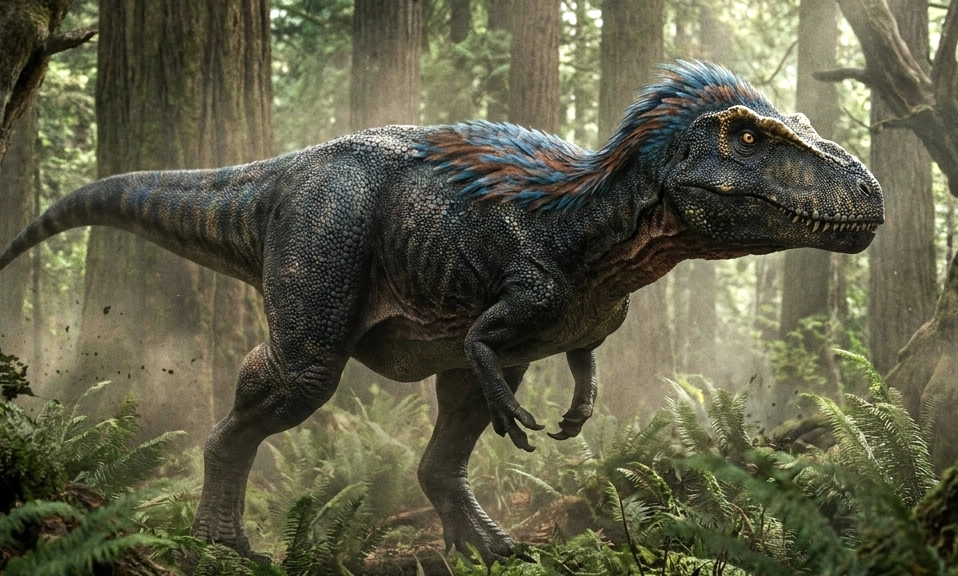
Two stunning discoveries are rewriting what we know about the tyrant lizards. One is a brand-new species pulled from a museum drawer after nearly a century. The other is the final confirmation of a decades-old suspicion: T. rex was not the only apex predator of its age. Together, they paint a picture of a Cretaceous world far more complex—and more crowded—than anyone imagined.
For generations, the story of the Late Cretaceous in North America was simple. There was Tyrannosaurus rex, the undisputed king, a bone-crushing behemoth that dominated the landscape. Any smaller tyrannosaur fossils found alongside it were assumed to be juveniles—teenage T. rexes still growing into their crown.
That story is now over.
A Century-Old Fossil Finally Gets Its Name
The first discovery comes from the Isle of Wight, off the southern coast of England. In 1924, the Natural History Museum in London acquired a chunk of a dinosaur skull—one of over a thousand specimens collected by amateur palaeontologist Reginald Walter Tooley. For nearly a hundred years, it sat in a drawer, overlooked and unstudied.
Then a team led by Dr Cassius Morrison of University College London ran a CT scan on the fossil, creating a 3D model and comparing it with skulls from tyrannosaurs, spinosaurs, raptors, and other two-legged predators. What they found was something entirely new.
They named it Invictibellatrix amberina. The name means “unconquered female warrior”—a fitting title for a predator that belonged to a group called megaraptorans, agile, two-legged carnivores closely related to Tyrannosaurus rex but built very differently.
A Killer Built Differently
Unlike T. rex, which relied on its massive jaws and banana-sized teeth to crush bone, Invictibellatrix had a slender head and attacked with its large arms and giant curved claws—some 10 to 20 centimeters long. It was smaller than its famous cousin, measuring roughly three to four meters long and just over a metre and a half tall, about the height of a human. It likely had feathers, and it hunted small dinosaurs, lizards, and mammals, occupying a niche similar to a modern hyena.
Crucially, it was not the apex predator of its time. But for humans, it would have been far more dangerous than a T. rex. As Morrison put it, Invictibellatrix would have seen us as “perfectly sized prey”—about a third of its body weight. “They definitely would have chased us,” he said. “A T. rex would not have bothered, as we would have been too small”.
The discovery is the first megaraptoran ever found in Europe, filling a key gap in the fossil record and supporting the theory that these predators originated in Asia and migrated through Europe before becoming apex predators across the southern landmass of Gondwana. “It is a real mystery that this fossil was overlooked for so long,” Morrison said.
The Nanotyrannus Debate Is Finally Settled
The second discovery is not a new fossil, but a new verdict on an old one. For more than eighty years, palaeontologists have argued over a set of smaller tyrannosaur skeletons found in North America. Were they young T. rex individuals, still growing into their adult proportions? Or were they something else entirely?
The debate began with the 1942 discovery of the “Cleveland Skull,” a uniquely proportioned tyrannosaur skull housed at the Cleveland Museum of Natural History. Over the decades, more specimens emerged, including a remarkably complete skeleton nicknamed “Jodi,” excavated from Montana’s Hell Creek Formation in 2019.
New research published in late 2025 and confirmed in 2026 has settled the question. Scientists examining growth rings within preserved bones found that these dinosaurs were fully formed adults, not juveniles. A comprehensive analysis identified roughly 150 morphological differences between these specimens and T. rex—far too many to be explained by the natural changes that occur during growth. They were, in fact, adults of a separate lineage: Nanotyrannus lancensis.
Two Killers, One Landscape
Nanotyrannus was not a miniature T. rex. It was a different kind of predator altogether.
An adult Nanotyrannus reached about 18 feet (5.5 meters) in length and weighed around 1,500 pounds (680 kilograms)—roughly half the length of an adult T. rex. But its proportions were distinct. Instead of the famously stubby arms of its larger cousin, Nanotyrannus had longer forelimbs and larger hand claws. Its teeth were more slender and bladelike, designed for slashing meat rather than crushing bone.
The ecological picture that emerges is one of niche partitioning. T. rex was the lumbering, bone-crushing apex predator that hunted slower, larger prey and could afford to eat the entire carcass. Nanotyrannus was faster and nimbler, built to chase down quicker prey and slash it apart. As Cassandra Hatton of Sotheby’s put it: “It’s like a lion and a cheetah. They hunted different prey. They were around at the same time”.
This coexistence fundamentally changes our understanding of the Late Cretaceous. T. rex was not a solitary tyrant ruling an empty landscape. It shared its world with at least one other large tyrannosaurid—a smaller, faster killer occupying its own distinct ecological role.
Why These Discoveries Matter
Both finds challenge long-held assumptions about dinosaur ecosystems.
The Invictibellatrix discovery shows that megaraptorans—a group so poorly known that they are considered “the most mysterious of the large, meat-eating dinosaurs”—were more widespread than anyone realized. It also demonstrates the untapped value of museum collections. As Professor Paul Barrett of the Natural History Museum noted, “Despite over 200 years of collecting, the Isle of Wight continues to surprise us with new dinosaur species”.
The Nanotyrannus confirmation rewrites the ecological history of North America’s most famous fossil grounds. It means that the Hell Creek Formation, long portrayed as the domain of a single tyrannosaur king, was actually home to a complex system of predator interaction and niche partitioning—a richer, more competitive world than the old single-king narrative allowed.
And there is a cultural dimension, too. The “Jodi” specimen, one of only three known Nanotyrannus skeletons, is set to go up for auction at Sotheby’s on October 27, with estimates of $6 million to $8 million. It is a reminder that these scientific debates have real-world stakes, not just for museums and collectors, but for how we understand the most iconic creatures of the prehistoric past.
The “king” of the dinosaurs
has been dethroned—not in size or ferocity, but in exclusivity. T. rex was not alone. It shared its world with a smaller, faster, blade-toothed cousin that occupied its own niche and hunted its own prey. And on the other side of the Atlantic, a forgotten fossil in a museum drawer has revealed yet another cousin—a clawed, feathered predator that would have found humans far more appetizing than the mighty tyrant ever would.
The Cretaceous was not a kingdom ruled by one monster. It was an ecosystem, crowded and competitive, shaped by many killers. And after a hundred years of waiting, two of them are finally stepping into the light.