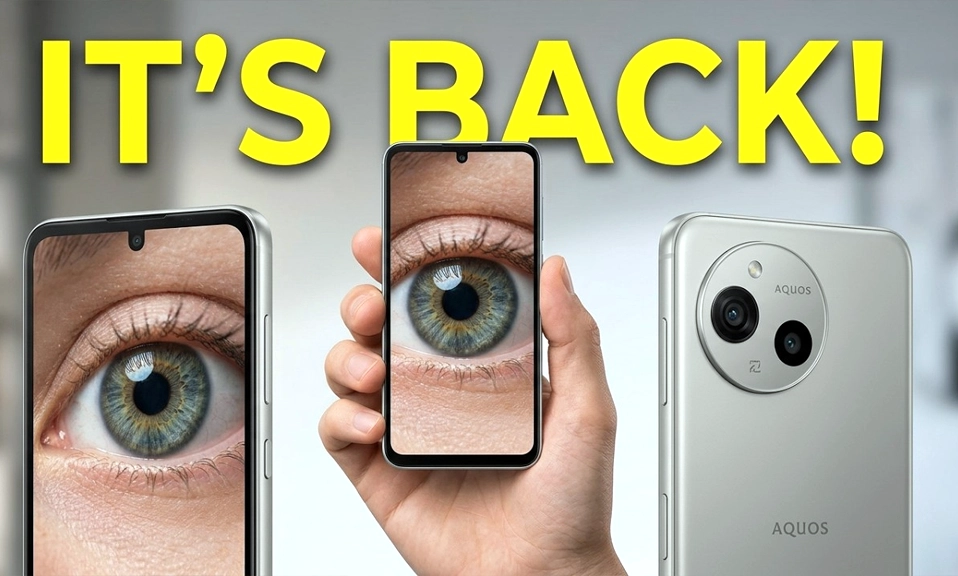
Sharp did something in its new commercial that no other phone company would dare to do.
It put its new phone on a scale. On the other side, a tomato.
The scale balanced.
That is the whole story of the AQUOS sense11. A phone that weighs the same as a tomato, is thinner than a pencil, and still packs a 5,000mAh battery that lasts two days.
And it is the phone Japan is obsessed with right now.
The Phone That Weighs Like A Tomato
The company says the 157 g phone runs about two days on its 5,000 mAh battery and will receive six years of security updates and up to four OS upgrades.
It pairs a slim, lightweight body, approximately 7.6 mm thick and 157 g, with a 5,000 mAh battery and 8 GB of RAM.
By redesigning the internal motherboard structure, the new device slims down its all-aluminum body to just 7.6mm and 157g while maintaining a 5,000mAh battery.
The AQUOS sense11 weighs 157g and is 7.6mm thick, and it still carries a 5,000mAh battery.
Weight: 157 g better than 97% of smartphones.
Design, Weight, 157 g, Thickness, 7.6 mm, Height, 151 mm, Width, 73 mm, Frame, Aluminium, Back, Aluminium, Ingress protection, IP68.
To put that in perspective:
- iPhone 17: 177g
- Samsung Galaxy S26: 174g
- Pixel 10: 204g
- OUKITEL WP63 from our last blog: 629g
The sense11 is lighter than almost every flagship on the market, and it has a bigger battery than most of them.
The new model weighs 157g and is 7.6mm thick, down from 166g and 8.9mm on the Aquos Sense 10.
It is 1.3mm thinner and 9g lighter than the previous generation.
That is why Sharp’s official ad does the tomato test. This is a Japanese-language commercial for the Sharp AQUOS sense11 smartphone. The video opens with the product name over a minimalist teal background featuring a balance scale, which then weighs the phone against a tomato to demonstrate its lightness of 157g. Text highlights ‘LIGHT’ and ‘THIN’ at 7.6mm thickness compared to a pencil.
The phone, shown in a rose-gold color with a circular camera module, floats against a blue sky with clouds. Closing text reads ‘Lightness for adult everyday life’ and ‘Half a step ahead of people’s wishes. SHARP’.
Sharp is not marketing this to gamers. It is marketing it to adults who are tired of heavy phones. People who want a phone they can hold for an hour on a train without their hand cramping. People who want a phone they forget is in their pocket.
At A Glance: AQUOS sense11
Feature | Sharp AQUOS sense11 |
|---|---|
Weight / Thickness | 157g, 7.6mm, aluminum body |
Display | 6.2-inch Pro IGZO OLED, 1080 x 2340, 1-240Hz, up to 3,000 nits |
Chip | Snapdragon 7s Gen 3 |
RAM / Storage | 8GB + 128GB or 12GB + 256GB, microSD up to 2TB |
Cameras | 50.3MP main OIS + 50.3MP ultrawide, 32MP selfie |
Battery | 5,000mAh, 36W wired charging, about 2 days |
Durability | IP68 / IP69, IPX5 / IPX8 / IPX9, IP6X dust, MIL-STD-810H, 80°C hot water |
Software | Android 17, 4 OS upgrades, 6 years security updates |
Colors | Copper, Gold, Silver, Black |
Price (Japan) | ¥94,600 (~$594) for 8GB/128GB, ¥119,900 (~$753) for 12GB/256GB |
Release | November 26, 2026, Japan only for now |
1. The Display: 240Hz And 3,000 Nits In A Mid-Range Phone
This is where Sharp flexes its display heritage. Sharp makes displays for other companies. It knows screens.
The camera system comprises a 50MP main shooter with OIS, a 50MP ultra-wide lens, and a 32MP selfie snapper.
The smartphone is equipped with a 6.2-inch Full HD+ Pro IGZO OLED display featuring a variable refresh rate of up to 240Hz and a peak brightness of up to 3000 nits.
The phone has a 6.2-inch Pro IGZO OLED display with a resolution of 2,340 x 1,080 pixels. Peak brightness reaches 3,000 nits, up 50% from the Sense 10, according to Sharp. The company lists a variable refresh rate of 1 to 240Hz, with the 240Hz mode available in supported apps.
The display is a 6.2-inch Pro IGZO OLED running at 2,340 by 1,080 pixels. Its refresh rate runs from 1 to 240 Hz in supported apps and games. Sunlight stops being a problem. Peak brightness hits 3,000 nits, half again brighter than the model that came before it.
240Hz is insane for a phone at this price. Most flagships are 120Hz. This is double. In supported games and scrolling, it feels like the screen is made of liquid.
And 3,000 nits means you can read it in direct sunlight, even in the harsh sun in East Africa or Southeast Asia. Most phones at $594 do not do that.
The phone also has 1 billion colors, 416 ppi, and a 1Hz low mode when you are reading, so it saves battery.
One promo notes its super-light 157-gram weight despite a 5,000 mAh battery and 3,000-nits display.
That combination, light + bright + smooth, is what makes this phone feel premium, even though it is not a flagship chip.
2. The Battery: 2 Days, But Slow To Fill
Battery life: 5000mAh battery, officially claimed to last about 2 days, supports 36W charging (approximately 120 minutes to fully charge).
Sharp promises 2 days. And because the chip is efficient, the display drops to 1Hz when idle, and the battery is 5,000mAh in a 6.2-inch phone, that claim is actually believable.
Most 5,000mAh phones are 190g to 210g. This one does it at 157g. That is the engineering trick.
The downside is charging. 36W is slow in 2026. It takes about 120 minutes to fully charge. Xiaomi does 90W in 35 minutes. Samsung does 45W in 60 minutes.
Sharp chose battery longevity over fast charging. If you charge overnight, you will not care. If you need a 15-minute top-up before you leave, you will.
There is no wireless charging listed, which is also a miss at this price.
3. The Chip: The Same Chip As Last Year. Yes, Really.
Here is the part that made fans angry.
The phone uses the same Snapdragon 7s Gen 3 chipset as last year’s model.
Sharp’s AQUOS sense11 raises base price 51%, keeps the same chip.
Under the hood, the Sharp Aquos Sense11 is powered by Qualcomm‘s Snapdragon 7s Gen 3 Mobile Platform and runs Android 17.
Key specifications include a slightly larger 6.2-inch Pro IGZO OLED display (1080×2340, 1-240Hz variable refresh rate) compared to the previous model, a Snapdragon 7s Gen 3 processor, memory/storage options of 8GB+128GB or 12GB+256GB, a 50.3-megapixel (1/1.55-inch) main camera + 50.3-megapixel wide-angle camera, a 5000mAh battery, microSD support, a side-mounted fingerprint sensor + face authentication (mask compatible), and Android 17.
So why would Sharp reuse the chip?
Because the Snapdragon 7s Gen 3 is already good enough for this phone’s audience. It runs WhatsApp, YouTube, Instagram, Maps, banking apps, and light games perfectly. It is efficient, which is why the battery lasts 2 days.
It is not a gaming chip. If you play Genshin Impact on max settings for 2 hours, it will get warm and throttle. If you are a normal user, you will never notice.
But the optics are bad. You are paying 51% more for the same chip. That is hard to defend.
What you do get for that price increase is more RAM, a brighter display, a lighter body, and longer software support. But Sharp needs to be honest: This is not a performance upgrade. It is a design and display upgrade.
One spec sheet sums it up: 6.2-inch Full HD+ Pro IGZO OLED display with 1-240Hz refresh, up to 3,000 nits peak brightness, Qualcomm Snapdragon 7s Gen 3 processor, 8GB/128GB or 12GB/256GB memory options with microSDXC expansion up to 2TB, dimensions 151 x 73 x 7.6 mm and 157 g weight, aluminum frame and back with glass front, IP68/IP69 dust and water resistance and MIL-STD-810H certification, and available colors Copper, Gold, Silver, and Black.
That 2TB microSD expansion is rare in 2026. Most phones killed the SD card slot. Sharp kept it. If you shoot a lot of photos or download movies, you can add 2TB for cheap.
4. Cameras: Two 50MP Cameras, No Telephoto
The rear cameras include a 50.3 MP standard lens with optical image stabilization and a 50.3 MP ultra-wide lens, with all-pixel PDAF autofocus and HDR video.
The rear camera setup consists of a 50.3MP primary camera with OIS and a 50.3MP ultrawide camera with a 122-degree field of view.
Both rear cameras shoot 50.3 megapixels.
That is unusual. Most phones give you a great main camera and a weak 8MP ultrawide. Sharp gives you two great cameras.
The main is 1/1.55-inch sensor, f/1.9, 23mm, with OIS. That is a large sensor for a mid-range phone, and OIS means your night photos will be sharp, not blurry.
The ultrawide is also 50.3MP, 122-degree field of view. That is wider than most flagships, perfect for group photos, landscapes, or tight rooms.
The selfie is 32MP, which is more than enough for video calls and selfies.
What is missing? A telephoto zoom lens. No 2x, no 3x optical zoom. You get digital zoom, which is just cropping. If you are a zoom lover, you will miss it.
But Sharp added something else: Quick Focus. A feature called ‘AKARIUM’ is shown with the phone’s camera light glowing in the dark. The ‘HOME DECO’ UI customization is displayed on screen. The ad emphasizes ‘2-DAY BATTERY LIFE’ and ‘QUICK FOCUS’ camera capability by showing the phone capturing a shattering glass sphere.
Quick Focus is Sharp’s all-pixel PDAF system that locks focus instantly, even on moving subjects like kids, pets, or a shattering glass ball. For parents, that matters more than zoom.
5. Durability: This Phone Survives Hot Water
This is the most underrated feature, and the most Japanese.
It boasts IP69 water and dust resistance, capable of withstanding strong jets of water. It clears 16 items in various MIL-STD compliant durability tests, including shock resistance, vibration resistance, humidity resistance, high temperature, low temperature, and freezing. Furthermore, to ensure peace of mind, it promises up to four OS updates and 6 years of security updates from its release.
The Sense11 carries IP68 and IP69 water and dust protection, and MIL-STD-810H certification for resistance to drops and other environmental stresses.
It also features a 3,000-nit, 240Hz Pro IGZO OLED screen and top-tier IPX9 waterproofing capable of withstanding 80°C hot water jets.
It adds IPX9 water resistance, which means surviving high-pressure water at 80°C, and Sharp says it passed 16 tests from MIL-STD-810H, a US military standard covering drops, heat and cold.
In addition to IPX5, IPX8, and IPX9 water resistance and IP6X dust resistance, the AQUOS sense11 offers high durability, including shock resistance compliant with MIL-STD-810H.
It supports dust and water resistance standards IPX5, IPX8, IPX9, and IP6X, and can withstand hot water at 80°C as well as the water flow from high-pressure cleaners.
80°C hot water. That is almost boiling water. Why? Because in Japan, people wash their phones. They use them in the bath. They clean them with hot water. Sharp built a phone that can survive that.
In Africa or Southeast Asia, that means it can survive rain, dust, drops, heat, and being washed after a dusty day. It is a rugged phone without looking like a rugged phone.
6. The Quirky Japanese Features: AKARIUM And Face-Down Notifications
Sharp’s AQUOS sense11 Signals Calls and Notifications With Its Screen Face Down.
That dark island also contains Akarium, Sharp’s light-and-sound feature for incoming calls, notifications, and quieter moments at home.
The company further differentiates the Sense11 with its proprietary Akarium experience, which uses gentle light and sound notifications alongside nature-inspired visuals.
What is AKARIUM? It is a small light ring around the camera module on the back. When the phone is face down, it glows gently for calls and notifications, like a calm aquarium light. It also plays soft sounds.
It is very Japanese. Calm, not loud. Gentle, not flashing.
Sharp also has HOME DECO, which lets you customize your home screen with themes that match your wallpaper, and AI features like object removal, shadow reduction, and reflection reduction in photos, plus auto text sensor.
These are small touches, but they make the phone feel thoughtful, not just spec-sheet.
7. Software: 6 Years Of Updates. That Is Flagship-Level.
The AQUOS sense11 runs Android 17 on a Snapdragon 7s Gen 3 processor with 8 GB RAM and 128 GB storage.
Sharp promises four Android version upgrades from Android 17 and six years of security updates from launch, one more of each than on the AQUOS sense10.
It also offers high durability and supports six years of security updates, making it a smartphone designed for long-lasting, comfortable use.
More important for keeping the phone around are promised security updates for six years from release and up to four Android version upgrades.
That means if you buy it in 2026, you will get updates until 2032. That is longer than Samsung’s mid-range phones, longer than most Chinese brands, and almost as long as Google Pixel.
For a phone that costs $594, that is excellent value. You can keep it for 5 to 6 years without it becoming insecure.
8. Price: The Big Problem
Here is the elephant in the room. This phone got 51% more expensive.
The Aquos Sense 11 goes on sale in Japan on November 26 in Copper, Gold, Silver, and Black. The phone is priced at ¥94,600 (∼$594) for the 8GB/128GB option and ¥119,900 (∼$753) for the 12GB/256GB option.
It will be released on November 26th, not only through the four major carriers but also as a SIM-free model. The SIM-free version will be priced at 94,600 yen for the 8GB+128GB model and 119,900 yen for the 12GB+256GB model.
Sharp announced the AQUOS sense11 on Tuesday, pricing its base unlocked phone at ¥94,600 in Japan. That is 50.9% above the previous model’s official store price. Sales are scheduled to start on November 26.
On November 17, 2026, Sharp announced the Aquos sense11, and its SIM-free model starts at ¥94,600 ($592).
The AQUOS sense11 is scheduled to reach Japan on November 26, 2026, starting at ¥94,600 (about $594).
Core Highlight 2: Impacted by component costs and exchange rates, the Japanese price has surged to 94,600 yen, a 50% increase; Sharp confirmed the model will not launch in Taiwan.
So why the jump? Sharp blames component costs and exchange rates. The yen is weak. OLED panels, aluminum, and chips are more expensive.
But fans are not happy. The comment section shows it.
Commenters respond in Bengali, Indonesian, and Urdu, mostly seeking practical purchase information such as RAM, price in taka, and how to obtain the phone, while others offer brief opinions on the 6.2-inch display size. One comment notes an expected Indonesia launch window of January-February.
Comments reflect a divided but engaged tech audience. Many users express fatigue with Sharp’s iterative design, noting three generations look identical and calling the camera module absurd compared to competitors. Price skepticism appears repeatedly, with doubts that waiting for discounts will work because stock disappears quickly. Others defend the familiar design for practical reasons like case compatibility and aesthetic uniqueness.
The sense11 is sold only in Japan for now. In Sharp’s announcement, the company lists a November 26 release through participating carriers and retailers, plus a SIM-free model.
The phone goes on sale in Japan on November 26 through NTT Docomo, KDDI, SoftBank, Rakuten Mobile, and J:COM.
If you are outside Japan, you will have to import it. And at $594, you are competing with Pixel 9a, Samsung Galaxy A56, Nothing Phone 3a Pro, and OnePlus 13R, all of which have faster chips or better cameras.
Sharp is betting that lightness + battery + display + durability + 6 years of updates is worth $594. For some people, it is. For others, it is not.
Who Should Buy The AQUOS sense11?
Buy it if you:
- Hate heavy phones and want the lightest 5,000mAh phone in the world
- Want a phone that lasts 2 days and 6 years of updates
- Need a bright 240Hz display for outdoor use
- Drop your phone a lot, or use it in rain, dust, or hot environments
- Want a compact 6.2-inch phone that fits in one hand
- Love microSD expansion up to 2TB
- Live in Japan or can import easily
Do NOT buy it if you:
- Need a flagship chip for heavy gaming
- Need a telephoto zoom lens
- Need fast charging, you will hate 36W
- Need wireless charging
- Want the best value for money at $594, there are cheaper phones with faster chips
- Live outside Japan and do not want to deal with import, warranty, and Japanese bloatware
A Perfect Phone For The Wrong Price?
The AQUOS sense11 is a brilliant phone with a pricing problem.
It is the lightest phone with a 5,000mAh battery. It has one of the best displays in its class. It is tougher than most rugged phones, but looks like a normal phone. It will get updates until 2032.
But it has the same chip as last year, slow charging, no telephoto, and costs 51% more than its predecessor.
If Sharp had priced it at ¥70,000 (∼$440), it would be the best mid-range phone of 2026. At ¥94,600 (∼$594), it is a niche phone for people who prioritize lightness and longevity over raw performance.
And maybe that is okay. Not every phone needs to be for everyone. This phone is for the person who picks it up in the store, feels how light it is, and says, “Oh, this is different.”
If you are that person, you will love it. If you are looking at spec sheets, you will not.