You have heard the hype.
“Starlink will replace your phone company! No more towers! No more dead zones!”
Is it true? Will Starlink Direct to Cell kill traditional mobile networks?
I looked at the real 2026 test data, not the marketing. The answer is more interesting than “Starlink wins” or “5G wins.”
One of them is better at speed. The other is better at coverage. And for most people, you will need both.
Here is the honest comparison.
Traditional mobile networks are better right now, for 95% of what you do.
They are faster, more reliable, and cheaper for everyday use.
Starlink Direct to Cell is better for the 5% that matters most: when you have no signal at all.
A recent hands-on test suggests it is still best used as a backup rather than a replacement for 4G or 5G networks.
T-Satellite is a supplemental coverage layer for texting, location sharing, emergency communication, selected apps and limited data, not a replacement for ordinary 4G or 5G broadband.
Think of it like this: Traditional networks are your car. Starlink Direct to Cell is your spare tire. You do not drive on the spare tire every day, but when you get a flat in the middle of nowhere, you are very happy it exists.
How Each One Works
Traditional Mobile Networks:
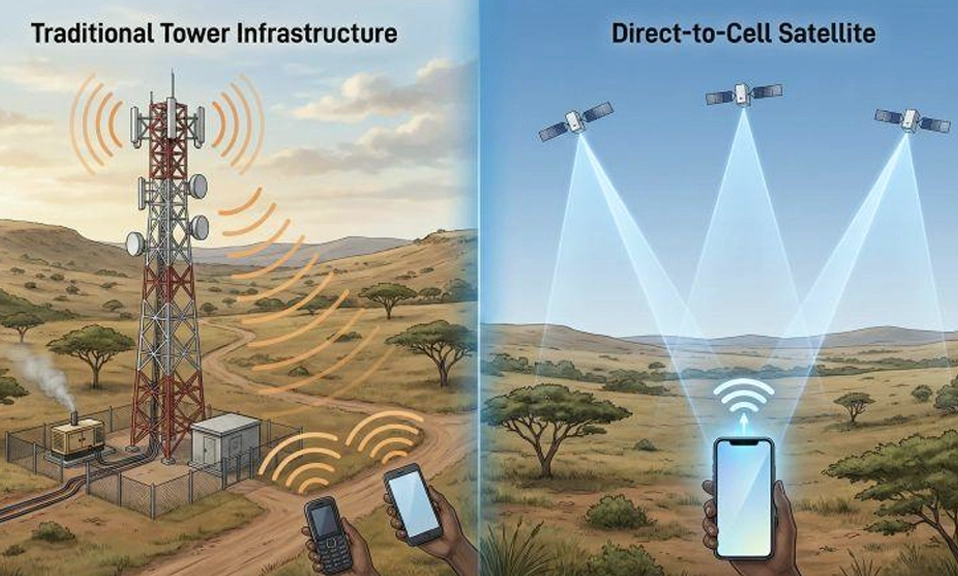
Your phone talks to a cell tower on the ground, usually within 1 to 5 km. That tower is connected by fiber to the internet. It is fast, because the distance is short and the tower is powerful.
Traditional carriers, by contrast, see coverage drop sharply outside urban and suburban areas. In rural zones, speeds often fall below 5 Mbps, and service can disappear entirely.
That is the problem. Towers are expensive. You need thousands of them to cover a country. In cities, it is worth it. In mountains, deserts, and oceans, it is not.
Starlink Direct to Cell:
Your phone talks to a satellite 550 km above Earth. That satellite acts as a cell tower in space. It relays your message to a ground station, which connects to the regular network.
Starlink’s primary advantage is its global reach. Unlike terrestrial networks, which depend on a dense web of cell towers, Starlink only requires a clear line of sight to the sky.
Coverage reaches anywhere you can see the sky, eliminating traditional dead zones.
Operating at just 550km altitude compared to traditional geostationary satellites at 35,000km, Starlink satellites deliver dramatically lower latency and higher speeds.
The service piggybacks SpaceX’s Starlink satellites and requires no extra antenna or app, automatically connecting when the phone can see the sky.
No new phone. No dish. It just switches over when you lose tower signal.
The Real Test Data: Ookla 2026
This is where the hype meets reality.
Ookla’s tests show it still lags terrestrial mobile networks in speed, reliability, and signal quality.
Ookla reported that terrestrial cell towers outpace satellite links significantly in both speed and delivery reliability across national testing routes.
Here are the numbers from Ookla and RootMetrics controlled testing along U.S. national drive routes during the second half of 2026:
|
Test
|
Starlink Direct to Cell
|
Traditional Cellular
|
|---|---|---|
|
Text delivery success
|
86%
|
98.1%
|
|
Median text delivery time
|
16.6 seconds
|
1.3 seconds
|
|
Lite data task success
|
60%
|
93%
|
|
Median lite data task time
|
922 ms
|
156 ms
|
|
Signal strength
|
-120 dBm, 15 dB weaker
|
Much stronger
|
Starlink D2D texts were delivered 86% of the time, compared with 98.1% on a representative terrestrial network, and took a median of 16.6 seconds to arrive versus 1.3 seconds on cellular. In Ookla’s “lite data” tests, 60% of D2D sessions were fully successful, compared with 93% on terrestrial networks.
Terrestrial cellular networks outperformed Starlink’s D2D network in texting and data. Texts sent over Starlink’s D2D service were delivered 86% of the time, below the 98.1% success rate RootMetrics recorded on a representative terrestrial cellular network along the same route.
That is a huge gap. If you send 100 texts on traditional networks, 98 arrive in 1 second. On Starlink, 86 arrive in 16 seconds.
For emergency texts, 86% is amazing when the alternative is 0%. For everyday chatting, 86% is frustrating.
Speed: Traditional Wins By A Lot
This is not close.
Coverage for traditional is limited to populated areas, speed is very fast, 5G up to 1 Gbps, latency is very low, 10 to 30ms. For Starlink, coverage is global, including oceans, speed is moderate, 2 to 10 Mbps initially, latency is low to moderate, 25 to 50ms.
5G deployments can deliver 50 to 500 Mbps, far outpacing satellite right now.
During trial measurements of the Starlink direct-to-cell network, researchers at the Universidad Politécnica de Madrid and Weplan Analytics estimated an aggregate channel capacity of roughly 4 megabits per second under favorable conditions, with potential regulatory and hardware upgrades raising that ceiling toward 12 megabits per second. By comparison, terrestrial T-Mobile 5G networks advertise peak download speeds up to 561 megabits per second.
Ookla’s 4.7 Mbps-per-beam figure and a separate study’s 3.1 Mbps estimate are model-based capacity calculations, not phone speed-test results.
That 4 Mbps is not per phone. It is per beam, per satellite, shared by everyone in that area. If 100 people are trying to use Starlink in the same valley, they share that 4 Mbps.
Traditional 5G gives you 50 to 500 Mbps, just for you.
And in real use, Google Maps remained functional through the satellite connection, although performance was slower than a normal mobile network. It took around 30 to 60 seconds for maps to load completely. Loading times improved when the phone was used outdoors. Even then, the connection remained noticeably slower than standard 4G and 5G services.
So for speed, traditional wins. For coverage, Starlink wins.
Coverage: Starlink Wins By A Lot
Network Latency RTT is 10ms to 30ms for 5G Terrestrial, 25ms to 45ms for LEO Direct-to-Cell. Geographic Coverage Rate is 15% to 30% of Global Landmass for legacy telco, 100% Ubiquitous, Land, Sea, Air for Starlink.
That is the whole point. Traditional networks cover only 15% to 30% of the Earth’s land. They cover cities, highways, and suburbs. They do not cover oceans, mountains, deserts, jungles, or most of Africa’s rural areas.
Starlink covers 100%, as long as you can see the sky.
If you are on a boat in the Pacific, traditional networks give you nothing. Starlink gives you texting.
If you are hiking in the Himalayas, traditional networks give you nothing. Starlink gives you texting.
If you are in a city, traditional networks give you 500 Mbps. Starlink gives you 4 Mbps shared. You would never choose Starlink in a city.
Latency: Traditional Wins, But Starlink Is Not Bad
Old satellite phones had 500ms+ latency. That is why calls sounded delayed and weird.
Starlink is different. Latency is 500ms+ for traditional satellite phones, less than 50ms for Starlink Direct-to-Cell. Coverage is variable for old satellite phones, anywhere you see sky for Starlink. Connection time is up to 6 minutes for old satellite phones, seconds for Starlink.
25 to 45ms is totally usable. It is a bit slower than 5G’s 10 to 30ms, but you will not notice it for texting or maps. You will notice it for gaming or video calls, but Starlink does not do video calls yet anyway.
Reliability: Traditional Wins, For Now
Why is Starlink only 86% reliable for texts?
Because the satellite is moving at 27,000 km/h. It is only above you for a few minutes. If a tree, a building, or a cloud blocks it, your message fails and has to wait for the next satellite.
Ookla measured a median U.S. D2D signal strength of -120 dBm, 15 dB weaker than terrestrial.
That weak signal means it drops more often. In a city, a tower is 500 meters away and blasts a strong signal. In space, a satellite is 550 km away and whispers.
That will improve as SpaceX launches more satellites. With 650 satellites now, there are gaps. With 15,000 satellites planned, there will be far fewer gaps.
But in 2026, traditional is more reliable.
Price: Traditional Is Cheaper For Everyday Use, Starlink Is Cheap For A Safety Net
T-Satellite is included on T-Mobile’s top-tier Experience Beyond plan, but it’s also available as a $10 a month add-on for other T-Mobile users.
T-Satellite lets compatible phones text and use select satellite-ready apps outdoors in places no carrier tower reaches. It’s included at no extra cost on T-Mobile’s Experience Beyond 2.0 and Better Value plans. Everyone else, including AT&T and Verizon customers with a compatible eSIM phone that isn’t locked to a carrier, pays $10 a month, which T-Mobile calls a limited-time price.
As of August 16, 2026, T-Mobile says T-Satellite is included with certain plans. For other customers, its buying page advertises an add-on at $10 per month per line, described as a limited-time $5-per-month saving.
Intro pricing is $10 per month for a limited time, rising to $15 later, with top-tier plans such as Experience Beyond at $100 a month.
So for $10 a month, you get a backup that works when your $70 a month 5G plan fails.
That is a good deal if you spend time off-grid. That is a bad deal if you never leave the city.
And customers of other carriers can sign up for about $10 a month, though you need a clear view of the sky and a compatible phone. Native voice calls were still in development as of mid-2026.
Voice is still not here. If you are paying $10 a month expecting to make calls, you will be disappointed in 2026.
When Is Each One Better? The Real Decision
Choose Traditional Mobile Networks if:
- You live in a city or suburb
- You need fast data for video, social media, work
- You need reliable calls and texts every day
- You want the cheapest price per gigabyte
- You never go off-grid
Choose Starlink Direct to Cell as an Add-On if:
- You hike, camp, boat, or travel to rural areas
- You live in a place with spotty coverage
- You want an emergency safety net
- You work outdoors, farming, mining, or construction
- You live in a country where towers do not reach your village
Do NOT choose Starlink as a replacement if:
- You think it will replace your 5G plan in 2026. It will not.
- You need to stream video, play games, or do video calls.
- You are indoors most of the time. Satellite needs a clear sky.
Will Starlink Eventually Replace Traditional Networks?
Not completely. Here is why.
Traditional networks will always be faster and cheaper in cities, because fiber + towers is more efficient than satellites when you have millions of people in a small area.
Starlink will always be better in remote areas, because launching a satellite is cheaper than building 1,000 towers in the Sahara.
The future is not Starlink vs Traditional. The future is Starlink + Traditional.
Your phone will use 5G when it can, and automatically switch to satellite when it cannot. You will not even notice. That is already how T-Mobile’s T-Satellite works. T-Mobile’s T-Satellite service, launched in 2025, represents a paradigm shift in connectivity. By leveraging over 650 Starlink satellites, the service automatically switches to satellite-based data when terrestrial signals falter.
That is the real revolution. Not replacement. Integration.
So, which is better?
For speed, reliability, and everyday use: Traditional mobile networks win, by a lot. 98.1% vs 86% delivery, 1.3 seconds vs 16.6 seconds, 561 Mbps vs 4 Mbps.
For coverage, everywhere, and emergencies: Starlink Direct to Cell wins, by a lot. 100% of Earth vs 15% to 30% of land.
The smart move in 2026 is not to pick one. It is to keep your traditional 5G plan, and add T-Satellite for $10 a month if you ever leave the city.
Your 5G is your car. Starlink is your spare tire. You need both to drive anywhere without fear.