The Greatest Cars We Never Got to Drive
Every year, automakers unveil concept cars that make jaws drop. Sleek, powerful, and unapologetically wild, they grace auto show stages and magazine covers, promising a future of automotive excellence. And every year, most of them vanish. They are the “what ifs” of the car world — fully functional prototypes, production-ready designs, and ambitious engineering marvels that were killed by budget cuts, corporate politics, or simply bad timing.
Here are some of the most legendary supercars that never made it to production, and the stories behind why we never got to drive them.
The British Heartbreakers
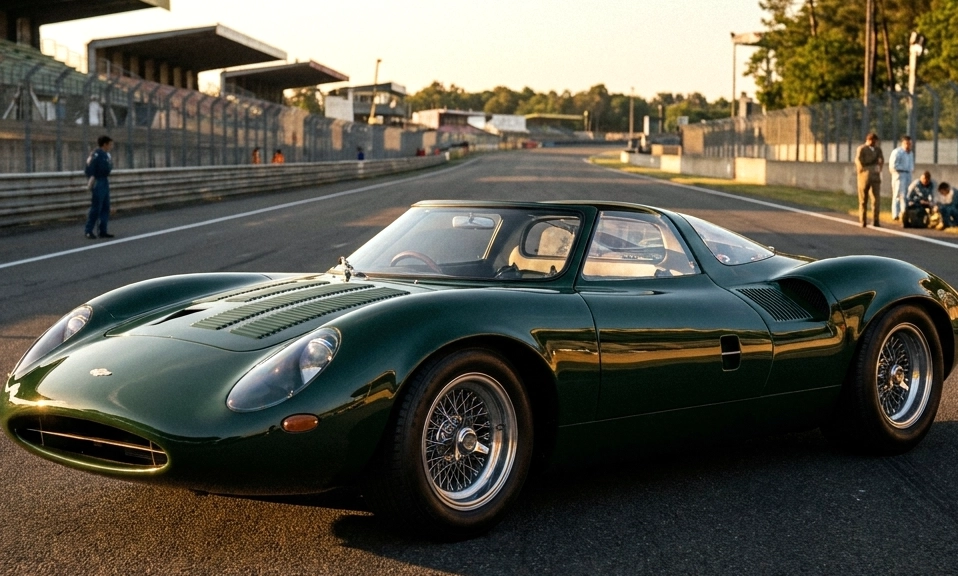
Jaguar XJ13 (1966)
If things had gone differently, the XJ13 — and not the Lamborghini Miura — might have been the world’s first mid-engined supercar. Jaguar built a single example in 1966, powered by a 5.0-litre V12, but by the time it was ready, it was unlikely to be competitive against the Ford GT40, which dominated Le Mans from 1966 to 1969. The project was shelved. The XJ13 did little more than a few high-speed runs before crashing heavily during a filming session in 1971. Comprehensively rebuilt, it survives today at the British Motor Museum as a reminder of what might have been.
Aston Martin Bulldog (1979)
The Bulldog was Aston Martin’s audacious attempt to build the world’s fastest production car. With a mid-mounted 5.3-litre twin-turbo V8 producing around 600 horsepower, gullwing doors, and pop-up headlights concealed behind five individual panels, it looked like nothing else on the road. Aston planned a limited run of 15 to 25 units at $130,000 each, but the project was shelved after the company changed hands. The sole prototype was recently restored and finally proved its 200+ mph claim in 2023 — 44 years late.
Jaguar C-X75 (2010)
Revealed in 2010, the C-X75 was a stunning Ian Callum design that promised hybrid supercar performance with a radical turbine-electric powertrain. Interest was high, and Jaguar set about putting it into limited production. But the global economic crisis made the £1 million price tag untenable. Jaguar cancelled the project in December 2012, deeming it “financial unviable” in the austere market conditions. Five prototypes were built; they appeared in the James Bond film Spectre, but the production car never materialised.
The American Dreams
Chevrolet Aerovette (1969)
Chevrolet launched its first mid-engined Corvette in 2019, but the Aerovette was a serious attempt to achieve the same thing back in the 1960s. Designed by Zora Arkus-Duntov, the “Father of the Corvette,” it used a pair of rotary engines developing 420bhp, promising a light and revolutionary American supercar. The project was ultimately shelved, and the Corvette remained front-engined for another five decades.
Ford GT90 (1995)
Ford’s answer to the McLaren F1 was a quad-turbocharged 6.0-litre V12 monster producing 720 horsepower and a claimed top speed of 253 mph. The angular, aggressive styling — a product of Ford’s “New Edge” design language — made the later production Ford GT look almost conservative. Ford estimated a production price around $3 million, which cooled enthusiasm internally despite strong public reaction. The GT90 remains one of the most extreme concepts to ever wear a Blue Oval.
Cadillac Cien (2002)
General Motors showed they could think beyond Corvettes with this stunning mid-engine concept unveiled at Detroit. The Cien packed a 7.5-litre V12 producing 750 horsepower, a carbon-fibre monocoque, and a fighter jet-inspired cockpit with dramatic scissor doors. The business case didn’t pencil out, and GM’s financial struggles in the following years sealed its fate. It proved American luxury could translate into genuine supercar territory — but the world never got to buy one.
Chrysler ME Four-Twelve (2004)
The ME Four-Twelve was one of the most promising American supercars ever built. Its all-aluminium, quad-turbo 6.0-litre V12 produced 850 horsepower and 848 lb-ft of torque. Weighing just 2,888 pounds, it could hit 60 mph in 2.9 seconds and 100 mph in 6.2 seconds. Chrysler called it “not really a concept car but a prototype that will be road-ready by summer”. It never happened. The project was cancelled, and the ME Four-Twelve became another entry in the long list of American supercars that almost were.
Shelby GR-1 (2004)
The GR-1 was a modern homage to the Shelby Daytona Coupe, blending retro styling with a 6.4-litre V10 producing 605 horsepower. It could sprint from 0-60 mph in 3.9 seconds and reach 190 mph. Despite a rapturous reception at Pebble Beach, Ford never greenlit production. A stretched wheelbase, more upright A-pillars, and weight reduction were all needed to make it viable — and Ford ultimately focused on the GT instead.
The German What-Ifs
Mercedes-Benz C 111 (1969)
The C 111 was never intended for production. It was a “rolling laboratory” — a testbed for experimental technologies including rotary engines, turbo-diesel engines, and advanced aerodynamics. Over 50 years later, it remains one of the most famous experimental vehicles ever built, even though it was never meant to be sold.
BMW M8 (1990)
BMW’s M Division began developing the ultimate E31 in 1990 — a car intended to challenge the Ferrari F40 and Porsche 959. It featured a 6.0-litre V12 producing over 500 horsepower. But in 1992, the project was cancelled. BMW’s management decided the M8 was too expensive, too extreme, and would cannibalize sales of the 850CSi. The global recession of the early 1990s reduced demand for expensive luxury cars, sealing its fate. The only M8 prototype remained hidden in BMW’s vaults for decades.
BMW Nazca M12 (1991)
The Nazca M12 was a V12-powered supercar designed by Italdesign for BMW. Despite development work on three variants, none ever made it to production. It lives on in stunning form at the BMW Museum in Munich — a beautiful reminder of what BMW could have built.
Volkswagen W12 Nardò (2001)
Ferdinand Piëch, the grandson of Ferdinand Porsche and the man who led the Volkswagen Group, decided VW needed a supercar. The result was the W12 Nardò — a gull-winged coupe with a 6.0-litre W12 engine producing 591 horsepower. In February 2002, it lapped a circular test track in southern Italy for 24 hours at an average speed of 200 mph, breaking seven world records. Then Volkswagen put it away and never sold it to anyone. It was an engineering statement, not a product.
The Italian Legends
Alfa Romeo Carabo (1968)
Marcello Gandini “abandoned the compass in favour of a ruler” when designing the wedge-shaped Carabo for Bertone. Derived from the Alfa 33 Stradale, it used the same 2.0-litre V8. During the design process, Gandini invented scissor doors, which would later appear on the Lamborghini Countach. The Carabo itself never went into production, but its influence is immeasurable.
Lamborghini Calà (1995)
The Calà was designed by Italdesign Giugiaro as a potential successor to the Jalpa and a “baby Lambo”. It was a fully functional prototype powered by a 4.0-litre V10 producing 372-400 horsepower. But when Lamborghini was sold to Audi in 1998, the Calà was completely sidelined. The V10 engine, however, lived on — it formed the basis for the engine used in the Gallardo.
Why Do These Cars Never Make It?
The reasons are as varied as the cars themselves. Some were killed by economics — the global recession of the early 1990s doomed the BMW M8 and the Jaguar C-X75. Others were victims of corporate politics — the Chrysler ME Four-Twelve and the Ford GT90 were shelved as priorities shifted. Some were too radical for their time — the Chevrolet Aerovette’s rotary engines, the Cadillac Cien’s carbon-fibre monocoque. And some, like the Mercedes C 111 and the Volkswagen W12 Nardò, were never meant for production at all. They were rolling laboratories, engineering statements, brand halo cars designed to showcase what was possible.
But every one of them represents a missed opportunity. A chance to drive something extraordinary. A future that never arrived.
The supercars that never made it to production are not failures. They are dreams — preserved in museums, private collections, and the memories of everyone who saw them and wondered, just for a moment, what it would be like to drive one.