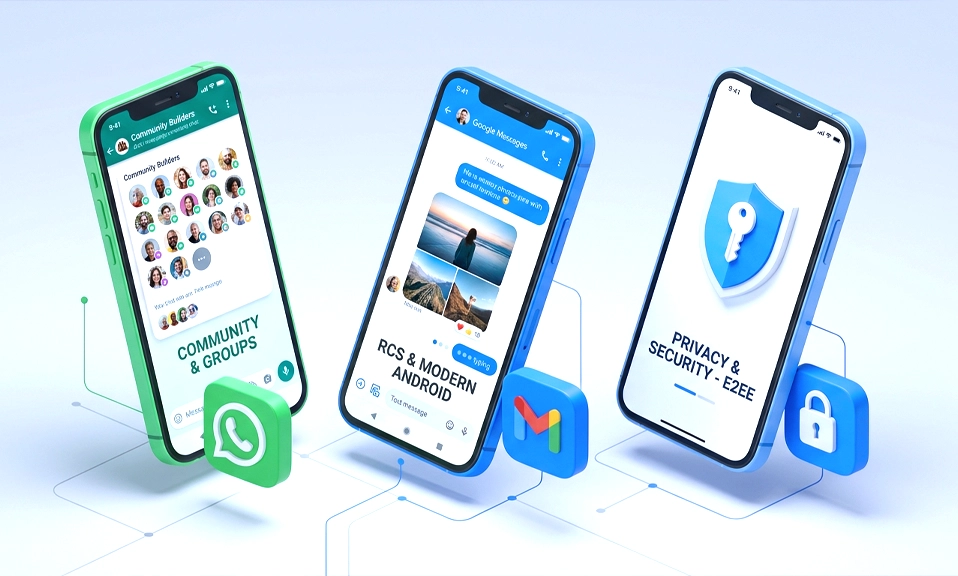
We text more than we talk. We share photos, send voice notes, and coordinate our entire lives through little chat bubbles. But with so many options available, the question remains: Which messaging app is actually the best?
For years, the debate was simple: iMessage for iPhone users, and whatever you could get for Android. But the landscape has shifted dramatically. Google has finally made RCS a reality, WhatsApp continues to add features at a breakneck pace, and Signal remains the uncompromising fortress of privacy.
If you’re trying to decide where your digital conversations should live, you need to know exactly what you’re signing up for.
Here is the ultimate, no-nonsense breakdown of WhatsApp vs. Google Messages vs. Signal, and how to choose the right one for your life.
🟢 1. WhatsApp: The Global Juggernaut
Owned by: Meta
Best for: Ubiquity, international communication, and feature-rich group chats.
Best for: Ubiquity, international communication, and feature-rich group chats.
If you live outside the United States, you already know WhatsApp is king. With over 2 billion active users, it is the default communication layer for much of the planet.
The Pros:
- Unmatched Network Effect: Everyone already has it. You don’t have to convince your grandma, your boss, or your friends abroad to download a new app.
- End-to-End Encryption (E2EE): WhatsApp uses the Signal Protocol, meaning the content of your messages and calls is encrypted and cannot be read by Meta or intercepted by hackers.
- Feature Rich: It’s basically a social network at this point. High-quality voice/video calls, large group chats, Status updates, Channels, and integrated payments (in many countries).
The Cons:
- The Meta Metadata Problem: While your messages are encrypted, your metadata is not. Meta knows who you talk to, when you talk to them, how often, and from what location. This data is used for advertising profiling across the Meta ecosystem.
- Account Bans: WhatsApp’s automated systems are notoriously aggressive. Users occasionally find their accounts permanently banned with little to no recourse or customer support.
- Feature Bloat: The app has become heavy and cluttered with Channels, AI bots, and business features you may never use.
🔵 2. Google Messages: The Android Champion
Owned by: Google
Best for: Android users who want a modern, seamless, “iMessage-like” experience without installing a third-party app.
Best for: Android users who want a modern, seamless, “iMessage-like” experience without installing a third-party app.
For years, Android texting was stuck in the dark ages of SMS/MMS (green bubbles, compressed photos, no typing indicators). Enter RCS (Rich Communication Services). Google has aggressively pushed RCS, and Google Messages is now the definitive hub for it.
The Pros:
- The Modern Texting Experience: With RCS, you get typing indicators, read receipts, high-resolution photo/video sharing, and Wi-Fi messaging. It finally brings Android texting up to par with iMessage.
- End-to-End Encryption: Google has rolled out E2EE for 1-on-1 RCS chats (and is actively expanding it to group chats), meaning your conversations are secure from prying eyes.
- Best-in-Class Spam Protection: Google’s AI is incredibly good at identifying and filtering out spam, scam, and phishing texts before they even hit your main inbox.
- Deep Android Integration: It works flawlessly with Wear OS, Android Auto, and cross-device syncing with your Chromebook or Windows PC.
The Cons:
- The Apple Gap (Though Closing): While Apple recently adopted RCS in iOS 18, the experience between an iPhone and an Android is still not quite as seamless as iMessage-to-iMessage.
- Carrier Dependency: While Google has bypassed this largely with its own Jibe servers, RCS can still occasionally hiccup depending on your mobile carrier’s legacy infrastructure.
- Less “App-like”: It’s fundamentally still your default SMS app. It lacks the dedicated community features (like Channels or massive group admin tools) that WhatsApp has.
🟡 3. Signal: The Privacy Fortress
Owned by: Signal Technology Foundation (a non-profit)
Best for: Privacy advocates, journalists, activists, and anyone who wants zero corporate surveillance.
Best for: Privacy advocates, journalists, activists, and anyone who wants zero corporate surveillance.
Signal is the gold standard of secure messaging. In fact, it’s so good that WhatsApp and Google use Signal’s open-source encryption protocol to secure their own chats. But Signal takes it a step further.
The Pros:
- Unmatched Privacy: Signal collects virtually zero metadata. They do not know who you are talking to, when you are talking, or what your contacts are. The only thing Signal knows is the day you created your account and the last time you connected to the server.
- Open Source & Non-Profit: The app’s code is publicly auditable by security experts worldwide. There are no shareholders, no ads, and no data harvesting. It is funded entirely by donations.
- Disappearing Messages & Screen Security: Robust, customizable disappearing messages, and features that prevent screenshots or screen recording in chats.
- Clean, Minimalist Interface: No ads, no channels, no AI bots. Just pure, focused messaging.
The Cons:
- The Network Effect Hurdle: This is Signal’s biggest weakness. It is only as useful as the people you know who are also using it. You will spend a lot of time saying, “Hey, can you just download Signal for this?”
- Fewer Bells and Whistles: While it has voice/video calls and basic stories, it lacks the polished, feature-heavy ecosystem of WhatsApp.
- Phone Number Requirement: You still need a phone number to register, which is a minor privacy friction point (though Signal is actively testing anonymous username features to fix this).
⚔️ Head-to-Head: The Verdict
Feature | WhatsApp | Google Messages | Signal |
|---|---|---|---|
Encryption | Yes (Content only) | Yes (RCS 1-on-1 & Groups) | Yes (Content + Zero Metadata) |
Ease of Use | High (Everyone has it) | High (Pre-installed on Android) | Medium (Requires convincing friends) |
Features | Very High (Calls, Channels, Pay) | Medium (Modern SMS/RCS features) | Low/Medium (Focused on core messaging) |
Corporate Tracking | High (Meta metadata collection) | Medium (Google ecosystem data) | None (Non-profit, open-source) |
Which One Should You Choose?
The “best” messaging app doesn’t exist. The right choice depends entirely on what you value most.
- Choose WhatsApp if: You need to stay connected with family, friends, or colleagues internationally, and you prioritize convenience and feature-rich group chats over absolute privacy.
- Choose Google Messages if: You are an Android user who wants a reliable, modern, and secure default texting experience that seamlessly bridges the gap between SMS and modern internet messaging, with excellent spam filtering.
- Choose Signal if: You believe privacy is a fundamental human right. If you are discussing sensitive information, or if you simply refuse to let a trillion-dollar tech company map your social graph, Signal is the only ethical choice.
Pro Tip: You don’t have to choose just one. Many privacy-conscious users keep Google Messages as their default for everyday, low-stakes texts (delivery drivers, two-factor authentication, casual acquaintances), and use Signal for close friends, family, and sensitive conversations.