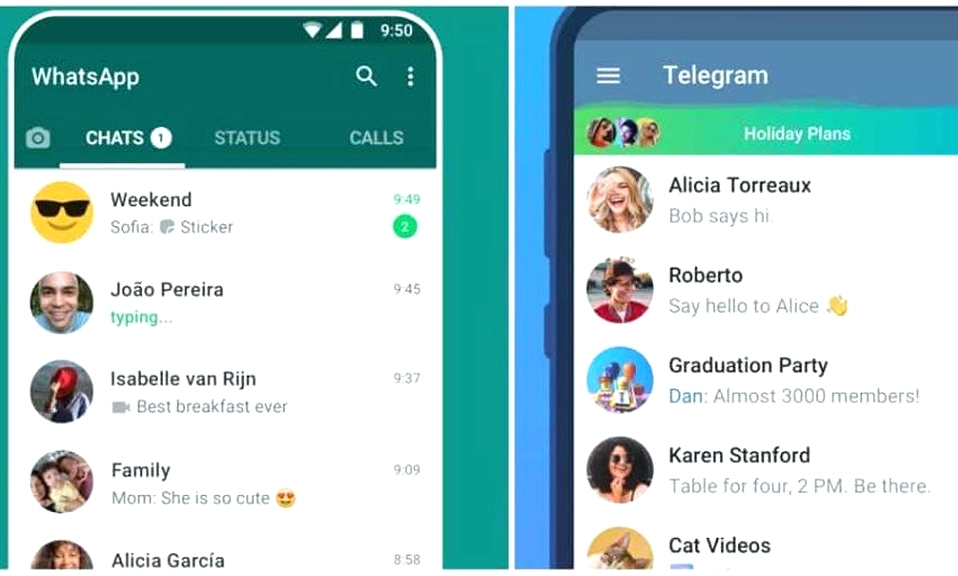
The choice between Telegram and WhatsApp is no longer a simple matter of feature count or user interface. In 2026, it has become a decision about what you value more: absolute privacy and control over your data, or the convenience of an all-in-one platform woven into the fabric of your daily life.
The short answer is this: WhatsApp is the better choice for the vast majority of people because it offers default end-to-end encryption for every message and call, and it has evolved into a genuine communications hub that handles events, payments, and productivity. Telegram is the better choice for privacy-conscious power users, large communities, and anyone who prioritizes speed, cloud storage, and cutting-edge features. The gap between them is philosophical, not just technical, and the right choice depends entirely on your threat model and how you use messaging apps.
🔒 Privacy and Security: Default Encryption vs. Optional Anonymity
This is the most critical difference between the two platforms, and it is where the choice becomes genuinely consequential.
WhatsApp: Encryption by Default, Metadata by Design
WhatsApp’s greatest strength is that it provides default end-to-end encryption (E2EE) via the Signal Protocol for all private chats, voice calls, and video calls. You do not have to enable it; it is always on. This means that your messages and calls are scrambled so that only you and the recipient can read or hear them—not even WhatsApp can access the content.
However, WhatsApp’s privacy story is complicated by its parent company, Meta. While the content of your messages is encrypted, WhatsApp collects significant metadata—information about who you talk to, when, and how often—and shares it with Meta. A 2026 security report gave WhatsApp a weighted privacy score of 5.0/10, noting that its “strong Signal-protocol content encryption [is] undermined by Meta metadata harvesting”. Furthermore, messages sent to businesses on WhatsApp are not end-to-end encrypted by default.
Telegram: Cloud Convenience vs. Optional Encryption
Telegram’s architecture is fundamentally different. By default, your chats are cloud-based and encrypted with Telegram’s own MTProto protocol, but the encryption keys are held by Telegram. This means that the company can technically read your messages and could be compelled to hand them over to authorities. End-to-end encryption is only available in “Secret Chats,” which you must manually enable for each conversation.
A 2026 security report ranked Telegram’s cloud chats last out of 24 services, with a score of 3.4/10, precisely because its default chats are not end-to-end encrypted. This is a deliberate design choice: it allows Telegram to offer seamless cloud sync across all your devices, massive file sharing, and the ability to search your entire chat history. You are trading the default security of your messages for convenience and features.
The Verdict: If your primary concern is that no one—not even the company running the app—can read your conversations, WhatsApp is the safer default because its encryption is automatic. If you are willing to accept that trade-off in exchange for cloud convenience, or if you are meticulous about using Secret Chats for sensitive conversations, Telegram offers a different kind of privacy—one focused on anonymity from other users and the ability to participate in massive public communities.
🚀 Features and Ecosystem: The All-in-One Hub vs. The Feature Powerhouse
In 2026, both apps have evolved far beyond simple text messaging, but they have done so in opposite directions.
WhatsApp: The Everyday Infrastructure
WhatsApp has become the default communication layer for over 3 billion people, and its 2026 updates reflect its ambition to be the only app you need for daily life. Recent additions include:
Events: You can now create and manage events, send invites (even to people who don’t have WhatsApp), and track RSVPs through a dedicated Events Home.
Productivity: Standalone account support for iPads, built-in PDF editing on web and desktop, and improved CarPlay/Android Auto integration for safer use in the car.
Messaging: Features like longer pinned chats, Group Status for sharing updates with specific groups, and new filters for mentions and replies.
WhatsApp is designed for utility. It is the app you use to coordinate a family dinner, share a document with a colleague, and pay a friend, all in the same thread.
Telegram: The Power User’s Playground
Telegram, with its 1 billion active users, has become the platform of choice for communities, power users, and anyone who wants maximum control over their chats. Its 2026 updates have been relentless, with over 75 new features across 13 updates in the first half of the year alone. The highlights include:
Massive Communities: Telegram supports groups of up to 200,000 members and broadcast channels with unlimited subscribers. It is a platform for reaching an audience, not just a contact list.
File Sharing: You can send files up to 2GB, and the cloud-based architecture means your entire chat history is searchable and available on every device.
AI-Powered Tools: Telegram has integrated AI editors for text, AI summaries for channels, and a rich bot ecosystem that allows for automation and mini-apps.
Customization: Unmatched control over themes, chat folders, and interface design, including a major “Liquid Glass” redesign on iOS.
The Verdict: If you want an app that handles the logistics of daily life—events, payments, documents, and calls—WhatsApp is more practical. If you want a messaging app that doubles as a social network, a file storage service, and a customizable productivity tool, Telegram offers a deeper and more powerful feature set.
🌍 User Base and Network Effects: The Deciding Factor for Most
This is the simplest and most decisive factor for many people: where are your contacts?
With over 3 billion users, WhatsApp is the default messaging app in countries like Brazil, India, and across much of Europe and the Middle East. If your family, friends, and colleagues are already there, switching to Telegram means convincing everyone you know to join you. For most people, the network effect is too powerful to overcome.
Telegram’s 1 billion users are substantial, but they are concentrated in specific regions and communities—particularly in Eastern Europe, Central Asia, and among tech-savvy groups. If your social circle is already on Telegram, it is an excellent choice. If not, you may find yourself using both apps.
💎 Which Is Better for You?
The honest answer is that there is no single winner. The “better” app depends on what you value most.
Choose WhatsApp if:
You want encryption to be automatic and non-negotiable for every message and call.
Your contacts are already there, and you want to avoid the friction of convincing them to switch.
You value an all-in-one utility that handles events, payments, document editing, and car integration.
You are comfortable with the trade-off of Meta collecting metadata in exchange for a free, reliable, and universally adopted service.
Choose Telegram if:
You are a power user who wants granular control over your chats, themes, and bots.
You need to manage large communities or broadcast to an audience (channels with unlimited subscribers, groups of 200,000).
You value cloud sync and file sharing (2GB per file) more than default end-to-end encryption.
You are privacy-conscious but willing to manually enable Secret Chats for sensitive conversations.
You want the most feature-rich, customizable, and fast messaging experience available.
For most people, WhatsApp is the safer and more practical default because its encryption is invisible and its ubiquity makes it indispensable. But for a growing number of users, Telegram’s combination of power, flexibility, and community features is worth the trade-off. The best app is the one that fits how you actually communicate—and in 2026, you are fortunate to have two genuinely excellent options.