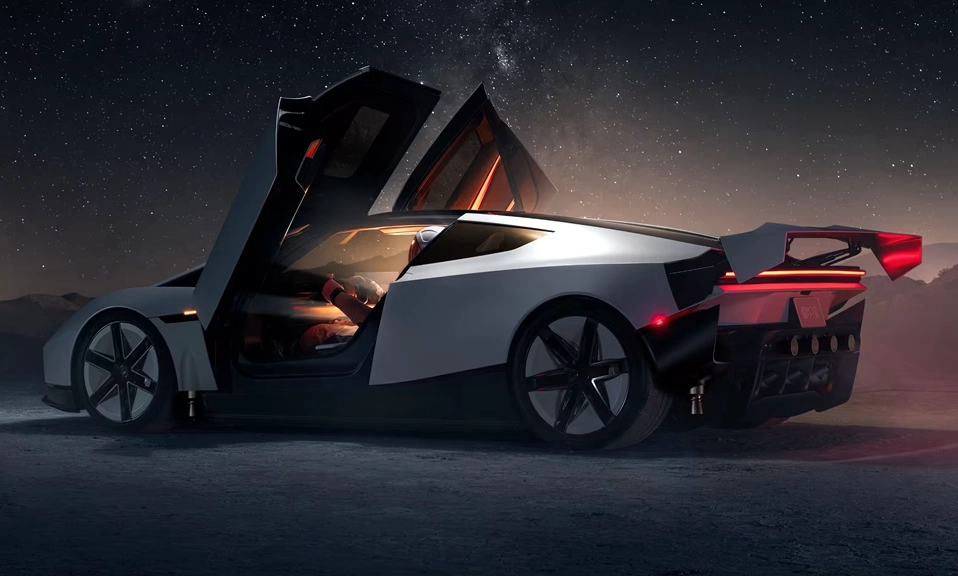
On October 15, 2026, Tesla finally showed the world its second-generation Roadster. It drove upside down on a ramp, launched off the edge, flipped in mid-air, and landed on its wheels. Elon Musk told the crowd it would “enter production in 2028.” The internet exploded. The headlines wrote themselves.
But here is the question that matters, nearly a decade after the car was first promised: was this a product launch, or a very expensive magic trick?
The gap between what Tesla demonstrated at the SpaceX test site in McGregor, Texas, and what a customer might actually be able to buy is the defining story of this Roadster. It has been for almost ten years. And the 2026 demonstration, for all its spectacle, did not close it.
What Tesla Actually Showed
Let’s be precise about the stunts, because Tesla has been imprecise in the past.
The Roadster drove up a curved ramp, held in place by a fan-based suction system that pulled air from beneath the vehicle, and came to a stop perpendicular to the ground, hanging upside down. Then it repeated the climb and launched off the top, its cold-gas thrusters firing to flip the car in mid-air and land it safely. In a second demonstration, it jumped over a row of Tesla vehicles, including a Semi truck, twisting in the air before touching down.
The entire demonstration was autonomous. No human was inside the car. Tesla programmed the stunts in advance.
The hardware behind the theatrics: cold-gas thrusters developed with SpaceX, using compressed nitrogen stored in carbon-fibre pressure vessels at up to 10,000 psi. Ten nozzles, 600 litres of compressed gas, and enough force—over 80 kilonewtons—to briefly override the weight of a two-ton car and throw it into the air.
It was, by any measure, an extraordinary engineering flex. Gene Munster of Deepwater Asset Management called it “an engineering flex with no commercial value beyond embarrassing traditional car makers”. He was not entirely wrong.
What Tesla Did Not Show
The demonstration did not show a flying car. It showed a short, controlled jump.
Cold-gas thrusters are not a propulsion system for sustained flight. They are a momentary impulse—a way to launch a car off a ramp and orient it in the air. “Flying” in any meaningful sense would require aerodynamic lift, wings, or a fundamentally different propulsion architecture. The Roadster has none of those things. It has a rocket-boosted hop.
More importantly, Tesla did not show a car that anyone can buy and drive on a public road.
Tesla is describing three configurations. The Performance version is a road-ready two-seater with a claimed sub-1.6-second 0–60 mph time. The Thrust version adds rear-mounted cold-gas thrusters for “jump-and-roll” manoeuvres, targeting under 0.9 seconds. And the Rocket version—the one with the full flight system—is invitation-only, single-seat, and explicitly not approved for public road use.
When Musk was asked whether the car was street legal, his answer was: “Yeah, depends on your street”. Tesla’s own website says the Rocket version is not approved for public roads.
So the version that did the backflip is the version you cannot have. The versions you might be able to buy are the ones that did not do the backflip. That distinction matters more than any headline about a “flying Tesla.”
The Timeline Problem: A Decade of “Two More Years”
The 2028 production target is not the first deadline Tesla has set for the Roadster. It is the fifth.
Tesla first unveiled the second-generation Roadster in November 2017, promising deliveries by 2020. The target slipped to 2022, then 2023, then “later this year” in 2024, and now 2028. Early reservation holders have been waiting nearly a decade. Some have given up entirely. OpenAI CEO Sam Altman requested a refund. Marques Brownlee, who put down a $50,000 deposit, said on a podcast in 2025: “Tesla has had my $50,000 for eight years”.
Musk’s track record on complex vehicle timelines is well documented. The Cybertruck was promised in 2019 and delivered in 2023. The Semi has been “coming next year” for half a decade. The 2028 Roadster target may prove to be accurate, but there is no evidence to support that conclusion beyond Musk’s word—and his word on production timelines has a poor historical record.
“This time it’s real,” Musk said at the event. He has said versions of that before.
The Regulatory Wall: You Can’t Just Add Rockets to a Car
Even if Tesla can build the Roadster on schedule, the regulatory hurdles are formidable.
A vehicle that can jump, flip, and land is not a car in any conventional regulatory sense. It is a hybrid—part automobile, part aircraft—and it falls into a gap between two regulatory regimes that were not designed to accommodate each other.
Automotive safety standards demand crumple zones, bumpers, and structural integrity in a collision. Aviation standards demand minimal weight and failure-mode redundancy. Combining the two is not a matter of compromise; it is a matter of inherent contradiction. As one analysis put it: “Such hybrid designs often result in expensive vehicles that underperform in both areas”.
The European Union is unlikely to approve a road-legal version of the Rocket configuration. Tesla’s Cybertruck, which is far less radical, is already unavailable in Europe because it fails to meet roadworthiness standards. The idea that a car with a full flight system will be waved through European regulators is, to put it gently, optimistic.
And the pressure vessels themselves raise safety questions. Carbon-fibre tanks at 10,000 psi are standard in aerospace, but they require collision protection, damage detection, and inspection protocols that Tesla has not detailed. How the tanks behave in a crash, how owners know when they need servicing, and what happens if a tank ruptures—these are not hypothetical concerns.
The Weight Problem: Physics Doesn’t Care About Hype
There is a simpler engineering challenge that the demonstration did not answer: packaging.
A production Roadster must accommodate a large battery pack, electric motors, occupants, crash structures, and the cold-gas thruster system—pressure vessels, plumbing, nozzles, and control electronics. The demonstrator may have been stripped down for the stunts. A showroom car cannot be.
The questions that remain unanswered are fundamental. How much does the thruster system weigh? How does that weight affect acceleration and range? Tesla claims “more than 300 miles” of range for the production car, down from the 620 miles originally promised in 2017. The thruster hardware almost certainly contributes to that decline. Whether the headline 0–60 mph figures survive the addition of production-spec components is unknown.
And then there is the question of replenishment. Tesla says the car can refill its own air tanks. But how long does that take? How much energy does it consume? How many full-performance manoeuvres are available before the system needs to recover? A buyer needs to know whether the headline acceleration is repeatable—or whether it is a one-time party trick that leaves the car neutered for the rest of the drive.
A Spectacle, Not a Product
The 2026 Tesla Roadster demonstration was genuinely spectacular. The engineering behind it—the cold-gas thrusters, the suction system, the autonomous control—is impressive. Tesla has built something that no other car company has built, and it deserves credit for that.
But a demonstration is not a product. A production target is not a delivery date. And a car that can do a backflip on a closed test range is not the same as a car that can be sold, insured, registered, and driven on a public road.
The Roadster that Musk showed the world is a halo car—a symbol of engineering capability, a recruiting tool, a headline generator. It is not a vehicle that will be in customer driveways in 2028, at least not in the form that did the barrel roll. The versions that might be available are slower, heavier, and less magical. The versions that are magical are not street legal.
Maybe Tesla will prove the skeptics wrong. Maybe 2028 will be the year the Roadster finally ships, and maybe the regulatory hurdles will be cleared, and maybe the production car will be everything the demonstration promised. Musk has defied the odds before.
But “maybe” is doing a lot of work in that sentence. And until Tesla provides a delivery date, a final price, and a regulatory approval path—not a production target, not a reservation deposit, but a date and a price and a yes from the regulators—the 2028 Roadster is not a car you can buy. It is a car you can watch on YouTube.
The rocket-like stunts are real. The question is whether the car is.