The wildlife trade is far larger than anyone thought—and most of it is perfectly legal. A landmark study has found that more than 107,000 species of animals, plants, and fungi are used or traded globally, double the previous estimate of roughly 50,000. But the real story isn’t the number. It’s the fact that for the vast majority of those species, we have almost no idea what the trade is doing to them.
The research, published in Science Advances and led by Professor Alice Hughes at the University of Melbourne, is the first comprehensive estimate of species use and trade across plants, animals, and fungi. It found 107,356 species in use or trade globally—a figure that includes up to 47,685 animal species, covering 42% of all described vertebrate species. The previous estimate, from the Intergovernmental Science-Policy Platform on Biodiversity and Ecosystem Services (IPBES), was around 50,000.
The study’s conclusion is stark: the true scale is almost certainly larger. “The number of species that we are talking about is still an underestimate,” said Molly Brown of the International Union for Conservation of Nature, a co-author of the paper.
What the Trade Actually Includes
When most people think of wildlife trade, they picture elephants, tigers, and pangolins—the charismatic megafauna of the illegal trade. That picture is incomplete.
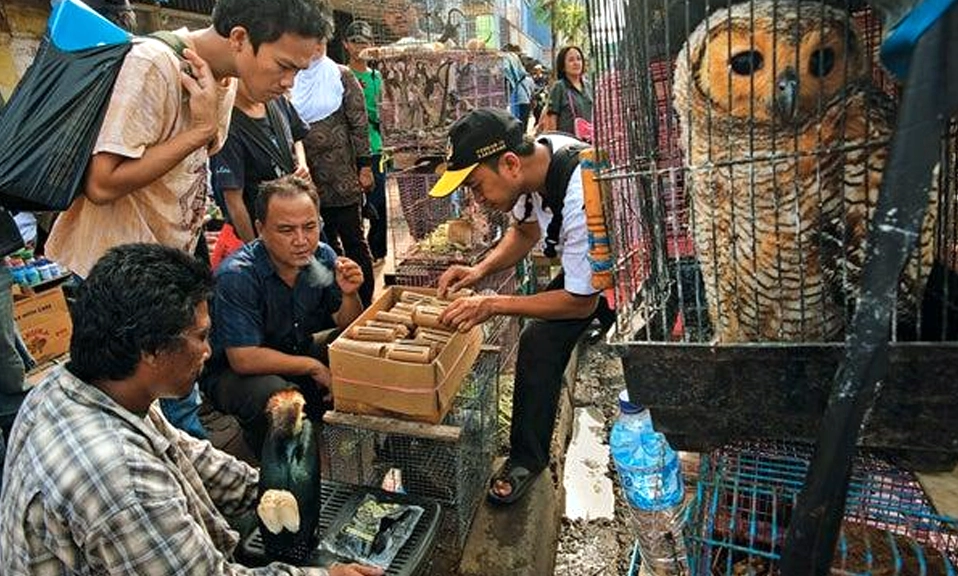
“Wildlife trade includes everything from timber, seafood and medicinal plants to pets, cut flowers, ornamental fish and fungi,” Hughes said. “And most of it is legal”.
The numbers bear that out. Legal trade is estimated to be worth US$220 to 300 billion annually**—approximately **5.6 to 10.6 times larger in value** than the illegal wildlife trade, which is estimated at **US$28.4 to 39.5 billion. Of the trade detected or observed, an estimated 99.99% is legal.
That doesn’t make it sustainable. It means the harm is happening in plain sight, through supply chains that are regulated on paper but rarely monitored in practice.
The Data Gap: A Monitoring System That Misses 97% of Species
The most important finding in the study isn’t the number of species traded. It’s how little we know about the trade in almost all of them.
“For most of these species we have little to no data,” Hughes said. “There is no data on quantity and origins, let alone the population level data to assess if trade poses a risk to species survival”.
The global monitoring architecture is fragmented and narrow. CITES, the convention that regulates international trade in at-risk species, covers about 40,000 species. The FAO monitors fisheries, but its data focuses on commercially valuable fish stocks. The International Tropical Timber Organization tracks timber production, but often fails to record key details on species or sourcing.
Beyond those specific systems, there is almost nothing. “The United States is the only country that systematically records and publicly shares trade data across a wide range of taxa,” Hughes said. “For much of the rest of the world, equivalent data simply does not exist”.
The consequence is that the Kunming-Montreal Global Biodiversity Framework’s trade target—the globally agreed goal for making wildlife trade sustainable—is measured by a single indicator: the proportion of fish stocks within biologically sustainable levels. That indicator covers at most 3% of all traded species, according to Hughes. The other 97% are effectively invisible to the framework designed to protect them.
Why This Matters: Extinction by Oversight
The data gap isn’t an academic problem. It has real consequences for species survival.
For species with population-level data, traded populations suffer an average of 50 to 60% loss in abundance relative to untraded populations. Wildlife trade has contributed, directly or indirectly, to the global extinction of 294 species, the extinction in the wild of 25 species, and 192 local extinctions.
And the trade is moving faster than the systems designed to regulate it. “Sometimes, it is years before things get listed,” Hughes said, referring to CITES. “And that means that they can be virtually extinct in the wild by that point”. Newly described species—often rare, with small ranges, and therefore especially valuable to collectors—can be traded and wiped out before scientists have even formally named them.
The under-regulation of trade has also created loopholes that allow species to be “laundered into legality”—captured in the wild, passed through captive-breeding facilities or fraudulent paperwork, and sold as legally sourced.
The Reforms That Could Close the Gap
The researchers are not calling for a ban on wildlife trade. They are calling for better data.
“To change the current situation, we need to standardise the collation of data on trade,” Hughes said. “At present, data is largely limited to a small number of datasets, and this lack of systematisation of data collection precludes assessments of sustainability”.
The study suggests that countries could repurpose existing customs and animal health inspection processes to develop a robust monitoring system—rather than building new bureaucracies from scratch. The infrastructure already exists. What’s missing is the political will to use it.
“With better data, we can accurately assess risks to biodiversity or identify when trade is pushing species towards decline,” Hughes said.
The 107,000 figure is a corrective.
It tells us that the wildlife trade is not a niche criminal enterprise on the margins of the global economy. It is a $220–300 billion industry that touches tens of thousands of species, most of it legal, most of it unmonitored, and much of it potentially unsustainable.
The trade is not inherently destructive. Well-managed, sustainable use can fund conservation, support livelihoods, and incentivise stewardship. But you cannot manage what you do not measure. And right now, we are measuring less than 3% of it.
The study’s message is simple: the first step toward saving traded species is knowing which ones are being traded, in what numbers, and from where. Until we do, the 97% will remain in the dark—and some of them will disappear before we ever turn a light on them.