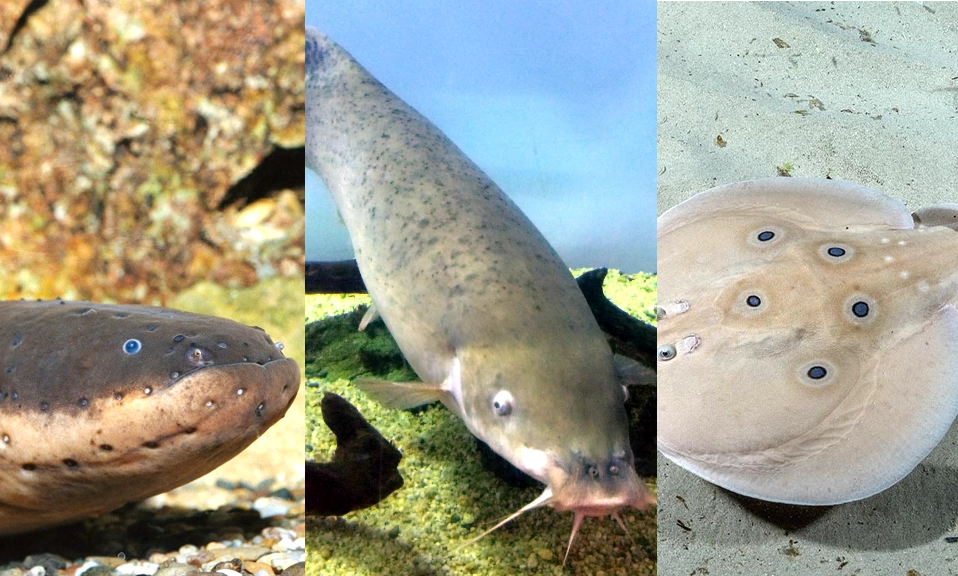
Nature has produced some truly shocking creatures. While most animals rely on teeth, claws, or speed to survive, a remarkable group of species has evolved a superpower straight out of a science fiction novel: the ability to generate electricity.
From stunning prey with high-voltage blasts to navigating murky waters with electric fields, these bioelectric marvels are among the most fascinating creatures on the planet. Here are the most electric animals on Earth.
1. Electric Eel: The Undisputed Champion 🥇
Voltage: 600-860 volts
The electric eel is nature’s most powerful living battery. Despite its name, this creature is actually more closely related to catfish and carp than to true eels.
The record-holder is Electrophorus voltai, a species discovered in 2019 that can produce an astounding 860 volts of electricity—the highest level ever measured from any living animal on Earth.
That’s more than six times the voltage of a standard household outlet!
How It Works:
Electric eels have three specialized organs that make up about 80% of their meter-long body: the main organ, Hunter’s organ, and Sach’s organ. These organs contain thousands of disc-shaped cells called electrocytes that work like a biological battery array.
When the eel needs to strike, its nervous system synchronizes these electrocytes, causing a rapid transfer of sodium ions that generates an electrical current. The result? A devastating shock powerful enough to stun large prey or deter predators.
What it’s used for:
- High voltage (600-860V): Stunning prey and defense
- Low voltage (10-50V): Navigation and detecting objects in murky water
2. Electric Catfish: Africa’s Shocking Predator 🐟
Voltage: 350-450 volts
Found throughout tropical Africa and the Nile River, the electric catfish is another heavyweight in the bioelectric arena. While not quite as powerful as its eel cousin, it can still deliver a nasty 350-450 volt shock.
These fish have been known to humans for thousands of years—ancient Egyptian hieroglyphics even depict them as the “thunder of the Nile.”
What it’s used for:
- Hunting and defense
- Navigation in muddy river waters
3. Electric Ray (Torpedo Fish): The Ocean’s Stunner 🌊
Voltage: 37-220 volts
Electric rays, also known as torpedo fish, are the marine champions of bioelectricity. These flattened, disc-shaped fish can produce around 220 volts, though some species max out closer to 45 volts.
Unlike electric eels that deliver a single powerful blast, electric rays can sustain their electrical discharge, creating a continuous field around their bodies.
What it’s used for:
- Stunning prey before consumption
- Defense against sharks and other predators
- Some species use lower voltages for navigation
4. Electric Stargazer: The Ambush Predator
Voltage: Up to 50 volts
The electric stargazer (Astroscopus) is one of the ocean’s creepiest and most dangerous fish. With its grotesque, upward-facing face and buried-in-sand ambush tactics, it’s already terrifying enough—but it also packs an electric punch.
These fish can discharge up to 50 volts of electricity through specialized organs located behind their eyes.
While 50 volts sounds modest compared to an electric eel, it’s still enough to cause serious pain to predators (or unlucky beachgoers).
Bonus danger: Stargazers are also venomous, with venomous spines in addition to their electric organs.
What it’s used for:
- Defense against predators
- Possibly stunning small prey
5. Weakly Electric Fish: The Electric Communicators 📡
Voltage: Less than 1 volt
Not all electric fish are trying to shock you. Weakly electric fish, like the famous Elephantnose Fish (Gnathonemus petersii), generate tiny electric pulses of less than one volt.
These African fish use their electric organs to create a weak electric field around their bodies. By sensing distortions in this field, they can “see” their environment in complete darkness—a process called electrolocation.
The Elephantnose Fish Superpower:
The elephantnose fish has a bizarre, trunk-like chin that’s packed with electroreceptors. This allows it to detect moving prey and worms hidden in the substrate of murky African rivers.
What it’s used for:
- Navigation in complete darkness
- Finding hidden prey
- Communication with other elephantnose fish
- Creating a 3D “electric image” of their surroundings.
How Do These Animals Generate Electricity? 🔬
The secret lies in specialized cells called electrocytes. These modified muscle or nerve cells are stacked in series, much like batteries in a flashlight.
Here’s the basic process:
- Resting state: Electrocytes maintain a voltage difference across their membranes
- Activation: The fish’s nervous system sends a signal to fire.
- Ion rush: Sodium ions rapidly flow across the electrocyte membranes.
- Current generation: This ion transfer creates an electrical current.
- Synchronization: Thousands of electrocytes fire simultaneously, amplifying the voltage.
In electric eels, this system is so efficient that about 80% of their body is dedicated to electricity generation.
Strongly vs. Weakly Electric Fish
Electric fish fall into two categories:
Strongly Electric Fish
- Generate high voltages (50-860V)
- Use electricity for hunting and defense
- Examples: Electric eels, electric catfish, electric rays
Weakly Electric Fish
- Generate low voltages (less than 1V)
- Use electricity for navigation, communication, and electrolocation
- Examples: Elephantnose fish, knife fish, some mormyrids.
The Evolutionary Marvel
What’s truly remarkable is that the ability to generate electricity has evolved independently at least six times in different fish lineages. This is a stunning example of convergent evolution—nature finding the same solution (bioelectricity) to solve similar problems (hunting, defense, navigation) in completely different groups of animals.
Fun Facts 💡
- Electric eels can leap out of the water to shock threats, a behavior discovered in 2016
- Ancient Romans used electric rays to treat headaches and gout—the shocks acted as a primitive form of electrotherapy
- Elephantnose fish have the highest brain-to-body mass ratio of any fish, thanks to their complex electric sensing systems
- Electric eels aren’t actually eels—they’re a type of knifefish more closely related to catfish
From the jaw-dropping 860-volt blast of the electric eel to the subtle electric whispers of the elephantnose fish, these creatures demonstrate that evolution can turn the most unexpected tools—like electricity—into survival superpowers.
The next time you get a static shock from a doorknob, remember: some animals have turned that tiny jolt into an art form, a weapon, and a sixth sense all rolled into one. Nature is shocking. ⚡
Which electric animal surprised you the most? And would you dare to swim in waters where electric eels lurk?