Some films are bad. Some films are disappointing. And then there is Justice League (2017) — a film that isn’t really one film at all, but a $300 million tug-of-war between two directors, two tones, two scores, and two entirely different ideas of what a superhero team-up should be.
It premiered on 17 November 2017 as the fifth entry in the DC Extended Universe — the first time Batman, Wonder Woman, Superman, Aquaman, the Flash, and Cyborg had ever shared the big screen. It should have been DC’s crown jewel, the answer to Marvel’s Avengers. Instead, it became the most fascinating disaster in modern blockbuster filmmaking — a film whose behind-the-scenes story is genuinely more dramatic than the one on screen.
Let’s break down how it happened, what actually works, what went wrong, and why — nearly a decade later — we’re still talking about it.
⚡ Quick Facts
Detail | Fact |
|---|---|
Release date | 17 November 2017 |
Studio / franchise | Warner Bros., fifth DCEU film |
Directors | Zack Snyder (principal), Joss Whedon (uncredited reshoots) |
Budget | ~$300 million |
Box office | $229M domestic / $657.9M worldwide |
Rotten Tomatoes | 40% (critics) |
Metacritic | 45/100 |
CinemaScore | B+ |
Runtime | 120 minutes (mandated) |
🎬 The Most Unusual Production in Blockbuster History
Here’s the thing people forget: Justice League was scouted, cast, written and shot as Zack Snyder’s film — a direct continuation of the mythic, operatic tone of Man of Steel and Batman v Superman. Then, in May 2017, tragedy struck. Snyder stepped away from production following the death of his daughter, Autumn .
Warner Bros. brought in Joss Whedon — the man who had just directed the first two Avengers films for the competition — to finish the movie. What began as “finishing touches” evolved into substantial reshoots from July to October 2017, estimated to cost somewhere between $25 and $50 million . Whedon wrote and directed new sequences, injected a brighter, more quippy tone, and slashed the runtime to a studio-mandated two hours, in accordance with directives from Warner Bros. .
Producer Charles Roven insisted Whedon only reshot 15–20% of the movie — but even that percentage came at a brutal cost: two complete post-production cycles, two complete film scores (Danny Elfman replacing Junkie XL), and sets rebuilt from scratch .
The result is a film that visibly changes director mid-scene. Snyder’s desaturated, heavy-metal iconography collides with Whedon’s sitcom lighting and joke-heavy inserts, and the seams are impossible to unsee once you notice them.
👨 The Mustache That Broke the Internet
You cannot write about Justice League (2017) without writing about the mustache.
When Whedon’s reshoots called Henry Cavill back to set, the actor was mid-production on Mission: Impossible – Fallout — and Paramount, contractually, would not allow him to shave the mustache he had grown for the role . Warner Bros.’ solution: digitally erase it in post-production.
The result was one of the most infamous pieces of CGI in cinema history. Cavill’s upper lip warps, blurs, and smears across several scenes — fans dubbed the scandal #LipGate, and it became shorthand for everything wrong with the film’s rushed, corner-cutting post-production .
A $300 million tentpiece, brought to its knees by facial hair. Hollywood truly cannot write this stuff.
✅ What Actually Works
It’s easy to dunk on Justice League, and the internet has spent years doing exactly that. But fairness demands we say this plainly: the theatrical cut is not a disaster of a watch. It’s fast, it’s frequently fun, and it contains real gems:
The team chemistry. Gal Gadot’s Wonder Woman had just come off a $800M+ solo triumph, and she anchors every scene she’s in. Ezra Miller’s nervous, endearing Flash and Jason Momoa’s rock-star Aquaman steal their moments so effectively that both spun off into successful solo franchises.
Danny Elfman’s score, which resurrects the classic 1978 Superman and 1989 Batman themes — a nostalgic masterstroke that gives the finale an emotional lift the script doesn’t quite earn .
The Superman rescue… and the morning-after scene. When Cavill’s resurrected Superman finally suits up and fights alongside the League, the film briefly becomes the movie it was always supposed to be.
The audience agreed, to a point. CinemaScore crowds gave it a B+ — better than Batman v Superman — with 85% positive PostTrak sentiment and a 69% definite recommend (Deadline). Ordinary moviegoers liked it more than the discourse suggests.
❌ What Goes Wrong
And yet — 40% on Rotten Tomatoes and 45 on Metacritic don’t come from nowhere . The problems are structural:
The tonal whiplash. Snyder’s mythological gravity sits uneasily beside Whedon’s lighter additions, producing a film that critics widely described as tonally inconsistent (Saturation.io).
The two-hour straitjacket. Six heroes, a resurrection, an alien invasion, and three films’ worth of world-building, compressed into 120 minutes. Cyborg and the Flash get origin arcs that feel like trailers for films we never saw.
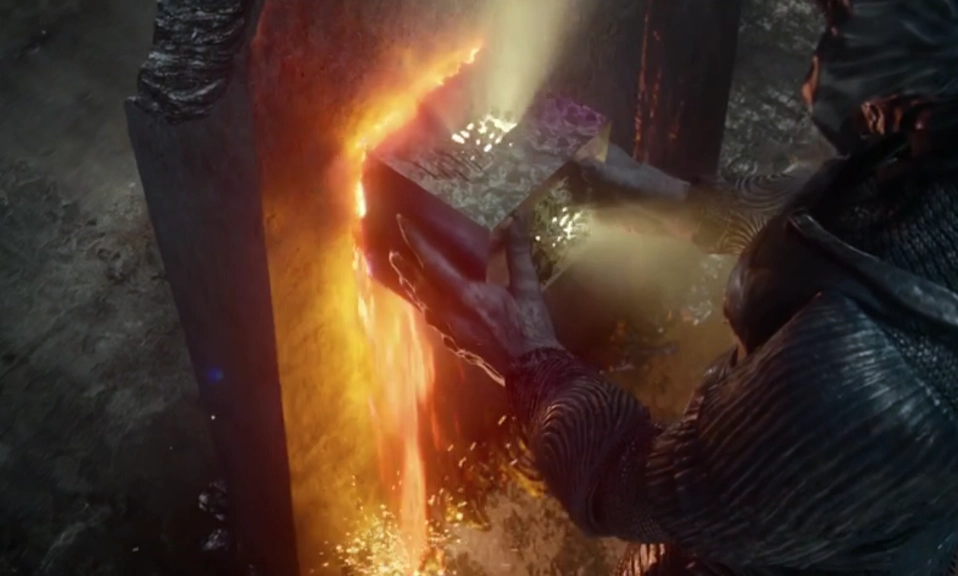
A flat villain. Ciarán Hinds’s Steppenwolf is a murky CGI conqueror with dialogue that consists mostly of the word “Motherbox” — arguably the least threatening major villain in the genre’s history.
The visual effects crunch, of which the mustache is only the most famous casualty. The third act looks like a video game cutscene that shipped before final polish.
💸 The Box Office: A Hit That Was a Miss
On paper, $657.9 million worldwide sounds like success. In reality, it was a catastrophe by tentpole standards. The film opened to just $93.8 million domestically — under projections, under Thor: Ragnarok‘s opening a week earlier, and humiliatingly, under Wonder Woman’s debut (MovieWeb).
Against a $300 million production budget swollen by reshoots, analysts estimated the film lost Warner Bros. around $60 million . For context: its two predecessors, Batman v Superman and Wonder Woman, had each grossed $820M+. The team-up was supposed to be the summit; it was the valley.
The damage was strategic, not just financial: Warner Bros. pivoted away from the shared-universe model, retreating toward standalone character films with less emphasis on an interconnected DCEU .
📣 The Fan Rebellion: #ReleaseTheSnyderCut
And here’s where the story becomes unprecedented in the history of cinema.
Because Snyder’s cut — his actual film — was rumored to exist. And the fans refused to let it die. The hashtag #ReleaseTheSnyderCut became a daily drumbeat across social media for years, championed not just by fans but by the film’s own stars, including Ben Affleck and Gal Gadot .
In May 2020, Warner Bros. capitulated. Zack Snyder’s Justice League was confirmed for HBO Max — and on 18 March 2021, a four-hour director’s cut finally streamed into the world (). It cost roughly $70 million to complete the visual effects, score, and editing, with new footage shot in October 2020 .
The differences weren’t cosmetic. The Snyder Cut restored Cyborg’s full storyline (Ray Fisher’s character went from supporting player to emotional core), rebuilt Steppenwolf’s design, added Darkseid, and ran in a stark 4:3 aspect ratio — Snyder’s intended frame. Critics received it considerably better than the theatrical version, even while balking at the length, and it became one of HBO Max’s most-streamed films of 2021 .
A fan campaign getting a studio to spend $70 million finishing a rejected film is, without exaggeration, something that had never happened before and may never happen again.
⚖️ So where does
Justice League (2017) land?
As a piece of blockbuster craftsmanship: a compromised, patchwork film — watchable, occasionally charming, structurally broken. It’s a movie that fires six heroes, one resurrection, and an alien apocalypse at you in two hours and gives almost none of it room to breathe. The villain is wallpaper, the tone is a coin flip, and the VFX clock was clearly still running when the film shipped.
As a cultural artefact: absolutely essential viewing. No other film so nakedly documents what happens when a studio loses faith mid-production — and what happens when the audience decides to fight back. Its failure killed the DCEU’s shared-universe ambitions, and its ghost loomed over every DC decision Warner Bros. made for the next half-decade.
🏆 Final Verdict: 6/10 as a film — 10/10 as a story. Watch the theatrical cut for the curiosity, then watch Zack Snyder’s Justice League for the redemption. And remember: Justice League (2017) matters not because of what it was, but because of what the fans refused to let it stay.
Team Whedon or Team Snyder? Did the theatrical cut deserve its 40%, or is it secretly the most rewatchable DCEU entry? 🦇⚡