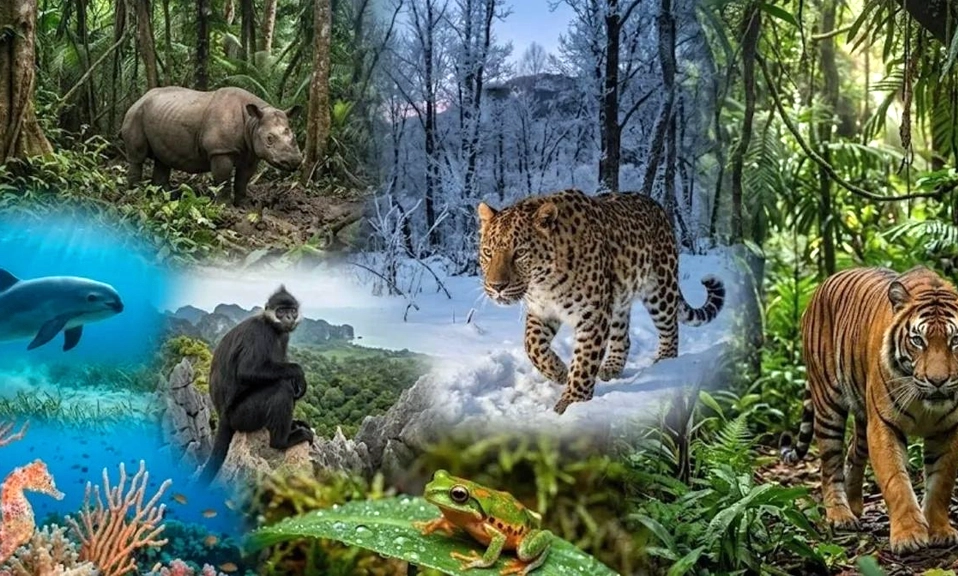
The headline is everywhere: wildlife populations have fallen by 73%. It sounds like a death sentence for nature—a number so vast it feels almost abstract. But the 73% figure does not mean what most people think it means. It is not the percentage of species lost, nor the percentage of animals that have vanished. It is something narrower, stranger, and—paradoxically—more hopeful than the doom-laden headlines suggest.
Here is what the 2026 Living Planet Report actually says, what it doesn’t say, and why the difference matters.
What the 73% Actually Measures
The number comes from the Living Planet Index (LPI) , compiled by the Zoological Society of London (ZSL) for WWF’s biennial report. It tracks 35,803 population trends across 5,790 vertebrate species—mammals, birds, reptiles, amphibians, and fish—between 1970 and 2022.
The LPI does not count individual animals. It does not count species. It calculates the average proportional change in the size of each monitored population, relative to its own baseline. A population that halves counts as a 50% decline, whether it started with 100 individuals or 100,000. Researchers then take the geometric mean of all those rates of change to produce the headline figure.
That methodology produces a number that is mathematically accurate and rhetorically explosive—but it is also easy to misread.
What It Does Not Mean
The report’s authors are unusually explicit about this. The 73% figure does not tell us:
How many species have gone extinct. It says nothing about extinction at all.
How many individual animals have been lost. A small population that halves counts as much as a vast one that halves.
What percentage of species or populations are declining. In fact, around half of the studied populations are either stable or increasing.
“It does not mean there are 73% fewer wild animals in the world,” one educational analysis put it bluntly. “It does not mean 73% of species are declining”. Those headlines are simply incorrect.
The 73% is an average of rates of change, pulled downward by populations that are not just shrinking but collapsing. That is why the overall trend is negative even though half the populations are holding steady or growing.
The Nuance: Half Full, Half Empty
The breakdown is striking. Of the populations studied, 50% were in decline, 43% were increasing, and 7% were stable.
That does not erase the crisis. The declines are real, and they are severe. Freshwater populations have fallen by an average of 85%—the worst of any ecosystem. Terrestrial populations are down 69%, and marine populations down 59%. Latin America and the Caribbean have seen a 95% average decline.
But the presence of so many stable and recovering populations changes the story from “nature is collapsing everywhere” to “nature is being reshaped, with winners and losers.” And some of the winners are spectacular.
The Recoveries: Proof That Action Works
The report itself highlights species that have rebounded—not as exceptions, but as evidence of what sustained conservation can achieve.
Tigers have increased by more than 70% since 2010, rising from roughly 3,200 to 5,700 individuals. WWF described it as the first documented reversal of the species’ long-term decline.
Green sea turtles became the first marine turtle species ever to be downlisted from Endangered to Least Concern in 2025, after 50 years of coordinated action across more than 80 nesting countries.
Bluefin tuna and southern African elephants have also shown recovery. And in Africa, some of the best-monitored mammal populations—including savannah elephants in parts of the continent—are stable or growing, even as global indicators point downward.
These are not isolated feel-good stories. They are evidence that the trajectory can be changed—and that the LPI, for all its utility, may understate the recoveries achieved through effective management.
The Criticism: An Imperfect Metric
The LPI is not beyond reproach. Scientists have raised legitimate concerns about how it handles uneven data.
A February 2026 study led by Stuart Pimm of Duke University argued that the LPI can give a “misleading impression of widespread collapse” by combining highly uneven population records. The researchers found that 65% of the African population time series they examined contained only two to four counts—too few to produce reliable trends. Among species with more extensive records, only the black rhinoceros was consistently declining.
Other analyses suggest that random population fluctuations could exaggerate the measured decline by nearly 10%.
The LPI’s defenders acknowledge these limitations but argue that the overall signal is clear. “I think one important point on which we would agree is that biodiversity trends vary,” said Robin Freeman of ZSL. But the broader pattern of decline—particularly in freshwater and tropical ecosystems—is not an artefact of methodology.
The honest position is this: the 73% is a real signal, but it is a noisy one. It tells us that many monitored populations are in serious trouble. It does not tell us that everything is in trouble everywhere.
What Is Driving the Decline?
The report identifies habitat loss and degradation as the leading driver, followed by overexploitation, climate change, pollution, invasive species, and disease. The food system—how we produce and consume food—is the single biggest cause of habitat loss.
These are not mysterious forces. They are the consequences of choices: how we farm, how we build, how we consume, how we power our economies. And because they are choices, they can be changed.
A Signal, Not a Sentence
The 73% is not a verdict. It is a warning shot.
It tells us that the populations we monitor—the ones we have enough data to track—are, on average, significantly smaller than they were in 1970. It tells us that freshwater ecosystems are in crisis. It tells us that tropical regions have borne the brunt of the loss.
But it also tells us something else: half of the populations we study are stable or growing. Tigers, green turtles, bluefin tuna, and southern African elephants are not just surviving—they are recovering. The mechanisms of collapse and the mechanisms of recovery are the same. The question is which direction we push them.
The 73% is a reason for urgency, not despair. Nature is not a lost cause. It is a system in transition—and we are the ones deciding which way it goes.