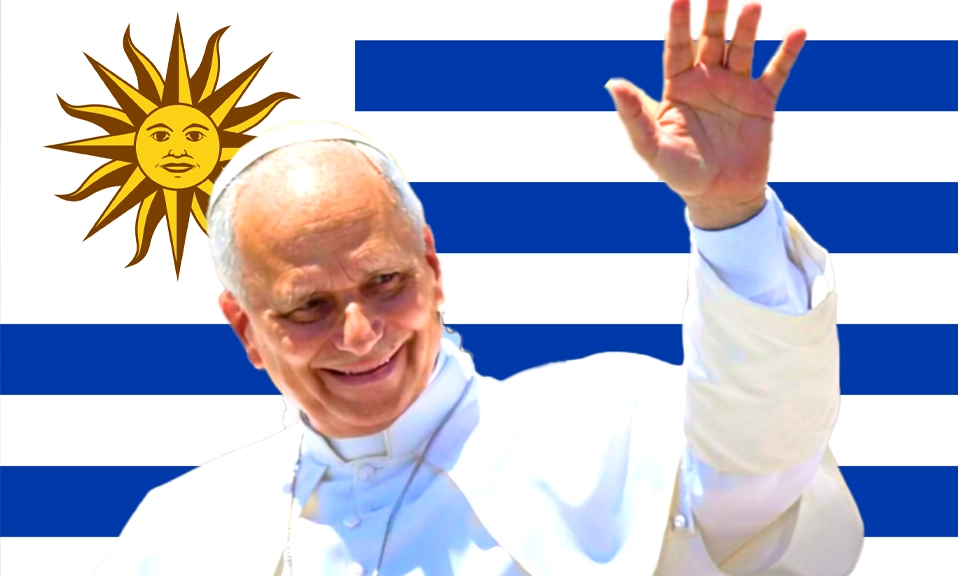
On November 6, 2026, Pope Leo XIV will step off a plane in Montevideo and make history. He’ll become only the second pope ever to set foot in Uruguay—and the first in 38 years. For a small nation of 3.4 million people, this is no small thing.
But why Uruguay? Why would the first American pope—born in Chicago, forged in Peru—choose this secular South American nation as the launchpad for his maiden apostolic journey to Latin America?
The answer reveals something profound about this pontiff, his vision, and the future of the Catholic Church.
A Promise Kept
The story begins not with Leo XIV, but with his predecessor.
Pope Francis had long promised to visit Argentina and Uruguay. For reasons of health and politics, he never made it. When Robert Francis Prevost ascended to the papacy as Leo XIV—the first Augustinian pope, the first American pope—he made a point of honoring that unfulfilled commitment.
“Pope Leo wants to fulfill this, which was a desire of Francis,” said Bishop Milton Tróccoli, president of the Uruguayan Bishops’ Conference. The gesture is deliberate: a bridge between pontificates, a nod to continuity, and a recognition that some promises transcend the men who make them.
The “Pope of the Periphery” Chooses the Periphery
Leo XIV is no stranger to Latin America. He spent decades in Peru as a missionary and bishop of Chiclayo, eventually adopting Peruvian citizenship. Many call him “the Peruvian pope”.
Yet he chose Uruguay—not Peru—as his first stop.
The reason is striking: Uruguay is the most secular country in Latin America. Less than half the population identifies as Catholic. The nation has legal euthanasia, robust separation of church and state, and a tradition of skepticism toward religious authority.
This is precisely why Leo XIV is coming.
“From the beginning of his pontificate, Pope Leo has shown a particular ability to engage in dialogue with the contemporary world,” Bishop Tróccoli observed. In a nation shaped by secularisation, the Pope’s message of dialogue, respect, and service will be especially valuable. He’s not visiting the faithful; he’s visiting everyone.
A Message for Believers and Non-Believers Alike
Cardinal Daniel Sturla, Archbishop of Montevideo, put it plainly: “These figures, Pope Leo today, as Pope John Paul II was in his visits, transcend the borders of the Catholic Church or of Christians”.
The Pope will arrive “with a message of hope for all, a message that Uruguay can—and all of Latin America—truly transform”.
President Yamandú Orsi, who met Leo XIV at the Vatican in October 2025, called the visit “opportune” and a “strong signal” for the region. “South America appears as a region of peace… this is like a balm, I think,” Orsi said.
What makes this remarkable is the respect between them. Orsi noted that the Pope had thoroughly studied Uruguay’s euthanasia law and offered thoughtful, nuanced perspectives. He also recommended reading Leo XIV’s encyclical Magnifica Humanitas, which addresses artificial intelligence and other pressing ethical questions.
This is a pope who engages with the world as it is—not as he wishes it to be.
Following in the Footsteps of a Saint
Uruguay’s last papal visitor was Saint John Paul II in 1988. For many Uruguayans, that visit remains vivid in memory.
Leo XIV’s journey rekindles that experience of communion with the universal Church. “We are a small Church, but one that always seeks to remain faithful and in communion with the Church of Rome,” Bishop Tróccoli said.
The symbolism is potent: a pope from the Americas, visiting a nation that has waited nearly four decades for another papal embrace.
Beyond Symbolism: A Concrete Agenda
This is not a ceremonial visit. The itinerary—three days across Montevideo, Paysandú, and Florida—includes:
A private meeting with President Orsi
A Mass in Paysandú
A visit to Casavalle, a Montevideo neighborhood marked by poverty, to highlight the Church’s social work
The celebration of the Feast of the Virgin of the Thirty-Three in Florida, Uruguay’s patron saint
Security officials are preparing for a mobilization of people “that perhaps has no precedent”. The visit is expected to generate significant economic activity and draw crowds from across the region.
Why It Matters
Uruguay matters because Leo XIV is sending a message—not just to Catholics, but to the world.
He’s saying: I come to listen. I come to engage. I come to a nation that doubts, that questions, that has built a society apart from faith—and I bring hope, not judgment.
In a time of polarization, this is radical. In a region hungry for peace and stability, it’s essential.
“The Pope’s presence will be a sign of closeness and communion for all the faithful,” said Bishop Tróccoli. But it may be even more significant for those outside the faith—the skeptics, the secularists, the uncertain.
Because if a pope can find common ground in the most secular country in Latin America, perhaps there’s hope for dialogue everywhere else.