There’s something quietly revolutionary about walking out your back door and picking a tomato you grew yourself.
In an era of £6 lettuce, supply chain worries, and ultra-processed everything, growing even a handful of your own vegetables feels like a small act of rebellion. And the benefits go far beyond the grocery bill. Studies show that just 30 minutes of gardening can lower cortisol levels more effectively than reading. Your home-grown produce will taste better, contain more nutrients, and come with zero plastic packaging.
But here’s the problem: most beginners quit before their first harvest. They buy the wrong seeds, plant them in the wrong spot, overwater them to death, and then declare they “don’t have a green thumb.”
Good news: there is no such thing as a green thumb. Gardening is a skill, not a gift. And like any skill, it can be learned.
If you’ve ever wanted to grow your own food but didn’t know where to start, this is your complete, jargon-free, beginner-proof guide. By the end of this post, you’ll have everything you need to put your first seed in the ground.
🌞 Step 1: Find Your Sun (The Non-Negotiable)
Before you buy a single seed, you need to answer one question: where does the sun go in your space?
Vegetables are sun worshippers. Most of them need a minimum of 6 to 8 hours of direct sunlight per day to produce a meaningful harvest. Leafy greens (lettuce, spinach, kale) can get by with 4 to 6 hours, but fruiting crops (tomatoes, peppers, cucumbers, squash) will struggle and produce poorly in shade.
How to audit your space:
- Spend a sunny day watching your yard, balcony, or windowsill. Note which areas get direct sun from morning to mid-afternoon.
- South-facing spaces (in the Northern Hemisphere) get the most light.
- Watch out for shadows from trees, fences, and neighbouring buildings—these change with the seasons.
If your space is mostly shady, don’t despair. You can still grow leafy greens, herbs, and radishes. Just adjust your expectations and your crop list.
🪴 Step 2: Choose Your Setup (Ground, Raised Bed, or Containers)
There are three main ways to grow vegetables at home. Each has pros and cons.
Option A: In-Ground Garden
Best for: People with decent soil and a decent-sized yard. Pros: Cheapest option. Plants have access to deep soil and natural earthworms. Less watering needed. Cons: You’re stuck with whatever soil you have. Weeds can be relentless. Hard to control drainage.
Option B: Raised Bed
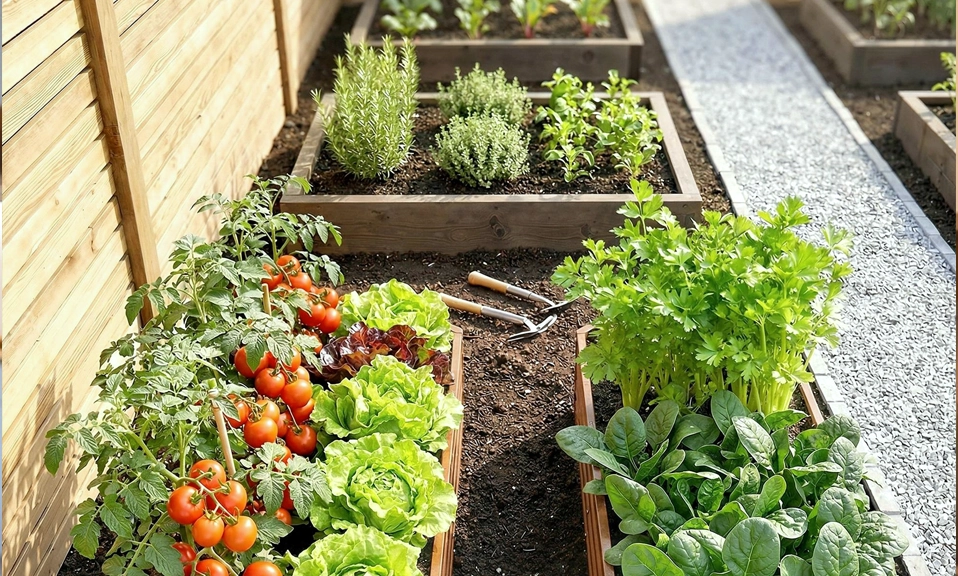
Best for: Most beginners. The sweet spot of control and volume. Pros: You fill it with perfect soil from day one. Excellent drainage. Warms up faster in spring. Easier on your back (less bending). Neat and tidy. Cons: Upfront cost for the bed and soil. Can dry out faster than in-ground.
Option C: Containers & Pots
Best for: Balconies, patios, small spaces, renters. Pros: Total control. Mobile (chase the sun). No digging required. Perfect for herbs, tomatoes, peppers, and salad greens. Cons: Dry out quickly. Need frequent watering and feeding. Limited root space for large crops.
Beginner recommendation: Start with 2 to 3 large containers (at least 30cm / 12 inches deep) or one small 1m x 1m raised bed. Don’t bite off more than you can chew in year one.
🌱 Step 3: Soil Is Everything (Don’t Skip This)
Here’s the secret that separates successful gardeners from frustrated ones: they obsess over soil.
Your plants are literally eating the soil. If the soil is poor, your plants will be poor. No amount of sunlight or water can fix bad soil.
For in-ground gardens: Mix in 5–10cm of compost before planting. This improves drainage, adds nutrients, and feeds the soil life.
For raised beds and containers: Don’t use garden soil (it’s too heavy and compact). Use a quality potting mix or raised bed mix that already contains peat or coir, perlite (for drainage), and compost.
The golden rule: Never use soil dug up from your yard in a container. It will compact, drain poorly, and likely contain weed seeds and pathogens.
🥬 Step 4: What to Grow First (The Beginner’s Hit List)
The biggest mistake new gardeners make is starting with the crops they love to eat rather than the crops that are easy to grow. Tomatoes are delicious, but they’re also demanding. Start with the “easy wins” to build your confidence.
Crop | Difficulty | Time to Harvest | Why It’s Great for Beginners |
|---|---|---|---|
Radishes | ⭐ Very Easy | 25–30 days | The fastest veggie. Ready in under a month. |
Lettuce & Salad Greens | ⭐ Very Easy | 30–45 days | Cut-and-come-again. Harvest outer leaves for weeks. |
Bush Beans | ⭐ Very Easy | 50–60 days | Direct-sow seeds. Heavy producers. |
Zucchini / Courgette | ⭐⭐ Easy | 50–65 days | One plant will feed your entire neighbourhood. |
Cherry Tomatoes | ⭐⭐ Easy | 60–75 days | Far easier than big tomatoes. Prolific producers. |
Herbs (Basil, Mint, Chives) | ⭐ Very Easy | Ongoing | Grow in a pot on the windowsill. Use daily. |
Sugar Snap Peas | ⭐⭐ Easy | 55–70 days | Delicious straight off the vine. |
Swiss Chard | ⭐ Very Easy | 50–60 days | Beautiful, productive, and heat-tolerant. |
Avoid in Year 1: Cauliflower, celery, head lettuce, and large heirloom tomatoes. Save these for when you’ve got a season or two under your belt.
🌰 Step 5: Seeds vs. Seedlings (Know When to Buy What)
You have two options for starting plants:
Seeds: Cheaper, more variety, and deeply satisfying. Best for fast-growing crops (radishes, beans, lettuce, peas) that don’t like being transplanted.
Seedlings (young plants from a garden centre): More expensive, less variety, but they give you a head start of 4–6 weeks. Best for slow-growing, long-season crops (tomatoes, peppers, eggplant).
Beginner strategy: Direct-sow your radishes, beans, and lettuce from seed. Buy tomato and pepper seedlings from the garden centre. You get the best of both worlds.
💧 Step 6: Watering Like a Pro (The #1 Killer of Plants)
More beginner plants are killed by overwatering than underwatering. It’s the plant equivalent of smothering someone with love.
The rules of smart watering:
- The Finger Test: Stick your finger 2–3cm into the soil. If it’s dry, water. If it’s moist, wait. This single habit will save most of your plants.
- Water the soil, not the leaves: Wet leaves invite fungal diseases like mildew and blight. Aim your watering can or hose at the base of the plant.
- Water deeply, less often: A long, slow soak encourages deep roots. A quick sprinkle every day encourages shallow, weak roots.
- Morning is best: Watering in the early morning gives plants time to absorb moisture before the heat of the day. Evening watering leaves leaves wet overnight, inviting disease.
- Containers need daily checks: In summer, pots can dry out completely in a single hot day. Check them every morning.
🍽️ Step 7: Feeding Your Plants (Keep Them Hungry)
Vegetables—especially heavy feeders like tomatoes, peppers, and squash—are hungry plants. They pull nutrients from the soil rapidly, and you need to replenish them.
The beginner feeding plan:
- At planting: Mix a slow-release organic fertiliser (like blood, fish, and bone, or a balanced vegetable feed) into the soil.
- Every 2–3 weeks during the growing season: Feed with a liquid organic fertiliser (seaweed emulsion, compost tea, or a balanced liquid feed).
- Top-dress with compost: Once a season, sprinkle a thin layer of compost around the base of your plants. It’s like a slow-release multivitamin.
Don’t overdo nitrogen (the first number on fertiliser labels) once plants start flowering. Too much nitrogen gives you huge, leafy plants with no fruit.
🚫 7 Beginner Mistakes That Kill Gardens
1. Planting Too Close Together Seedlings look tiny. It’s tempting to cram them in. Don’t. They’ll compete for light, water, and nutrients, and become prone to disease. Follow the spacing on the seed packet.
2. Ignoring Weeds Weeds aren’t just ugly—they’re stealing your plants’ food and water. Spend 10 minutes every few days pulling weeds while they’re small. It’s easier than a two-hour marathon later.
3. Not Mulching A 5cm layer of straw, shredded leaves, or wood chips around your plants conserves water, suppresses weeds, and regulates soil temperature. It’s the closest thing to a gardening cheat code.
4. Planting Out of Season Tomatoes planted in March will die of cold. Lettuce planted in July will bolt (go to seed) in the heat. Know your local frost dates and plant accordingly. Seed packets tell you when to sow.
5. Giving Up After One Failure Every gardener kills plants. I’ve killed hundreds. It’s part of the process. Learn from it, adjust, and try again.
6. Ignoring Pests Until It’s Too Late Walk your garden every day. Look under leaves. Catch aphids early and blast them off with a hose. Hand-pick caterpillars. Early intervention is 90% of pest control.
7. Expecting Perfection Your tomatoes will have bumps. Your carrots will be crooked. Your lettuce might have a few holes. Home-grown food isn’t supermarket-perfect—and it tastes a thousand times better because of it.
📅 A Simple First-Season Timeline
Not sure when to do what? Here’s a rough guide for a spring/summer garden in most temperate climates:
- 4–6 weeks before last frost: Start seeds indoors (tomatoes, peppers) or buy seedlings later. Plan your layout.
- 2 weeks before last frost: Direct-sow cold-hardy crops (radishes, peas, lettuce, spinach).
- After last frost: Plant warm-season crops (tomatoes, peppers, beans, zucchini, cucumbers). This is usually late spring.
- Throughout summer: Harvest, water, weed, feed. Succession-sow lettuce and radishes every 2–3 weeks for a continuous harvest.
- Early autumn: Plant a second round of cool-season crops (kale, spinach, garlic for next year).
🛠️ The Minimal Beginner Toolkit
You don’t need a shed full of gadgets. Here’s all you really need:
- A hand trowel (for digging small holes)
- A watering can or hose with a gentle spray nozzle
- A pair of secateurs / pruning snips (for harvesting and trimming)
- Gardening gloves (optional but nice)
- A kneeling pad (your knees will thank you)
- A notebook (to track what you planted, when, and what worked)
Total cost: under £30 / $40. Everything else can wait.
🐛 What About Pests? (The Organic First Approach)
You will have pests. It’s not a failure—it’s gardening. Here’s how to handle them without reaching for harsh chemicals:
- Aphids: Blast them off with a strong jet of water. Repeat every few days.
- Slugs and snails: Crushed eggshells, copper tape, or a shallow dish of beer as a trap.
- Caterpillars: Hand-pick them (gross but effective) or use organic Bacillus thuringiensis (BT) spray.
- Whitefly: Yellow sticky traps catch adults. Neem oil spray disrupts their lifecycle.
Pro tip: Plant flowers like marigolds, alyssum, and nasturtiums among your vegetables. They attract beneficial insects (ladybugs, hoverflies, parasitic wasps) that eat your pests for free.
Start Small, Learn Fast, Eat Well
The most important thing to remember about your first vegetable garden is this: it doesn’t have to be perfect. It just has to be planted.
You don’t need a sprawling backyard. You don’t need years of experience. You don’t need a “green thumb.” You need a sunny spot, a bag of good soil, a few seeds or seedlings, and the willingness to show up and pay attention.
Start with three containers. Grow some basil, a cherry tomato plant, and a tray of lettuce. Water them. Watch them. Eat them.
That first salad made from leaves you picked yourself, drizzled with olive oil and sprinkled with basil you grew on your windowsill—it will change the way you think about food forever.
And once you’ve tasted that, you’ll never look at a supermarket tomato the same way again.