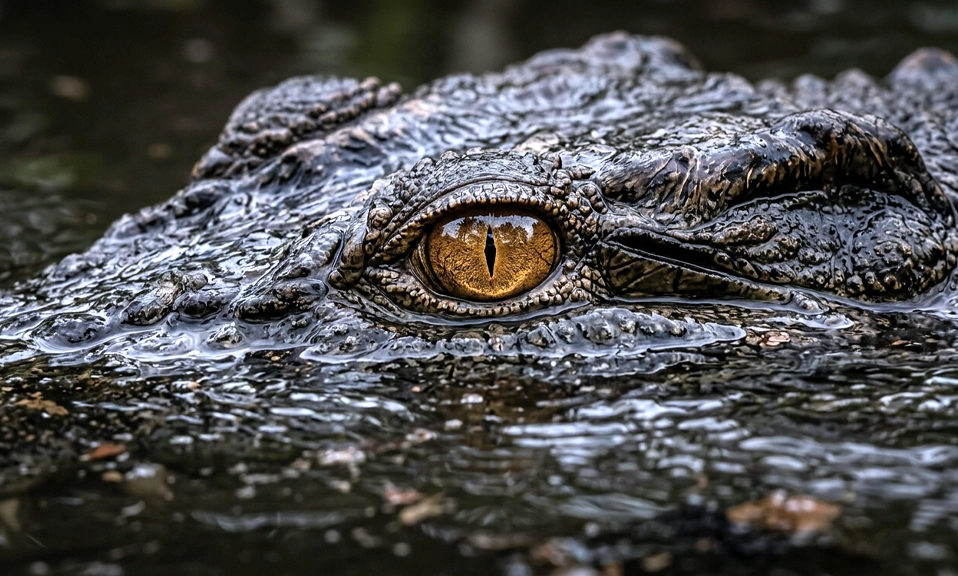
They are ambush predators that hunt in murky water, where visibility is measured in inches. Yet crocodiles can track prey, lunge with precision, and protect their eyes from debris, salt, and struggling animals — all without ever closing them. The secret is an eyelid you’ve probably never heard of.
If you’ve ever seen a crocodile swimming, you might have noticed something strange about its eyes. They look cloudy. Milky. Almost like they’re covered in a thin layer of fog. That’s not a trick of the light or a sign of illness. You’re watching one of nature’s most elegant engineering solutions in action.
Crocodiles don’t have two eyelids like humans. They have three — and the third one is the reason they can see perfectly well while their eyes are, technically, closed.
How Many Eyelids Does a Crocodile Have?
The answer is three, and each serves a different purpose.
The upper eyelid and the lower eyelid work like ours do. They close vertically, meeting in the middle to shut out light, dust, and physical threats. They’re the eyelids you see when a crocodile is sleeping or basking on a riverbank.
But beneath those two horizontal lids sits a third eyelid — the nictitating membrane. Unlike the upper and lower lids, it doesn’t close vertically. It sweeps horizontally across the eye, from the inner corner to the outer edge, like a windshield wiper made of translucent tissue. And unlike the other two, it never fully blocks vision.
This third eyelid is the crocodile’s “built-in goggles” — a transparent shield that slides over the eye when the animal submerges, allowing it to see underwater while protecting the eyeball from debris, salt, and damage from struggling prey.
What the Nictitating Membrane Actually Does
The nictitating membrane — from the Latin nictare, meaning “to blink” — is found in crocodiles, alligators, birds, most sharks, and some mammals. It’s often called a “third eyelid” or “haw”.
In crocodiles, it performs three critical functions.
1. Protection Underwater
When a crocodile submerges, the nictitating membrane slides across the eye. It’s translucent, which means the crocodile can still see clearly enough to hunt, navigate, and track prey — but the eye itself is shielded from dirt, murky water, and the thrashing of an animal fighting for its life.
This is essential for an ambush predator. Crocodiles often hunt in water where visibility is poor, where debris and sediment swirl constantly. The membrane allows them to keep their eyes open and focused, even in conditions that would blind an unprotected eye.
2. Moisturization
Crocodiles spend a lot of time out of the water. Sunbathing on a riverbank, basking on a sandbar, waiting for prey at the water’s edge. The nictitating membrane helps keep the eye lubricated, spreading fluid across the surface to prevent dryness and maintain a healthy cornea.
This is particularly important in the dry, dusty environments where many crocodilian species live. The membrane acts as a built-in cleaning and moisturizing system, keeping the eye functional even when the animal is out of the water for extended periods.
3. A Cleaning Mechanism
The membrane doesn’t just protect. It also cleans. When it sweeps across the eye, it wipes away debris, bacteria, and foreign particles. It secretes a lubricating fluid automatically — a natural, antibacterial solution that keeps the eye healthy and functional.
The Anatomy Behind the Shield
The nictitating membrane isn’t just a loose flap of tissue. It’s a complex piece of biological engineering, reinforced with cartilage and operated by a dedicated muscle.
In crocodiles, the membrane is strengthened by a piece of cartilage that gives it structure and rigidity. It has two folds on its outer surface, which help it glide smoothly across the eye and maintain its shape as it moves.
The muscle that controls it is the pyramidalis membranae nictitantis (mPMN). In crocodiles and alligators, this muscle is a long, triangular strap that arises from the nasal side of the sclera — the white of the eye — and extends across a significant portion of the eyeball. When it contracts, it pulls the membrane across the eye. When it relaxes, the membrane retracts back into the inner corner.
What’s remarkable is how different this muscle is in crocodiles compared to birds. In birds, the same muscle is one-quarter muscle and three-quarters tendon. In crocodiles, it’s relatively large and muscular throughout — a powerful, dedicated mechanism for a predator that depends on its eyes for survival.
Built-In Goggles, Built for the Hunt
To understand why the nictitating membrane matters, you have to understand how crocodiles hunt.
They are ambush predators. They wait. They submerge. They approach silently, eyes just above the waterline, nostrils barely breaking the surface. When they strike, it’s explosive — a sudden lunge powered by a massive tail, jaws snapping shut with bone-crushing force.
Throughout all of this, their eyes are their most critical sense. They need to see their prey. They need to judge distance. They need to track movement. And they need to do all of it while their head is half-submerged in water that may be cloudy, dirty, or filled with the thrashing of the animal they’re attacking.
The nictitating membrane allows them to do this. It’s a built-in pair of goggles that never fogs up, never needs adjusting, and never gets lost. It protects the eye while preserving vision. It keeps the eye clean while keeping the crocodile hidden.
It’s one of the most elegant adaptations in the animal kingdom — a simple solution to a complex problem, refined over millions of years of evolution.
The “Crocodile Tears” Myth
There’s a reason the phrase “crocodile tears” exists. Ancient writers believed that crocodiles wept while devouring their prey — a display of false remorse from an animal that couldn’t possibly feel it.
The truth is less poetic but more interesting. Crocodiles don’t cry from emotion. They don’t cry at all, in the human sense.
What looks like crying is a physiological response — the lubrication of the eye, the flushing away of debris, the constant maintenance required to keep a predator’s most important sense organ functioning. The nictitating membrane plays a central role in this process, spreading fluid across the eye and keeping it moist.
So the next time you see a crocodile’s eye go cloudy, remember: it’s not crying. It’s not sick. It’s just putting on its goggles.
A Window Into an Ancient World
Crocodiles have been around for over 200 million years. They survived the asteroid impact that killed the dinosaurs. They’ve outlasted countless species that were faster, larger, or more specialized.
Part of the reason for their success is their adaptability. They can survive in fresh water, salt water, and brackish estuaries. They can go months without eating. They can regulate their body temperature by basking and retreating to the water.
But part of it is their sensory toolkit — and the nictitating membrane is a crucial part of that toolkit. It’s a reminder that evolution doesn’t always produce complexity. Sometimes it produces simplicity so elegant that it lasts for hundreds of millions of years.
A transparent eyelid. A built-in pair of goggles. A shield that never needs to be cleaned, never needs to be replaced, and never gets in the way of the hunt.
It’s not glamorous. It’s not flashy. But it works — and for a crocodile, that’s all that matters.