The electric vehicle (EV) revolution has passed its “early adopter” phase. We are no longer talking about $100,000 luxury toys or compromised compliance cars.
As we move through 2026, the automotive industry is hitting a critical inflection point. The next wave of EVs isn’t just about replacing the gas tank with a battery; it’s about redefining affordability, software integration, charging speed, and even the concept of car ownership itself.
From legacy automakers finally cracking the code on affordable EVs to tech giants turning cars into rolling smartphones, here are 10 electric vehicles that have the potential to completely disrupt the car market.
1. Tesla Model 2 (The “Compact”) 🚗
The Disruption: The Sub-$30,000 Volume Driver
Why it matters: For years, Tesla’s growth has been capped by its premium pricing. The long-rumored, compact Model 2 (sometimes referred to as the “Model Q”) is built on Tesla’s next-generation, cost-slashed manufacturing platform. By stripping away unnecessary complexity and utilizing massive gigacasting, Tesla aims to offer a 250+ mile range EV at a price that directly undercuts the Toyota Corolla or Honda Civic. If Tesla can deliver this at scale, it will force every legacy automaker to radically slash their own EV prices.
Why it matters: For years, Tesla’s growth has been capped by its premium pricing. The long-rumored, compact Model 2 (sometimes referred to as the “Model Q”) is built on Tesla’s next-generation, cost-slashed manufacturing platform. By stripping away unnecessary complexity and utilizing massive gigacasting, Tesla aims to offer a 250+ mile range EV at a price that directly undercuts the Toyota Corolla or Honda Civic. If Tesla can deliver this at scale, it will force every legacy automaker to radically slash their own EV prices.
2. Rivian R2 🏕️
The Disruption: Bringing “Adventure EVs” to the Middle Class
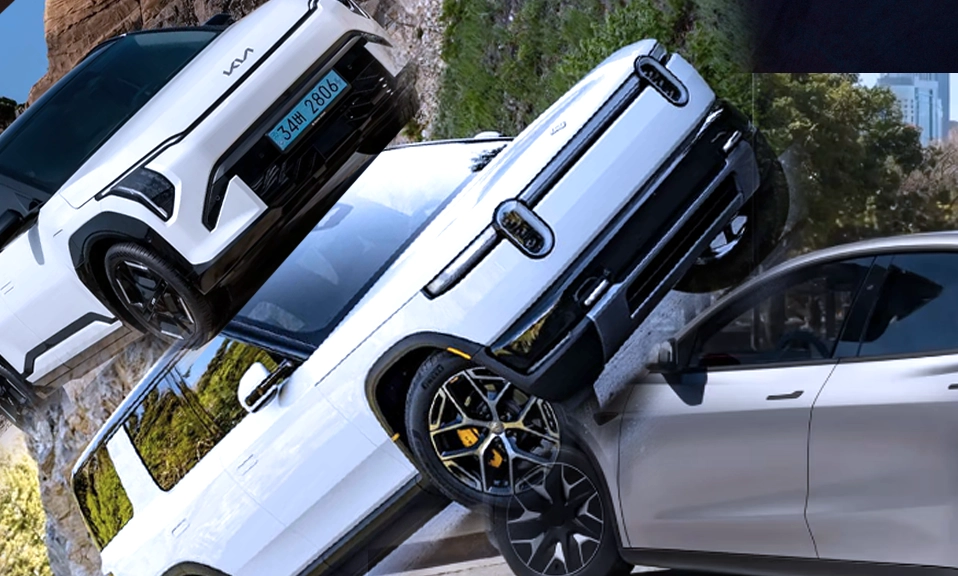
Why it matters: Rivian’s R1T and R1S proved that electric trucks and SUVs could be incredibly desirable, but their $70,000+ starting prices kept them out of reach for most. The R2, launching in 2026, is a mid-size, two-row SUV built on a new, more efficient platform with a starting price targeting the mid-$40,000s. It offers the beloved Rivian tech, off-road capability, and clever storage, but in a package that competes directly with the Tesla Model Y and Ford Mustang Mach-E.
Why it matters: Rivian’s R1T and R1S proved that electric trucks and SUVs could be incredibly desirable, but their $70,000+ starting prices kept them out of reach for most. The R2, launching in 2026, is a mid-size, two-row SUV built on a new, more efficient platform with a starting price targeting the mid-$40,000s. It offers the beloved Rivian tech, off-road capability, and clever storage, but in a package that competes directly with the Tesla Model Y and Ford Mustang Mach-E.
3. Kia EV3 ⚡
The Disruption: The Ultimate Value Proposition
Why it matters: Kia has been quietly building some of the best EVs on the market, and the EV3 is their masterstroke. It packs an 800-volt architecture (allowing for ultra-fast charging), a spacious, tech-heavy interior, and up to 300 miles of range into a compact SUV footprint, all starting under $35,000. It proves that you don’t need to spend luxury-car money to get premium EV features.
Why it matters: Kia has been quietly building some of the best EVs on the market, and the EV3 is their masterstroke. It packs an 800-volt architecture (allowing for ultra-fast charging), a spacious, tech-heavy interior, and up to 300 miles of range into a compact SUV footprint, all starting under $35,000. It proves that you don’t need to spend luxury-car money to get premium EV features.
4. Honda “0” Series (Saloon & Space-Hub) 🌐
The Disruption: A Legacy Automaker’s Complete Software Reinvention
Why it matters: Honda was late to the EV party, but their “0 (Zero) Series,” launching in 2026, is a radical pivot. Built on the philosophy of “Thin, Light, and Wise,” these cars feature a drastically lower profile, a revolutionary “steer-by-wire” system, and an entirely new, Honda-developed software architecture (ASIMO OS). It’s Honda’s bold attempt to prove that traditional automakers can build software-defined vehicles that rival Tesla.
Why it matters: Honda was late to the EV party, but their “0 (Zero) Series,” launching in 2026, is a radical pivot. Built on the philosophy of “Thin, Light, and Wise,” these cars feature a drastically lower profile, a revolutionary “steer-by-wire” system, and an entirely new, Honda-developed software architecture (ASIMO OS). It’s Honda’s bold attempt to prove that traditional automakers can build software-defined vehicles that rival Tesla.
5. Lucid Gravity 🌌
The Disruption: Shattering the “Range Anxiety” Myth for Families
Why it matters: Lucid already proved its engineering prowess with the Air sedan, but the Gravity SUV brings that magic to the most lucrative segment in America: the three-row family hauler. With an estimated EPA range pushing past 440 miles and industry-leading efficiency (miles per kWh), the Gravity forces competitors like the Tesla Model X and Rivian R1S to justify their existence. It proves that large EVs don’t have to be range-crippled.
Why it matters: Lucid already proved its engineering prowess with the Air sedan, but the Gravity SUV brings that magic to the most lucrative segment in America: the three-row family hauler. With an estimated EPA range pushing past 440 miles and industry-leading efficiency (miles per kWh), the Gravity forces competitors like the Tesla Model X and Rivian R1S to justify their existence. It proves that large EVs don’t have to be range-crippled.
6. Tesla Cybercab (Robotaxi) 🤖
The Disruption: Ending the Era of Personal Car Ownership
Why it matters: Unveiled without a steering wheel or pedals, the Cybercab is designed exclusively for autonomous ride-hailing. While fully driverless regulatory approval is still rolling out, the Cybercab represents a massive shift in Tesla’s strategy: moving from selling cars to individuals to operating a high-margin, automated mobility-as-a-service (MaaS) network. If successful, it could fundamentally alter urban transportation and auto sales models.
Why it matters: Unveiled without a steering wheel or pedals, the Cybercab is designed exclusively for autonomous ride-hailing. While fully driverless regulatory approval is still rolling out, the Cybercab represents a massive shift in Tesla’s strategy: moving from selling cars to individuals to operating a high-margin, automated mobility-as-a-service (MaaS) network. If successful, it could fundamentally alter urban transportation and auto sales models.
7. Volkswagen ID.2 (or ID.2all Production) 🇪🇺
The Disruption: Europe’s Answer to the Affordable EV
Why it matters: European buyers have been starved for cheap, high-quality EVs, often forced to buy imported Chinese models. VW’s ID.2 is designed specifically to change that. Targeting a sub-€25,000 price point, it’s a stylish, practical compact hatchback built on a simplified version of VW’s MEB platform. It’s the car that could finally make EVs the default choice for first-time car buyers in Europe.
Why it matters: European buyers have been starved for cheap, high-quality EVs, often forced to buy imported Chinese models. VW’s ID.2 is designed specifically to change that. Targeting a sub-€25,000 price point, it’s a stylish, practical compact hatchback built on a simplified version of VW’s MEB platform. It’s the car that could finally make EVs the default choice for first-time car buyers in Europe.
8. Xiaomi SU7 📱
The Disruption: The Smartphone Maker That Builds Better Cars
Why it matters: Even if its availability is currently limited by global trade dynamics, the Xiaomi SU7 has sent shockwaves through the global auto industry. It offers Porsche Taycan-level performance and a seamless, hyper-integrated ecosystem with Xiaomi smartphones and smart home devices, all at a fraction of the price of European rivals. It sets a new global benchmark for what a “software-defined vehicle” should feel like, pressuring legacy brands to drastically improve their infotainment and connectivity.
Why it matters: Even if its availability is currently limited by global trade dynamics, the Xiaomi SU7 has sent shockwaves through the global auto industry. It offers Porsche Taycan-level performance and a seamless, hyper-integrated ecosystem with Xiaomi smartphones and smart home devices, all at a fraction of the price of European rivals. It sets a new global benchmark for what a “software-defined vehicle” should feel like, pressuring legacy brands to drastically improve their infotainment and connectivity.
9. Chevrolet Equinox EV 🇺🇸
The Disruption: The “Normal Person’s” Electric Car
Why it matters: General Motors has stumbled out of the EV gate, but the Equinox EV is their course correction. Stripping away the “premium” tax, it offers a practical, spacious, and straightforward electric crossover with around 300 miles of range for roughly $35,000 (before incentives). It’s not flashy, and that’s exactly the point. It’s designed to be the invisible, reliable, everyday EV that finally bridges the gap for mainstream, non-enthusiast buyers.
Why it matters: General Motors has stumbled out of the EV gate, but the Equinox EV is their course correction. Stripping away the “premium” tax, it offers a practical, spacious, and straightforward electric crossover with around 300 miles of range for roughly $35,000 (before incentives). It’s not flashy, and that’s exactly the point. It’s designed to be the invisible, reliable, everyday EV that finally bridges the gap for mainstream, non-enthusiast buyers.
10. Aptera 🌞
The Disruption: Challenging the Need to Plug In
Why it matters: Aptera is the ultimate wildcard. This ultra-aerodynamic, three-wheeled solar electric vehicle is designed to be so efficient that its integrated solar panels can generate up to 40 miles of range per day. For the average commuter, this means “never charging” for daily errands. While its teardrop shape is polarizing, Aptera’s radical approach to efficiency (achieving over 1,000 miles of range on a massive battery pack) pushes the boundaries of what’s physically possible in EV design.
Why it matters: Aptera is the ultimate wildcard. This ultra-aerodynamic, three-wheeled solar electric vehicle is designed to be so efficient that its integrated solar panels can generate up to 40 miles of range per day. For the average commuter, this means “never charging” for daily errands. While its teardrop shape is polarizing, Aptera’s radical approach to efficiency (achieving over 1,000 miles of range on a massive battery pack) pushes the boundaries of what’s physically possible in EV design.
The Tipping Point is Here
For the last decade, the EV market was defined by compromise: you could have long range, or you could have affordability, but rarely both.
The vehicles on this list represent the end of that compromise. In 2026, we are seeing the convergence of next-generation battery chemistry, radical manufacturing efficiency, and software-first design.
The car market isn’t just transitioning to electric; it’s being completely rewritten. The winners won’t be the companies with the most heritage, but the ones that can deliver the best technology at a price the average consumer can actually afford.
Which of these EVs are you most excited about? Do you think legacy automakers can catch up to Tesla and the tech newcomers, or is the gap too wide?