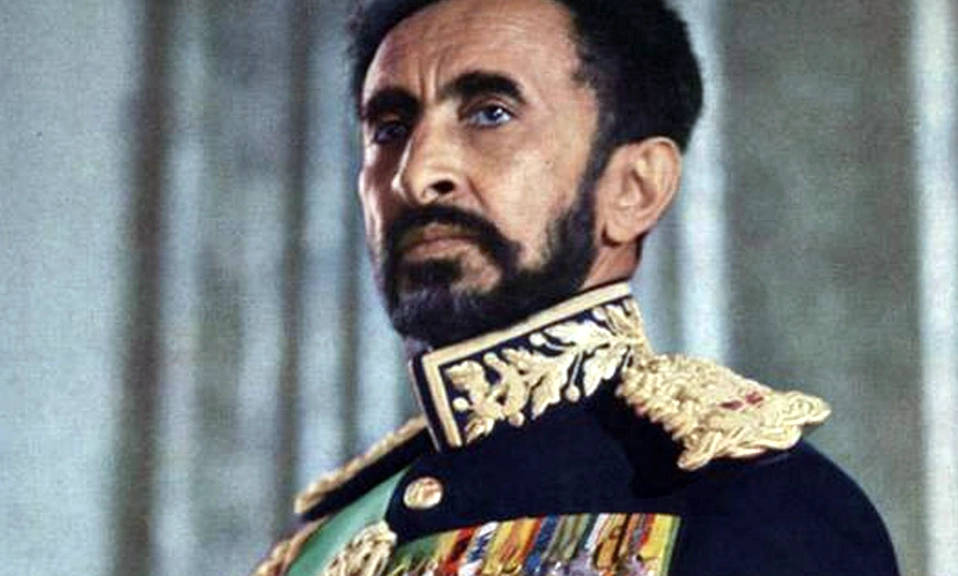
He was 5’4″ tall. He spoke in a whisper. He wore a cape covered in lions, rode in a Rolls-Royce, and was worshipped as God by millions of Jamaicans who had never met him.
He was the last emperor of a 3,000-year-old dynasty, the only African leader to look Mussolini in the eye and tell the world: We will not be colonized.
His name was Tafari Makonnen. The world knew him as Haile Selassie I — Power of the Trinity.
The Boy Who Would Be King
Haile Selassie I (Ge’ez: ኃይለ፡ ሥላሴ, “Power of the Trinity” ) (23 July 1892 – 27 August 1975), born Tafari Makonnen, was Ethiopia’s regent from 1916 to 1930 and Emperor of Ethiopia from 1930 to 1974.
He was born in Ejersa Goro, near Harar, to Ras Makonnen, governor of Harar, a grandnephew of Emperor Menelik II — the emperor who defeated Italy at Adwa in 1896 and kept Ethiopia free when all of Africa was being carved up.
His mother died when he was 2. He was raised to read Amharic, French, and history. He watched Menelik die, watched the empire wobble.
In 1916 he ousted Menelik’s successor, Lij Iyasu, replacing him with Zauditu, the old emperor’s daughter, and made himself regent. When Zauditu died in 1930, he succeeded her, taking the name Haile Selassie I, which means “Might of the Trinity.”
On November 2, 1930, he was crowned Negus Negast — King of Kings — in Addis Ababa. He traced his lineage to Emperor Menelik I, son of King Solomon and the Queen of Sheba. He was a member of the Solomonic dynasty. For Ethiopians, he wasn’t just a politician. He was the 225th descendant of Solomon.
The world press came. Marcus Garvey’s followers in Harlem wept — Garvey had prophesied in 1920: “Look to Africa where a Black king shall be crowned, he shall be the Redeemer.” In Jamaica, they started calling Tafari their living God. That’s where Rastafari — Ras Tafari — comes from.
Modernizing an Ancient Empire
Haile Selassie is a defining figure in both Ethiopian and African history. Widely considered to be a defining figure in modern Ethiopian history.
He knew Ethiopia could not stay medieval and stay free. In 1931 Selassie granted his subjects a constitution — Ethiopia’s first. First written constitution in the country’s history.
He did what Menelik couldn’t:
- Abolished slavery in 1924 (officially, though it lingered)
- Built schools, hospitals, the first printing press
- Created a central bank, joined the League of Nations in 1923
- Built roads and telephone lines from Addis to the provinces
- Sent young Ethiopians to study in Europe to come back as doctors and engineers
He was trying to prove to Europe: We are modern. You have no excuse to “civilize” us.
Europe didn’t care.
1935: The Struggle for Sovereignty
When Italy invaded Ethiopia in 1935, he was forced into exile (1936), despite his appeal to the League of Nations for help.
Mussolini wanted revenge for Adwa. In October 1935, 500,000 Italian troops invaded from Eritrea and Somalia with tanks, planes, and poison gas — mustard gas dropped on villages.
Ethiopia had rifles from 1890 and spears.
Selassie went to the front himself. He watched his army get gassed. Then he made a decision no African king had made: He went to the white man’s court to shame them.
June 30, 1936 — Geneva, League of Nations.
He stood up, small man in a dark cape, and gave one of the greatest speeches of the 20th century. He said:
“It is us today. It will be you tomorrow.”
He told them Italy was using chemical weapons against civilians. He told them the League’s promises of collective security were a lie. The Italian journalists in the hall booed him, whistled, shouted “Savage!”
The League did nothing. Britain and France had already secretly agreed to give Ethiopia to Italy to keep Mussolini away from Hitler.
Haile Selassie went into exile in Bath, England, living in a small house called Fairfield. He lived there from 1936 to 1941, walking his dogs, writing his memoir, listening to the radio as Europe burned — exactly as he warned.
Return and Triumph
In 1941, with British help and Ethiopian patriots (the Arbegnoch), he returned to Addis Ababa on May 5 — exactly five years after the Italians had taken it.
He was now a global symbol. The only African leader to defeat European colonialism and return.
From 1941 to 1974, he became the father of modern Africa:
He also served as Chairperson of the Organisation of African Unity from 25 May 1963 to 17 July 1964 and 5 November 1966 to 11 September 1967.
In 1963, he hosted 32 African heads of state in Addis Ababa and founded the OAU — now the African Union. He gave it a home in Addis. He gave Africa a capital. Kwame Nkrumah, Jomo Kenyatta, Julius Nyerere — they all called him elder.
He traveled to Washington, met JFK — Originally named Tafari Makonnen, Selassie was a grandnephew of Emperor Menelik II — Kennedy called him a symbol of African independence. He met with Haile Selassie in 1963 and gave Ethiopia aid, but also pressured him to reform faster.
The Fall
He ruled for 44 years. Too long, his critics say.
He modernized, but he kept feudalism. He built schools, but kept power in the hands of Shewan aristocrats. Landlords still owned 90% of land. While he celebrated in his palace, peasants starved in Wollo in 1972-73, and his government tried to hide the famine.
On September 12, 1974, a Marxist junta of low-ranking officers called the Derg deposed him. He was Emperor from 1930 to 1974. He was put in a VW Beetle, driven to a basement in the palace, and kept there. He died on August 27, 1975. The Derg said he died of natural causes. In 1994, his bones were found under a toilet in the palace, buried face down.
The last emperor of Solomon.
Why His Struggle Still Matters
Haile Selassie was not perfect. He was an absolute monarch who believed in monarchy. He was slow to give land to the poor.
But he did something no other African leader had to do in the 1930s: He had to prove that a Black African nation had the right to exist at all.
When Italy invaded in 1935, every other African country except Liberia was a colony. If Ethiopia fell, the message was: Africa cannot govern itself. If Ethiopia survived, the message was: We can.
His 1936 speech in Geneva is taught today in international law as the first time a leader of the Global South called out the hypocrisy of the international system — and predicted World War II.
And in Jamaica, in a shack in Trenchtown, a young Bob Marley heard his name and believed a Black man could be God — because a Black man had stood up to empire and come home alive.
Haile Selassie I was the last Emperor (1930 – 1936;1941 – 1974) of Ethiopia.
He was not just emperor of Ethiopia. He was emperor of the idea that Ethiopian — and African — sovereignty was non-negotiable.
That idea still lives.
“Throughout history, it has been the inaction of those who could have acted, the indifference of those who should have known better, the silence of the voice of justice when it mattered most, that has made it possible for evil to triumph.” — Haile Selassie, Geneva, 1936