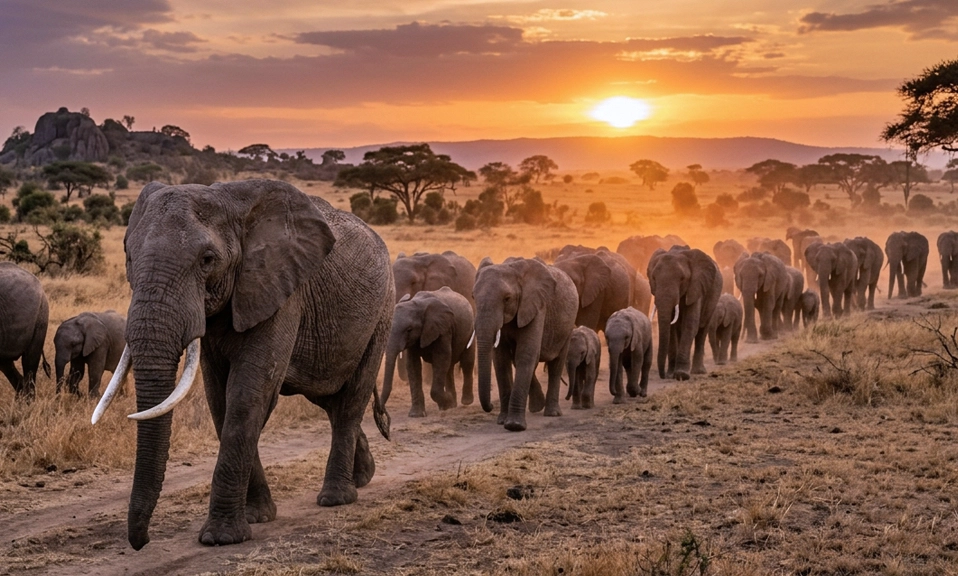
They are the architects of their ecosystems, the gardeners of the savanna and the forest. And they are concentrated in just a handful of nations.
There is something almost mythical about the elephant. It is the largest land animal on Earth, a creature of immense intelligence and deep social bonds, capable of grief, joy, and memory that spans decades. But for all their grandeur, elephants are also a story of vulnerability. Their numbers have plummeted over the past century, and today, the vast majority of the world’s remaining elephants are concentrated in a small number of countries.
According to the most recent estimates, there are roughly 415,000 African elephants and between 40,000 and 50,000 Asian elephants left in the wild. Where they live tells a story of conservation success, ecological pressure, and the delicate balance between human and animal worlds.
Here are the 10 countries with the most elephants in the world.
1. Botswana — The Undisputed Kingdom of Elephants
Estimated population: 131,909
No country on Earth holds more elephants than Botswana. The southern African nation is home to roughly a third of all of Africa’s elephants, with an estimated 131,909 wild elephants within its borders. Some estimates place the population even higher, at around 150,000.
Botswana’s success is no accident. Strict anti-poaching laws, vast protected areas, and a stable political environment have created a sanctuary for the species. The Chobe River in the north supports up to 50,000 elephants during the dry season, and the Okavango Delta is one of the most spectacular wildlife destinations on the planet.
But Botswana’s success has also created a problem. With an elephant population nearly double what the land can sustain, human-elephant conflict is rising, and the government has faced international criticism over its decision to allow trophy hunting and even culling.
2. Gabon — The Forest Elephant Stronghold
Estimated population: 95,000
Gabon is the unlikely custodian of Africa’s forest elephants. While the rest of Central Africa has seen forest elephant populations collapse, Gabon’s numbers have risen to approximately 95,000 — around 70% of the entire forest elephant population on the continent.
These are not the savanna elephants of the open plains. Forest elephants are smaller, darker, and live in the dense rainforests of the Congo Basin. They are critically endangered, and Gabon represents their last great refuge.
But Gabon’s success has come at a cost. As elephant numbers rebound, crop raids have skyrocketed, destroying livelihoods and leaving families hungry. The country now faces the challenge of balancing conservation with the needs of its people.
3. Zimbabwe — The Second-Largest Population in the World
Estimated population: 100,000
Zimbabwe is home to one of Africa’s largest elephant populations, with estimates ranging from 82,000 to over 100,000 animals. The Hwange National Park alone supports roughly 45,000 elephants — far above its ecological carrying capacity of about 15,000.
Like Botswana, Zimbabwe faces the challenges of an “overpopulation” of elephants. The country has considered mass culling and has faced international criticism for its wildlife management policies. But the elephants remain, a testament to the resilience of the species and the complexity of managing them.
4. Tanzania — A Conservation Success Story
Estimated population: 66,714
Tanzania’s elephant population has staged a remarkable recovery. After plummeting from about 134,000 before 2005 to just 46,408 in 2014 due to rampant poaching, the population has rebounded to 66,714, according to a 2024/2025 national wildlife census.
Tanzania is now the third-largest holder of elephants in Africa, after Botswana and Zimbabwe. The Tarangire National Park is famous for its large elephant herds, and the country is home to some of the last “super tuskers” — elephants with tusks so large they nearly touch the ground.
5. South Africa — From 120 to 44,000
Estimated population: 44,000 to 45,000
South Africa’s elephant story is one of the most dramatic in conservation history. In 1920, the country had just 120 elephants in four locations. Today, it is home to an estimated 44,000 to 45,000 African savanna elephants across 40 locations.
The majority live in Kruger National Park, which supports about 35,000 elephants — one of the densest populations in Africa. South Africa’s elephants are listed as “least concern” nationally, reflecting a stable and widespread population.
6. Kenya — A Remarkable Recovery
Estimated population: 42,000
Kenya’s elephant population has more than doubled since 1989, growing from just 16,000 to over 42,000 in 2026. The recovery is a direct result of strengthened anti-poaching efforts, community conservancies, and habitat protection.
Kenya is also home to some of the most famous elephants in the world, including the “super tuskers” of Amboseli and the iconic herds of the Maasai Mara. The country’s elephant population is now growing at a rate that conservationists describe as a genuine success story.
7. Namibia — Desert-Adapted Survivors
Estimated population: 24,000
Namibia is home to roughly 24,000 wild African elephants, including the famous desert-adapted herds of the Kunene region. These elephants have evolved to survive in one of the harshest environments on Earth, traveling vast distances in search of water and food.
Namibia’s community conservancy model has been credited with helping the population grow from around 7,500 in 1995 to its current level. But the country has also faced controversy over its decision to auction elephants and allow trophy hunting, with conservationists disputing official population statistics.
8. Zambia — A Population in Decline
Estimated population: 22,000 to 25,000
Zambia’s elephant population tells a more somber story. A century ago, the country had an estimated 250,000 elephants. Today, only around 22,000 to 25,000 remain.
The Luangwa Valley is the country’s elephant stronghold, home to about 14,000 animals — roughly 80% of Zambia’s entire population. Poaching and habitat loss remain significant threats, though recent conservation efforts have shown signs of stabilisation.
9. India — Asia’s Elephant Giant
Estimated population: 22,446 to 27,312
India is the global stronghold for the Asian elephant, supporting more than 60% of the world’s remaining wild population. Estimates vary, with the Wildlife Institute of India’s first DNA-based census putting the population at 22,446, while World Population Review lists 27,312.
India’s elephants are spread across 33 elephant reserves in 14 states, with Karnataka having the highest number. The country manages an additional 2,725 captive elephants. But India’s elephants face growing threats from habitat loss, human-elephant conflict, and a worrying 18% decline in population over the past nine years.
10. Mozambique — The Tuskless Legacy
Estimated population: 10,800
Mozambique’s elephant population is estimated at around 10,800, a fraction of what it once was. During the country’s civil war between 1977 and 1992, 90% of its elephants were killed for ivory to finance the conflict.
The war left a strange evolutionary legacy: a disproportionate number of female elephants born without tusks. This genetic adaptation, driven by the intense selective pressure of poaching, is a haunting reminder of what the species endured.
The Ones Just Outside the Top 10
Several other countries hold significant elephant populations:
Angola: ~12,400 elephants, recovering after decades of civil war
Democratic Republic of the Congo: ~13,500 elephants, primarily forest elephants
Thailand: ~3,000 to 3,700 elephants, mostly in protected areas and sanctuaries
Sri Lanka: ~6,000 elephants, one of the highest densities in Asia
Myanmar: ~4,000 to 5,000 elephants
Why This Matters
The concentration of elephants in a handful of countries is both a blessing and a burden. It means conservation efforts can be targeted and effective. It also means that if those countries fail, the species fails with them.
Botswana, Zimbabwe, and Gabon alone hold more than half of Africa’s elephants. India holds more than half of Asia’s. These nations are not just custodians of their own wildlife — they are custodians of a global heritage.
The challenges are immense: human-elephant conflict, habitat loss, poaching, and the economic pressures of managing wildlife in nations with pressing human needs. But the successes are real. Tanzania’s recovery. Kenya’s doubling. South Africa’s transformation from 120 elephants to 44,000.
The gentle giants are not yet safe. But in these 10 countries, they are still here — and in some places, they are thriving.
The question now is whether the world can help them stay.