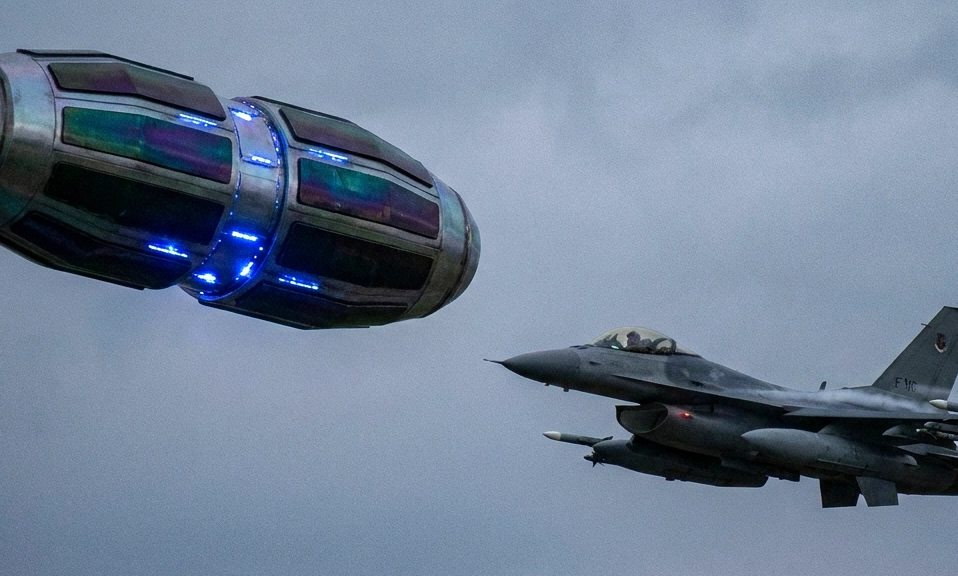
It was 8 p.m. on August 16, 2026, and two pilots were threading their private jet through a gap between two towering thunderstorm cells over Ohio. The clouds around them climbed to 55,000 feet. Their own aircraft was at 41,000. And then, just ahead and slightly above them, they saw something that shouldn’t have been there: a silver, pill-shaped object, hanging almost motionless in the sky, with no wings, no lights, and no explanation.
The pilots contacted Cleveland air traffic control. Nothing on radar. They checked their collision-warning system and flight-tracking app. Nothing. They asked whether a weather balloon had been launched nearby. The FAA found no matching records. The object stayed visible for roughly two minutes, passed about two to three miles to their left, and then disappeared into the distance.
One of the pilots managed to photograph it with his iPhone. The image, and the account, were filed with the National UFO Reporting Center (NUFORC) on October 26, 2026. NUFORC investigator Ben Hansen later obtained air traffic control recordings and radar data through a Freedom of Information Act request. The object was never identified.
Here’s what we actually know—and what might explain it.
What the Pilots Saw
According to the NUFORC report, the object was:
Silver and highly reflective, like “pure polished metal”
Uniform and pill-shaped, with “no warps or creases on the surface, nor was it tapered at the bottom”
Vertically positioned, estimated at at least 30 feet (9 metres) in height
Slightly above their aircraft, at an estimated altitude of 43,000 feet
Traveling in the opposite direction, passing to their left
The pilot, identified only as “J,” initially thought it might be a weather balloon. But the object’s shape was too even, too symmetrical, and too large. “Coupled with the witness’s estimate that the object was at least 30 feet in height and uniformly shaped without tapering at the top or bottom, it presents some challenges to the balloon theory,” Hansen wrote in the report.
The weather conditions made the sighting even stranger. The pilots were navigating around a severe thunderstorm system. Their own aircraft experienced engine icing and moderate turbulence after entering the clouds. J questioned whether a balloon could have survived those conditions.
The Radar Problem
The most unsettling detail is the absence of radar evidence.
Cleveland Center air traffic controllers told the pilots that no aircraft or unidentified objects were showing on radar. The jet’s onboard collision-warning system detected nothing. The flight-tracking app showed nothing. Whatever the object was, it was not broadcasting a transponder signal, and it was not reflecting enough radar energy to register—or it was designed to avoid detection.
A weather balloon, by contrast, would typically appear on radar, even if faintly. The FAA’s database of planned balloon launches turned up no matches. Hansen confirmed that the FAA “did not detect an object on radar and found no database matches for planned balloon launches”.
The Possible Explanations
Investigators have not ruled out a conventional explanation. Here are the leading candidates—and why each one is imperfect.
Weather Balloon
The most obvious hypothesis. Weather balloons are launched regularly, they can reach altitudes of 40,000 feet or more, and they can appear as silvery objects when sunlight catches their payload or envelope.
Why it doesn’t quite fit: The object’s shape was too uniform and too large. Weather balloons are typically round or teardrop-shaped, and their payloads hang beneath them on a string. A 30-foot-tall, perfectly symmetrical pill with no tapering at the top or bottom is not a standard weather balloon profile. The FAA found no launch records, and the severe weather conditions—engine icing, moderate turbulence—would have been hostile to a fragile balloon.
Military Aircraft or Drone
The object was flying in the opposite direction at high altitude, in a region with active military aviation. A classified drone or experimental aircraft could explain the shape, the lack of radar signature, and the absence of transponder data.
Why it doesn’t quite fit: The object was described as having no wings, no visible propulsion, and no lights. Most military aircraft, even stealthy ones, have a discernible shape. A 30-foot pill is not a standard aircraft profile. And if it were a classified program, the FAA would typically be notified to close airspace or issue a NOTAM—neither of which appears to have happened.
Atmospheric Phenomenon
A rare atmospheric optical effect—a mirage, a lenticular cloud, or a reflection—could theoretically produce a strange shape at high altitude.
Why it doesn’t quite fit: The object was described as having a solid, metallic surface with no warps or creases. It moved in a consistent direction, passing the aircraft and disappearing. Atmospheric phenomena don’t typically behave like solid objects on a trajectory.
Misidentification
The pilots were flying in challenging conditions—approaching a thunderstorm, dealing with turbulence and icing—and were likely fatigued or stressed. It’s possible they misidentified a conventional object: a distant aircraft, a balloon, a drone, or even a reflection on their canopy.
Why it doesn’t quite fit: Both pilots saw the object. One photographed it. The sighting lasted two minutes. The object’s description is consistent and detailed. Misidentification is possible, but the report is unusually well-documented for a UFO case.
The Broader Pattern: Tic Tac UFOs and the Modern Sightings
The Ohio object bears a striking resemblance to the “Tic Tac” UFO famously filmed by U.S. Navy pilots off the coast of San Diego in 2004—a white, pill-shaped craft that appeared to hover, accelerate instantly, and vanish. That incident became a cornerstone of the modern UFO disclosure movement, and it helped normalize the idea that unidentified objects in controlled airspace are a real phenomenon worth investigating.
The Ohio sighting is different in one important way: it was reported by civilian pilots, not military personnel. That matters. Military pilots have protocols for reporting unidentified objects, and their accounts are often classified. Civilian pilots have no such protocols—they file with NUFORC, a private organization, and their reports are publicly available. The Ohio case is transparent in a way that many military sightings are not.
But it also means the evidence is limited to the pilots’ testimony and a single iPhone photograph. There is no radar data, no video, and no physical evidence. The investigation rests on the credibility of the witnesses and the consistency of their account.
Two experienced pilots,
flying at 41,000 feet through a gap between thunderstorms, saw a 30-foot silver pill hanging in the sky. They checked with air traffic control. Nothing on radar. They checked their instruments. Nothing. They photographed it. Two minutes later, it was gone.
It could have been a weather balloon that defied the odds. It could have been a classified aircraft. It could have been an atmospheric anomaly. It could have been something else entirely.
The NUFORC investigation is ongoing. Ben Hansen and his team have done the work: FOIA requests, radar analysis, balloon-launch records, witness interviews. They have not reached a conclusion. “The object remains unidentified,” the report states, “although investigators have not ruled out a conventional explanation”.
That’s the honest answer. Not every strange thing in the sky is a mystery. But not every mystery has been solved, either.
The pilots saw something. They don’t know what it was. And for now, neither do we.