Picture the scene: A gritty detective speeds down a rain-slicked city street at midnight, gripping the steering wheel, his face illuminated by the rhythmic flash of passing streetlights. The engine roars, the tires hum, and the tension is palpable.
Now, here’s the plot twist: The car hasn’t moved an inch. The actor is parked inside a soundstage in Burbank, sipping a lukewarm coffee between takes, while a crew member vigorously rocks the chassis and flashes a flashlight past the windows.
Welcome to the magic of cinematic illusion.
Whether it’s a high-stakes chase or a quiet, emotional conversation, filming inside a moving vehicle is one of the most notoriously difficult challenges in filmmaking. Between lighting, sound recording, and basic safety, actually driving while filming is a logistical nightmare.
So, how do they do it? Here is the behind-the-scenes breakdown of the 5 most common ways Hollywood fakes a car scene.
🚙 1. The “Poor Man’s Process” (The Classic Budget Hack)
Don’t let the name fool you; this isn’t a sign of a cheap production. It’s a clever, time-tested technique that even A-list directors like Quentin Tarantino and Christopher Nolan use for dialogue-heavy scenes.
How it works: The car is parked on a soundstage or on location. The actors get in, and the crew literally shakes the car to simulate the vibration of an engine and the road. To fake the movement outside, crew members rhythmically wave large pieces of black cloth (called “flags”) or flashlights past the windows to mimic passing streetlights, trees, or other cars.
Why it’s used: It gives the director total control over the lighting and allows the sound department to capture crisp, clean dialogue without the deafening roar of a real engine or wind noise.
🚛 2. The Process Trailer (The Hollywood Workhorse)
When the scene requires the car to actually be outside and moving, but the actors still need to deliver lines safely, filmmakers turn to the “process trailer” (also known as a low-loader or picture car tow).
How it works: The hero car is strapped securely onto a massive, low-profile flatbed truck. The truck’s bed is often painted green or covered in green screen material. The actors sit in the car, and the truck drives them down a closed road or highway.
The Magic: In post-production, Visual Effects (VFX) artists erase the flatbed truck and replace the background with the desired scenery. Sometimes, they don’t even use green screen; they’ll just shoot at a low angle, using the real road as the background and carefully framing out the tow truck.
🖥️ 3. The LED Volume (The 2026 Gold Standard)
If the “Poor Man’s Process” is the classic, the LED Volume is the modern revolution. Popularized by shows like The Mandalorian and now standard in high-end film and commercial production, this technology has completely changed how car scenes are shot.
How it works: The car is parked on a hydraulic gimbal (which can tilt and vibrate the car realistically) inside a massive, curved room made of high-definition LED screens. Instead of a green screen, the screens play a hyper-realistic, 3D-rendered video of a road, city, or landscape moving past the car.
Why it’s a game-changer: With a green screen, the green light reflects onto the actors’ faces and the car’s interior, requiring tedious cleanup later. With an LED volume, the moving background provides real, interactive lighting on the actors’ faces and the car’s dashboard. If the virtual car passes under a streetlamp, the actor’s face is genuinely lit by a streetlamp. It’s seamless, immersive, and requires almost no post-production VFX cleanup.
is actually moving, but it’s highly controlled.
How it works: Productions will shut down miles of city streets or use private race tracks. The actor might be in the driver’s seat, but a professional stunt driver is often controlling the car via hidden remote controls, or the actor is driving at a very low, safe speed.
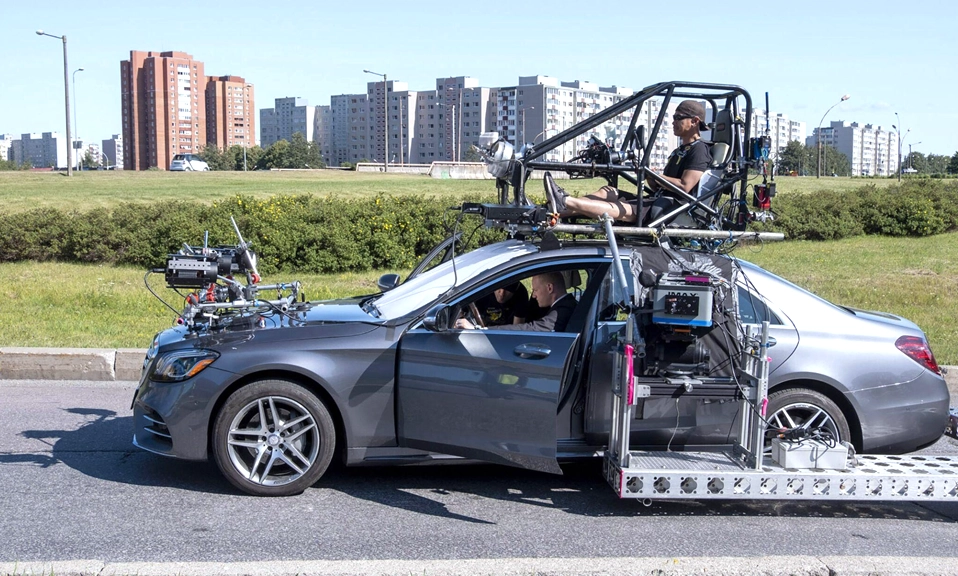
The Camera Car: To get those dynamic, sweeping shots of the car in motion, cinematographers use a “Russian Arm” (or Pursuit Arm)—a high-speed crane mounted to the back of a modified SUV. This allows the camera to swing 360 degrees around the hero car, matching its speed perfectly while capturing buttery-smooth footage.
🎬 5. The Invisible Magic of Post-Production (VFX & Sound)
Even when a car is genuinely driving, the footage rarely looks “fast” or “cinematic” straight out of the camera. This is where post-production does the heavy lifting.
- Faking Speed: A car driving at a safe 25 mph looks like it’s crawling on camera. VFX artists add “motion blur” to the background, digitally speed up the footage, and add a subtle “camera shake” to simulate the vibration of high speed. is responsible for up to 50% of the illusion. The rumble of the engine, the hum of the tires on the asphalt, the whoosh of wind, and the creak of the suspension are almost always added in a Foley studio long after filming wraps. A well-designed soundscape will convince your brain the car is doing 100 mph, even if the visual tells a different story.
🎬The Best Illusions Are the Ones You Don’t Notice
The next time you watch a movie and see two characters having a deep, intimate conversation while navigating a treacherous mountain pass, look closely.
Are the background lights passing at perfectly regular intervals? Is the actor’s body vibrating slightly, but their head remains perfectly still? Is the sound of the engine a little too clean?
You’re likely watching the “Poor Man’s Process” or a brilliantly executed LED volume shot.
Filmmaking is the art of controlled deception. Whether it’s a $200 flashlight and a shaking chassis, or a $10 million virtual production stage, the goal is always the same: to make you forget you’re watching a movie, and make you believe you’re in the passenger seat.