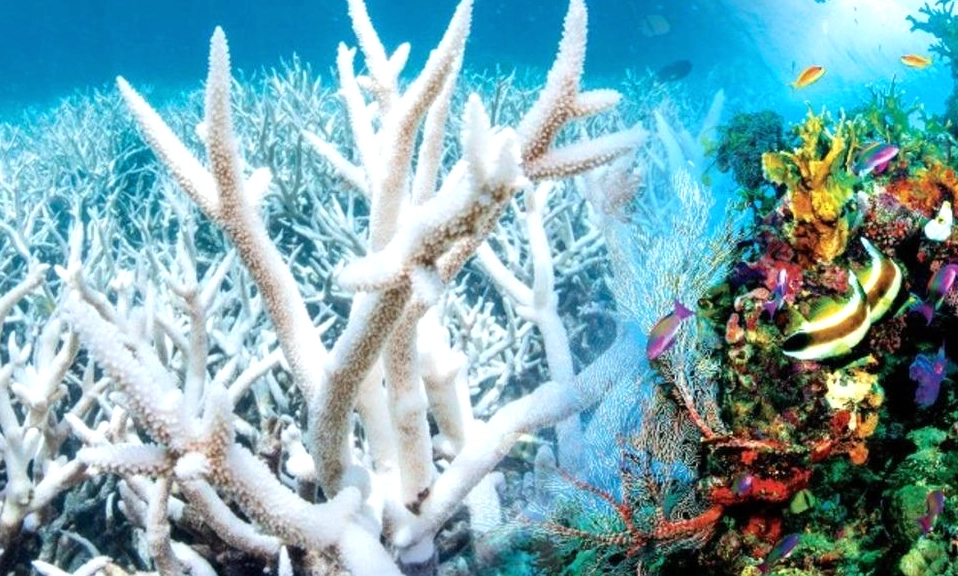
For decades, a bleached coral reef has been a symbol of irreversible decline—a ghostly graveyard where a vibrant ecosystem once thrived. But a new discovery has upended that grim narrative. Scientists have found that bleached coral, even when on the brink of death, can be brought back to life at record speed through something astonishingly simple: physical contact with a healthy neighbour.
The finding, published on October 14, 2026, in the journal Science Advances, has stunned marine biologists and offered a rare glimmer of hope for reefs devastated by climate-driven marine heat waves. The research reveals that a simple “touch” can trigger a biological rescue mission, transferring life-giving algae from a healthy coral clone to its bleached counterpart, restoring its colour and vitality in a matter of weeks—not months or years.
The Accidental Discovery That Changed Everything
The story begins, as many great scientific breakthroughs do, with a happy accident. In 2025, Stanford University marine biologist Steve Palumbi was working in his lab when two coral fragments in a tank tipped over and began touching. One was bleached, ghostly white, and dying. The other was healthy and colourful. To his astonishment, Palumbi noticed that where the two fragments met, colour began to seep back into the bleached coral.
“I’d never seen that before,” Palumbi later recalled. Around the same time, PhD student Danny Collins was exploring a related question: if harmful bacteria can enter corals through physical contact, could good things—like beneficial algae—be transferred the same way? Together, they set up a series of experiments to find out.
How the “Magic Touch” Works
The science behind this rapid recovery is as elegant as it is surprising. Corals are not single animals but colonies of tiny, genetically identical polyps—clones of one another. When two fragments from the same colony touch, they recognise each other as “self” and their tissues fuse together, creating a microscopic tissue bridge.
This bridge acts like a biological highway. Through it, the symbiotic algae (known as zooxanthellae) that live inside the healthy coral’s tissues flow directly into the bleached coral. Once inside, the algae don’t just sit there—they begin to reproduce at an explosive rate, doubling approximately every four days. This is up to 10 times faster than the slow, natural recovery process where bleached corals reabsorb free-floating algae from the water.
The results were staggering. In Collins’s experiments, bleached fragments of cauliflower coral (Pocillopora damicornis) that were placed in contact with a healthy clone fully recovered within seven weeks—the fastest documented recovery to date. The bleached fragments that were kept separated, even by just a few millimetres, died. The transformation was so rapid and so complete that the researchers watched it happen “right before our eyes”.
The Catch: Why You Can’t Just Hug Any Coral
The discovery comes with a crucial caveat: the healing touch only works between genetically identical clones. When Collins tried pairing bleached coral with a healthy fragment from a different colony, the reaction was the opposite. The healthy coral’s polyps sent out tiny stinging appendages, attacking the stranger as if it were an intruder. The bleached fragments eventually died.
Palumbi likened it to the human immune system rejecting an organ transplant from a stranger. But when the donor is an identical twin—or in this case, a genetic clone—the tissue is accepted, and the healing begins. This specificity is both the method’s greatest strength and its biggest limitation. It means the technique cannot be used to heal a bleached coral by simply touching it to any healthy coral. The two must be part of the same original colony.
What This Means for the Future of Reefs
The discovery does not offer a simple, scalable cure for the world’s dying reefs. The researchers are quick to caution that their experiments were conducted in a laboratory, on a single species, and involved only a small number of specimens. In the wild, holding coral fragments in contact for a week is logistically challenging, and it would only work if parts of the same colony remained healthy while others bleached.
But the implications are profound. This is the first time scientists have observed bleached corals on the brink of death fully recover through brief contact with healthy clones. It proves that rapid, full recovery is biologically possible, and it opens the door to new restoration strategies that could one day be deployed at scale.
If scientists can find a way to artificially transplant the symbiotic algae—perhaps through a gel, a spray, or a targeted delivery system—they might be able to replicate the effect without the need for physical contact between coral fragments. The “tissue bridge” discovery provides a blueprint for what is possible. As Palumbi put it, the surprise is not just that the algae transfer, but that they replicate at such high speed. That is the mechanism that could be harnessed.
For a generation that has
watched coral reefs decline at an alarming rate, this discovery is a genuine cause for hope. It does not solve the climate crisis, and it will not single-handedly save the world’s reefs. But it reveals a hidden resilience in these remarkable animals—a capacity for recovery that no one knew existed. It shows that even a ghostly, bleached coral is “not dead yet,” and that a single touch from a healthy neighbour can be enough to bring it back to life.
The next challenge will be translating this laboratory miracle into a real-world tool. If that can be achieved, the “magic touch” of a healthy coral might one day help restore the vibrant, living colours of reefs that seemed lost forever.