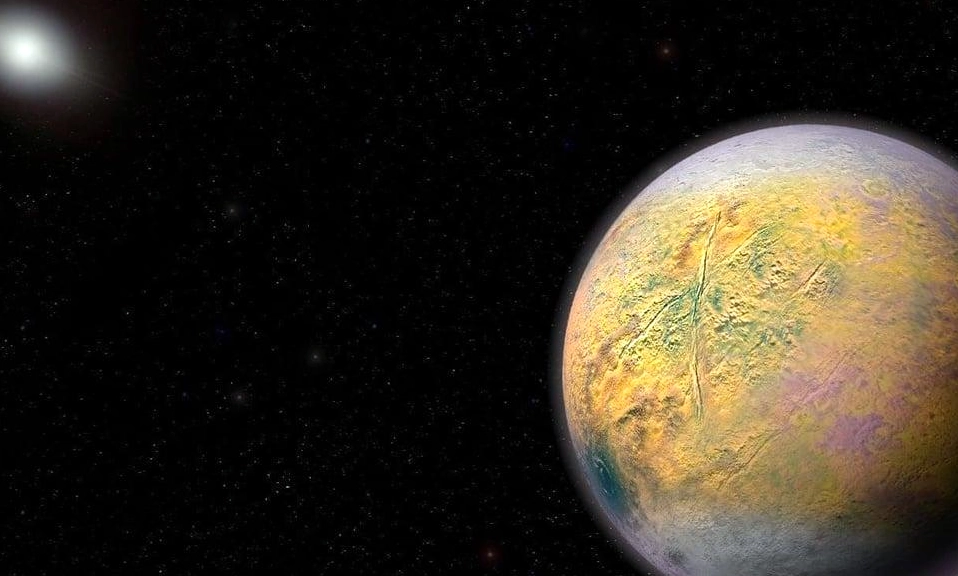
The outer reaches of our solar system have always been a place of whispers and shadows, a frontier where our maps fade into the dark. But now, a new light has been cast into that darkness. Astronomers have just announced the discovery of a massive, hidden world beyond Pluto—a potential new dwarf planet that has been quietly orbiting our Sun, unnoticed, for billions of years. It’s a find that not only adds a new member to our solar system’s family but also serves as a powerful reminder that our cosmic backyard is far from fully explored. What else, then, might be hiding in the vast, cold expanse beyond Neptune?
The New Neighbor: Meet 2026 ED138
The object, provisionally designated 2026 ED138, is a true giant of the outer solar system. It was discovered by the newly operational Vera C. Rubin Observatory in Chile, a telescope designed to repeatedly scan the entire southern sky with the world’s largest digital camera. Its discovery was made by astrophysicist Matthew Holman, who described his first reaction as “excited disbelief,” immediately suspecting an error in his search code because objects of this size are so rare.
Here’s what we know about this new world:
It’s Massive: With a diameter estimated between 600 and 1,500 kilometers, 2026 ED138 is a behemoth. It is potentially larger than Ceres, the smallest of the currently recognized dwarf planets, and could be comparable in size to Makemake or Haumea.
It’s Distant: It orbits the Sun at a staggering distance of about 46 astronomical units (AU)—that is 46 times the distance from the Earth to the Sun. For context, Pluto orbits at an average of about 40 AU, making this new object even more remote.
It’s a Candidate: For now, it is officially a candidate dwarf planet. To be confirmed, astronomers need to determine its physical size and verify that it is massive enough for its own gravity to have pulled it into a nearly round shape. Follow-up observations with telescopes like ALMA are planned to measure its thermal emissions and confirm its true size.
The discovery is a testament to the power of the Rubin Observatory. The object had eluded detection for years for two key reasons. First, it is located in the southern sky, which is less observed by major surveys. Second, and more poetically, its orbit has kept it in front of the dense, starry backdrop of the Milky Way, where its faint light was lost in the celestial glare.
What Else Is Hiding in the Dark?
The discovery of 2026 ED138 is not just a single find; it’s a sign of things to come. The Rubin Observatory is expected to discover an estimated 32,000 objects beyond Neptune over the next decade, and there could be “a handful” more objects as large as this one waiting to be found. This influx of data will help astronomers answer some of the biggest questions about our solar system’s origins.
The Elusive Planet Nine: For years, astronomers have observed that a group of extreme trans-Neptunian objects (ETNOs) have strangely clustered orbits, as if they are being shepherded by the gravity of an unseen, massive planet. This hypothetical world, often called Planet Nine or Planet X, is predicted to be several times more massive than Earth (perhaps up to 15 times) and orbit the Sun at a mind-boggling distance of at least 200 AU, and possibly much farther. In 2026, researchers announced they may have found the first direct evidence of this planet in archival infrared data, identifying a single candidate object that moved as expected over a 23-year period. However, this is not a confirmed discovery, and the search continues.
The Kuiper Belt and Beyond: The space beyond Neptune is not empty. It is home to the Kuiper Belt, a vast donut-shaped region of icy bodies that extends to about 55 AU. It’s populated by thousands of small, icy objects and is the source of many comets. Even farther out lies the hypothetical Oort Cloud, a shell of icy debris that may extend tens of thousands of AU into space. While we have detected thousands of objects in the Kuiper Belt, the sheer number of undiscovered ones means our inventory is still woefully incomplete.
The discovery of 2026
ED138 is more than just a new name on a list. It is a symbol of a new era in astronomy. The Vera C. Rubin Observatory is transforming our understanding of the outer solar system from a collection of scattered clues into a detailed map of a vast and complex frontier.
The space beyond Pluto is not an empty void but a crowded, dynamic, and largely unknown realm. With every new object discovered, we edge closer to understanding how our solar system formed and evolved. And who knows? The next discovery could be the one that finally confirms the existence of Planet Nine, a world that has been hiding in the dark for eons, just waiting for us to finally look in the right place, at the right time.
The question is no longer if there are more worlds hiding beyond Pluto, but simply: what will we find next?