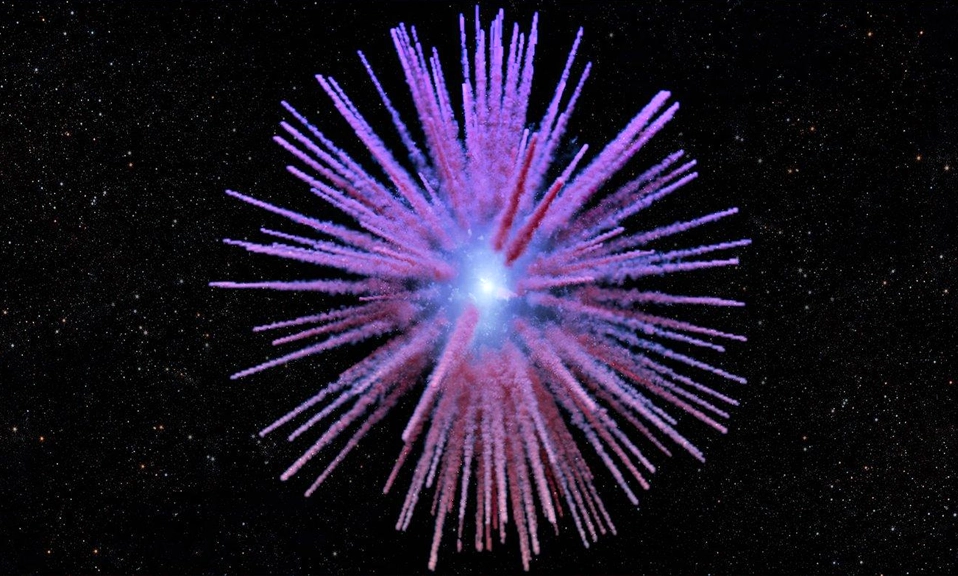
In 1181, stargazers in China, Japan, and the Arab world watched a new star blaze in the constellation Cassiopeia. It shone for 185 days and then faded. For more than eight centuries, its remnant eluded astronomers entirely—until a chance discovery revealed not a typical explosion site, but a cosmic crime scene with a “zombie star” at its heart and a bizarre structure that still defies explanation.
The object is Pa 30, a nebula about 7,500 light-years from Earth. New observations from the Gemini North telescope in Hawaii have delivered the most detailed view yet, revealing that what looked like smooth streaks of gas are actually chains of individual clumps, “like pearls on a string”. These “pearls” are enormous—each knot is so large that the entire planetary region of our solar system could fit inside it about ten times with room to spare. The findings, published in The Astrophysical Journal, are forcing scientists to rethink how this unusual supernova unfolded.
A Supernova That Didn’t Finish the Job
The first clue that Pa 30 was extraordinary came from what should have been missing. In a standard Type Ia supernova, a white dwarf star is completely destroyed in a thermonuclear explosion. No star survives. But at the center of Pa 30, there is a star.
This surviving object—informally dubbed a “zombie star” —is extraordinarily hot, with a surface temperature of approximately 200,000 degrees Celsius (360,000 degrees Fahrenheit). It is also emitting ferociously fast stellar winds, clocking in at around 16,000 kilometers per second. Its presence points to a rare class of explosion called a Type Iax supernova—a lower-energy, incomplete detonation that damages the star but does not annihilate it.
The leading explanation for this scenario is a collision. Astronomers believe Pa 30 formed when two white dwarfs spiraled together and merged. The resulting blast was powerful enough to eject the nebula we see today, but not powerful enough to fully unbind the merged stellar core. What remains is the “zombie” — a stellar remnant that survived its own supernova.
The Pearl Necklace Mystery
The new Gemini observations reveal roughly ten times as many filamentary structures as earlier images showed, and expose the knotted chains that make up those filaments. But how these remarkably uniform knots formed remains unanswered.
One possibility is that the debris was shaped by the environment around the star at the time of the explosion. The analysis suggests that substantial variations in temperature or density in the gas, dust, and charged particles surrounding the star could have sculpted the ejected material into clumps and knots as it expanded outward. The knots themselves are “quite strikingly uniform,” according to astrophysicist Ilaria Caiazzo, and modeling them is the next challenge.
The Star That Stayed Home
There is another anomaly. When a star survives a supernova, the explosion is rarely symmetrical. The blast should deliver a “kick” that sends the surviving star flying away from the explosion site at high speed. But Pa 30’s zombie star sits almost exactly at the center of the remnant.
This suggests the explosion was relatively symmetrical, and it rules out a strong kick that would have displaced the star from its position. The star stayed home—another clue that the event that created Pa 30 was unusual in more ways than one.
A Historical Detective Story
The connection between Pa 30 and the 1181 supernova is itself a remarkable piece of scientific detective work. The supernova, designated SN 1181, is one of only five in the Milky Way observed from Earth before the invention of the telescope. Eight separate historical texts from Chinese, Japanese, and Arab astronomers record its appearance between August 4 and 6, 1181, and its visibility for 185 days.
For centuries, its remnant was missing. That changed in 2013, when American amateur astronomer Dana Patchick discovered Pa 30 during a citizen science campaign to find planetary nebulae in data from NASA’s WISE satellite. Follow-up observations revealed its distinctive radial filaments and a central star whose properties matched the expected age of the 1181 event. Based on its estimated age and brightness, scientists now consider Pa 30 the probable remnant of SN 1181.
Pa 30 is unique among
all known supernova remnants in the Milky Way. It is the only known example of a Type Iax remnant in our galaxy—a rare chance to study an “incomplete” explosion and the surviving star it left behind. The pearl-chain knots and the zombie star’s improbable stillness raise questions that will require new models and further observations to answer.
What makes Pa 30 so valuable is its proximity. At 7,500 light-years away, it is close enough for telescopes to resolve details that would be impossible to see in more distant supernovae. “This proximity makes Pa 30 uniquely valuable for study,” Caiazzo said.
For now, the medieval “guest star” of 1181 is still teaching astronomers about the violence and strangeness of stellar death. It exploded, but it did not die. It left behind a star, a nebula shaped like fireworks, and a string of pearls that no one can yet fully explain. Eight and a half centuries later, the mystery is as luminous as ever.